
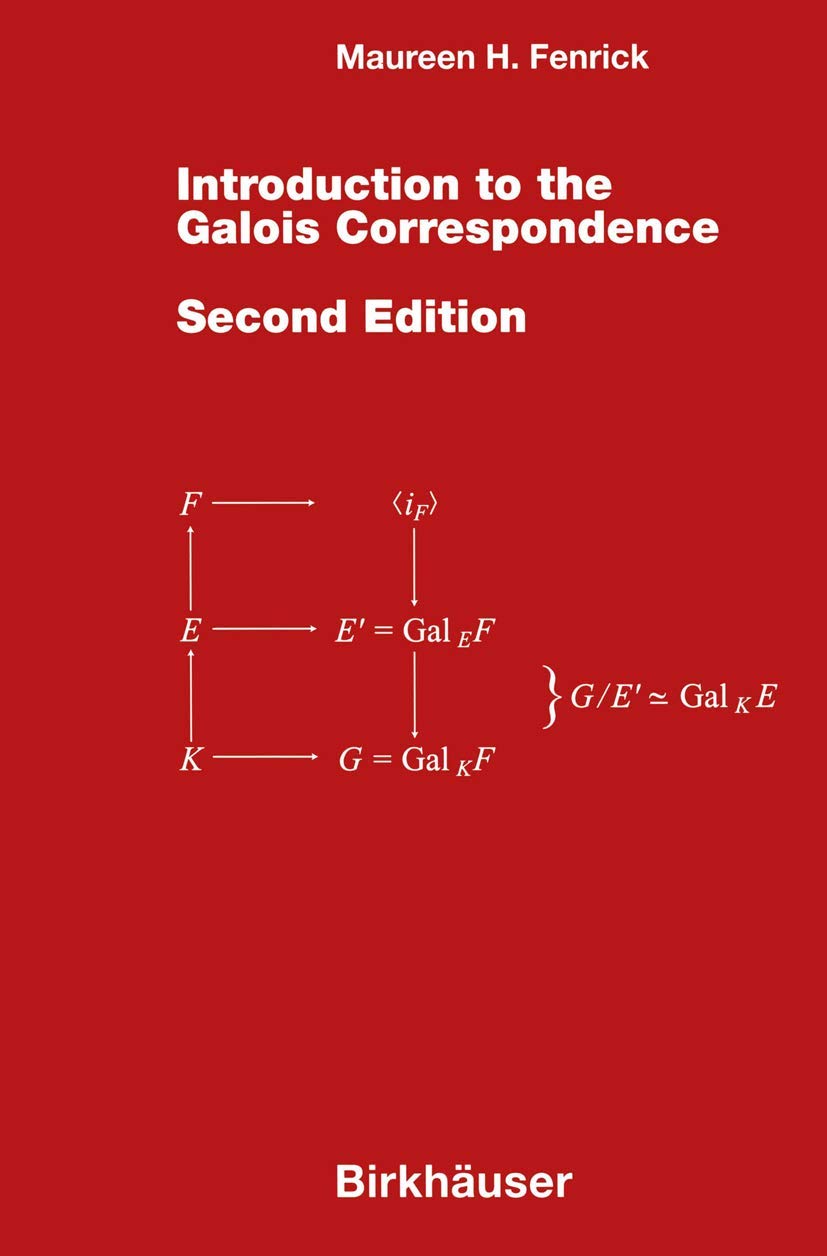
Title
Introduction to the Galois Correspondence,Used
Sold by Ergodebooks, an authorized reseller.
Returns accepted within 30 days | support@ergodebooks.com
Shipping Information
- Free Standard Shipping — United States only
- Processing Time: 3–5 business days
- Estimated Delivery: 6–10 business days after dispatch
- Double-boxed, fully insured & discreetly packaged
- Tracking number sent via email once dispatched
Returns & Refund
Returns accepted within 30 days of delivery.
Damaged or Defective Item
Free return shipping + replacement or full refund
Wrong Item Received
Free return shipping + replacement or full refund
Change of Mind
Return shipping at customer's expense · 25% restocking fee applies
Payment Option

In this presentation of the Galois correspondence, modern theories of groups and fields are used to study problems, some of which date back to the ancient Greeks. The techniques used to solve these problems, rather than the solutions themselves, are of primary importance. The ancient Greeks were concerned with constructibility problems. For example, they tried to determine if it was possible, using straightedge and compass alone, to perform any of the following tasks? (1) Double an arbitrary cube; in particular, construct a cube with volume twice that of the unit cube. (2) Trisect an arbitrary angle. (3) Square an arbitrary circle; in particular, construct a square with area 1r. (4) Construct a regular polygon with n sides for n > 2. If we define a real number c to be constructible if, and only if, the point (c, 0) can be constructed starting with the points (0,0) and (1,0), then we may show that the set of constructible numbers is a subfield of the field R of real numbers containing the field Q of rational numbers. Such a subfield is called an intermediate field of Rover Q. We may thus gain insight into the constructibility problems by studying intermediate fields of Rover Q. In chapter 4 we will show that (1) through (3) are not possible and we will determine necessary and sufficient conditions that the integer n must satisfy in order that a regular polygon with n sides be constructible.
⚠️ WARNING (California Proposition 65):
This product may contain chemicals known to the State of California to cause cancer, birth defects, or other reproductive harm.
For more information, please visit www.P65Warnings.ca.gov.