
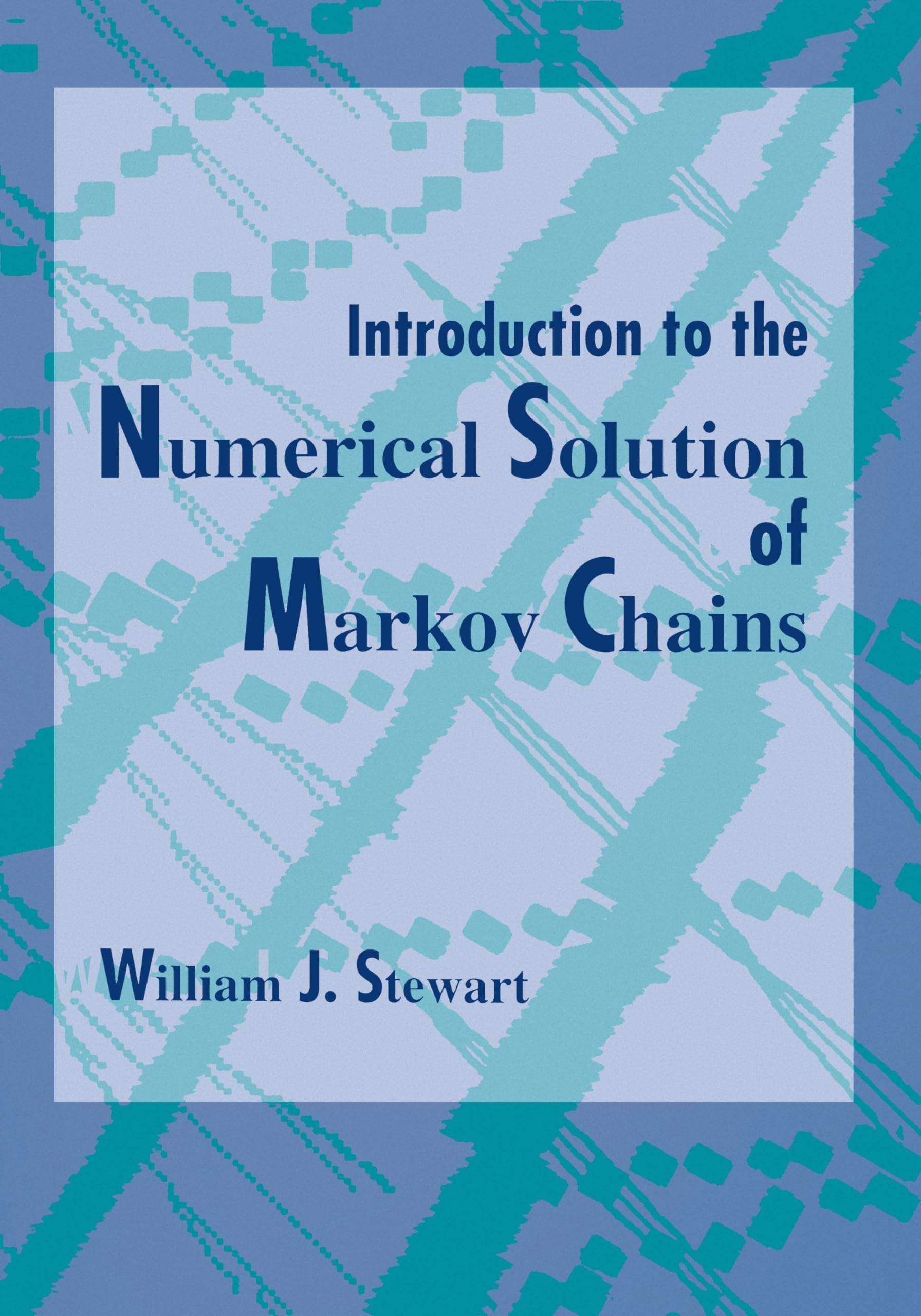
Title
Introduction to the Numerical Solution of Markov Chains,Used
Sold by Ergodebooks, an authorized reseller.
Returns accepted within 30 days | support@ergodebooks.com
Shipping Information
- Free Standard Shipping — United States only
- Processing Time: 3–5 business days
- Estimated Delivery: 6–10 business days after dispatch
- Double-boxed, fully insured & discreetly packaged
- Tracking number sent via email once dispatched
Returns & Refund
Returns accepted within 30 days of delivery.
Damaged or Defective Item
Free return shipping + replacement or full refund
Wrong Item Received
Free return shipping + replacement or full refund
Change of Mind
Return shipping at customer's expense · 25% restocking fee applies
Payment Option

A cornerstone of applied probability, Markov chains can be used to help model how plants grow, chemicals react, and atoms diffuseand applications are increasingly being found in such areas as engineering, computer science, economics, and education. To apply the techniques to real problems, however, it is necessary to understand how Markov chains can be solved numerically. In this book, the first to offer a systematic and detailed treatment of the numerical solution of Markov chains, William Stewart provides scientists on many levels with the power to put this theory to use in the actual world, where it has applications in areas as diverse as engineering, economics, and education. His efforts make for essential reading in a rapidly growing field.Here Stewart explores all aspects of numerically computing solutions of Markov chains, especially when the state is huge. He provides extensive background to both discretetime and continuoustime Markov chains and examines many different numerical computing methodsdirect, singleand multivector iterative, and projection methods. More specifically, he considers recursive methods often used when the structure of the Markov chain is upper Hessenberg, iterative aggregation/disaggregation methods that are particularly appropriate when it is NCD (nearly completely decomposable), and reduced schemes for cases in which the chain is periodic. There are chapters on methods for computing transient solutions, on stochastic automata networks, and, finally, on currently available software. Throughout Stewart draws on numerous examples and comparisons among the methods he so thoroughly explains.
⚠️ WARNING (California Proposition 65):
This product may contain chemicals known to the State of California to cause cancer, birth defects, or other reproductive harm.
For more information, please visit www.P65Warnings.ca.gov.