
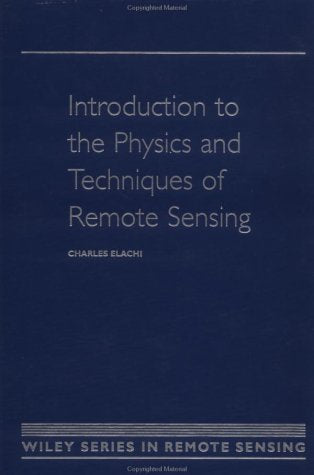
Title
Introduction To The Physics And Techniques Of Remote Sensing,Used
Sold by Ergodebooks, an authorized reseller.
Returns accepted within 30 days | support@ergodebooks.com
Shipping Information
- Free Standard Shipping — United States only
- Processing Time: 3–5 business days
- Estimated Delivery: 6–10 business days after dispatch
- Double-boxed, fully insured & discreetly packaged
- Tracking number sent via email once dispatched
Returns & Refund
Returns accepted within 30 days of delivery.
Damaged or Defective Item
Free return shipping + replacement or full refund
Wrong Item Received
Free return shipping + replacement or full refund
Change of Mind
Return shipping at customer's expense · 25% restocking fee applies
Payment Option

Covers A Wide Spectrum Of Remote Sensing Techniques As Applied To Earth And Planetary Atmospheres And Surface Sciences. Examines The Basic Physics Of Wave/Matter Interactions And Techniques Of Remote Sensing Across The Electromagnetic Spectrum (Uv, Visible Mm And Microwave), And Provides Examples Of Major Applications In The Fields Of Geology, Oceanography, Planetology, And Atmospheric Sciences.
⚠️ WARNING (California Proposition 65):
This product may contain chemicals known to the State of California to cause cancer, birth defects, or other reproductive harm.
For more information, please visit www.P65Warnings.ca.gov.
- Q: How many pages does this book have? A: This book has four hundred thirty-two pages. It provides an extensive overview of remote sensing techniques and applications.
- Q: What is the binding of this book? A: This book is bound in hardcover. The hardcover design enhances durability and makes it suitable for frequent use.
- Q: What are the dimensions of this book? A: The dimensions of this book are seven point seventeen inches in length, zero point eighty-eight inches in width, and ten point twenty-eight inches in height. These dimensions make it easy to handle and store.
- Q: What is the main focus of this book? A: The main focus of this book is on remote sensing techniques. It covers various applications in earth and planetary sciences.
- Q: Who is the author of this book? A: The author of this book is Charles Elachi. He is well-known for his work in the field of remote sensing and planetary science.
- Q: Is this book suitable for beginners in remote sensing? A: Yes, this book is suitable for beginners. It covers fundamental concepts in remote sensing, making it accessible to newcomers.
- Q: Can this book be used as a textbook for a course? A: Yes, this book can be used as a textbook for a course. It provides comprehensive coverage of remote sensing techniques and applications.
- Q: What academic background is needed to understand this book? A: A basic understanding of physics and earth sciences is helpful. The book examines wave/matter interactions fundamental to remote sensing.
- Q: Is this book intended for professionals in the field? A: Yes, this book is also intended for professionals. It includes advanced topics and applications relevant to experts in remote sensing.
- Q: How should I care for this hardcover book? A: To care for this hardcover book, keep it in a dry place and avoid exposing it to direct sunlight. This will help preserve its condition.
- Q: Can I store this book on a shelf with other books? A: Yes, you can store this book on a shelf with other books. Its sturdy hardcover makes it suitable for shelf storage.
- Q: Is this book safe to read for all ages? A: Yes, this book is safe for all ages. It contains educational content about remote sensing techniques.
- Q: What should I do if my book arrives damaged? A: If your book arrives damaged, contact the seller for a replacement or refund. They should assist you with return policies.
- Q: Is there a warranty on this book? A: No, there is no warranty on this book. However, check the seller's policy for returns or exchanges.
- Q: Where can I find additional resources related to this book? A: You can find additional resources online or in academic libraries. Many institutions provide supplementary materials for remote sensing topics.