
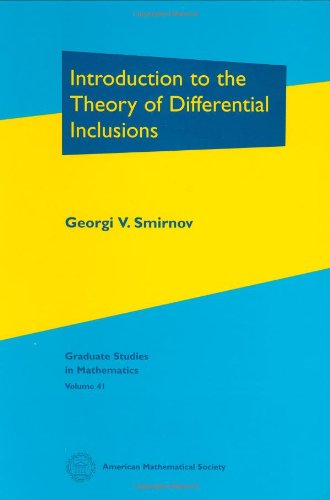
Title
Introduction To The Theory Of Differential Inclusions (Graduate Studies In Mathematics),Used
Sold by Ergodebooks, an authorized reseller.
Returns accepted within 30 days | support@ergodebooks.com
Shipping Information
- Free Standard Shipping — United States only
- Processing Time: 3–5 business days
- Estimated Delivery: 6–10 business days after dispatch
- Double-boxed, fully insured & discreetly packaged
- Tracking number sent via email once dispatched
Returns & Refund
Returns accepted within 30 days of delivery.
Damaged or Defective Item
Free return shipping + replacement or full refund
Wrong Item Received
Free return shipping + replacement or full refund
Change of Mind
Return shipping at customer's expense · 25% restocking fee applies
Payment Option

A Differential Inclusion Is A Relation Of The Form $Dot X In F(X)$, Where $F$ Is A Setvalued Map Associating Any Point $X In R^N$ With A Set $F(X) Subset R^N$. As Such, The Notion Of A Differential Inclusion Generalizes The Notion Of An Ordinary Differential Equation Of The Form $Dot X = F(X)$. Therefore, All Problems Usually Studied In The Theory Of Ordinary Differential Equations (Existence And Continuation Of Solutions, Dependence On Initial Conditions And Parameters, Etc.) Can Be Studied For Differential Inclusions As Well. Since A Differential Inclusion Usually Has Many Solutions Starting At A Given Point, New Types Of Problems Arise, Such As Investigation Of Topological Properties Of The Set Of Solutions, Selection Of Solutions With Given Properties, And Many Others.Differential Inclusions Play An Important Role As A Tool In The Study Of Various Dynamical Processes Described By Equations With A Discontinuous Or Multivalued Righthand Side, Occurring, In Particular, In The Study Of Dynamics Of Economical, Social, And Biological Macrosystems. They Also Are Very Useful In Proving Existence Theorems In Control Theory.This Text Provides An Introductory Treatment To The Theory Of Differential Inclusions. The Reader Is Only Required To Know Ordinary Differential Equations, Theory Of Functions, And Functional Analysis On The Elementary Level.Chapter 1 Contains A Brief Introduction To Convex Analysis. Chapter 2 Considers Setvalued Maps. Chapter 3 Is Devoted To The Mordukhovich Version Of Nonsmooth Analysis. Chapter 4 Contains The Main Existence Theorems And Gives An Idea Of The Approximation Techniques Used Throughout The Text. Chapter 5 Is Devoted To The Viability Problem, I.E., The Problem Of Selection Of A Solution To A Differential Inclusion That Is Contained In A Given Set. Chapter 6 Considers The Controllability Problem. Chapter 7 Discusses Extremal Problems For Differential Inclusions. Chapter 8 Presents Stability Theory, And Chapter 9 Deals With The Stabilization Problem.
⚠️ WARNING (California Proposition 65):
This product may contain chemicals known to the State of California to cause cancer, birth defects, or other reproductive harm.
For more information, please visit www.P65Warnings.ca.gov.
- Q: What is the main topic covered in 'Introduction to the Theory of Differential Inclusions'? A: This book primarily covers differential inclusions, a generalization of ordinary differential equations, focusing on set-valued maps and their applications in various mathematical and real-world problems.
- Q: Who is the author of this book and what is their background? A: The book is authored by Georgi V. Smirnov, who has expertise in mathematics and has contributed to the field through various academic works.
- Q: What prior knowledge is required to understand the content of this book? A: Readers are only required to have a basic understanding of ordinary differential equations, the theory of functions, and elementary functional analysis.
- Q: How many pages does this book contain? A: The book contains a total of 226 pages.
- Q: What is the binding type of this book? A: The book is available in hardcover binding, providing durability for readers.
- Q: What condition is the used book in? A: The used book is listed in 'Good' condition, indicating it may have some wear but is still usable and intact.
- Q: What are some key topics discussed in the chapters of this book? A: Key topics include convex analysis, set-valued maps, nonsmooth analysis, existence theorems, viability problems, controllability, extremal problems, stability theory, and stabilization.
- Q: Is this book suitable for beginners in mathematics? A: While the book provides an introductory treatment, it is more suitable for readers with some foundational knowledge in differential equations and mathematical analysis.
- Q: Can this book be used as a reference for advanced mathematical studies? A: Yes, it can serve as a reference for advanced studies in differential inclusions and related topics in control theory and dynamical systems.
- Q: When was 'Introduction to the Theory of Differential Inclusions' published? A: The book was published in January 2002.