
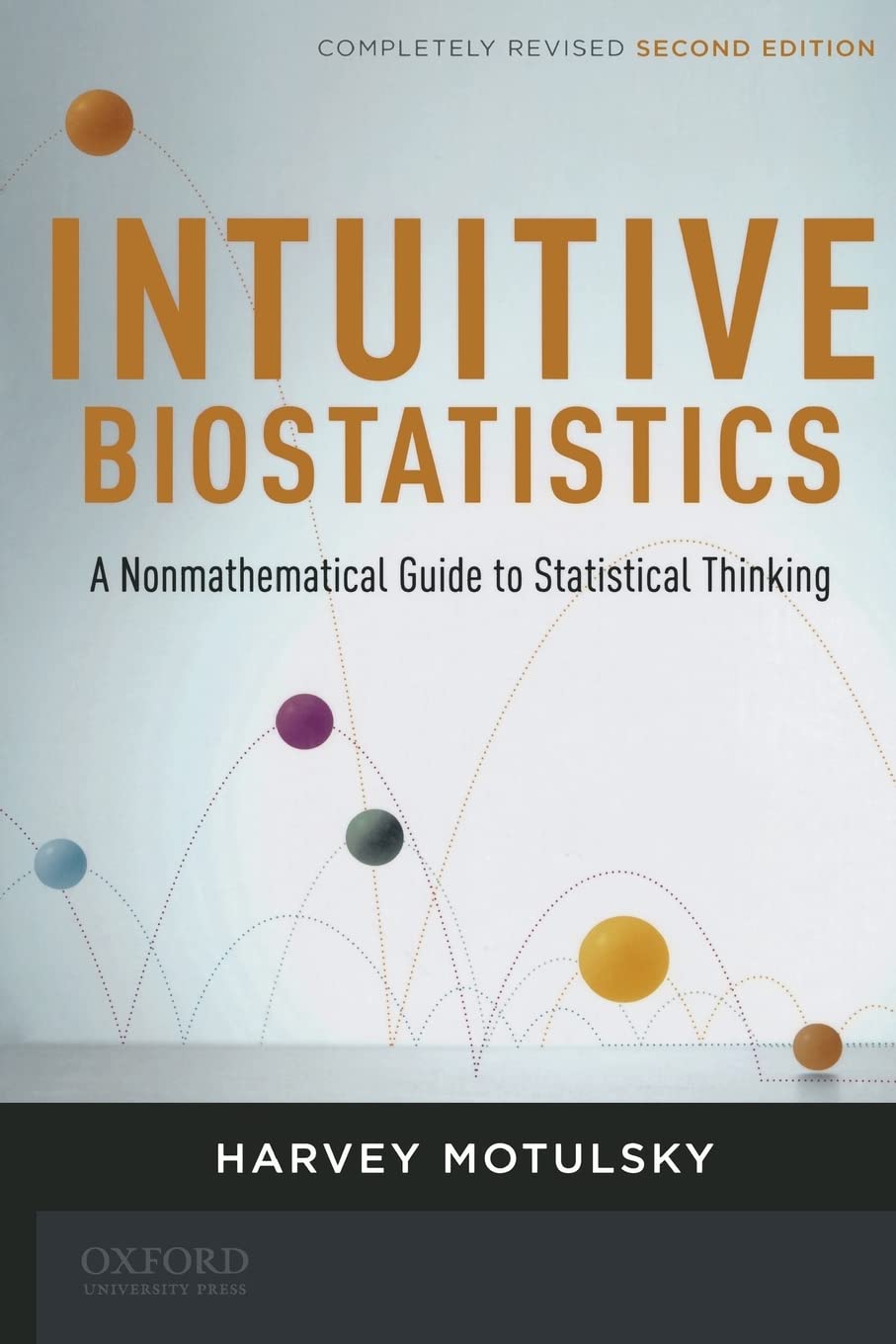
Title


Intuitive Biostatistics: A Nonmathematical Guide To Statistical Thinking, 2Nd Revised Edition
Sold by Ergodebooks, an authorized reseller.
Returns accepted within 30 days | support@ergodebooks.com
Shipping Information
- Free Standard Shipping — United States only
- Processing Time: 3–5 business days
- Estimated Delivery: 6–10 business days after dispatch
- Double-boxed, fully insured & discreetly packaged
- Tracking number sent via email once dispatched
Returns & Refund
Returns accepted within 30 days of delivery.
Damaged or Defective Item
Free return shipping + replacement or full refund
Wrong Item Received
Free return shipping + replacement or full refund
Change of Mind
Return shipping at customer's expense · 25% restocking fee applies
Payment Option

This Is For The 2Nd Edition. The 3Rd Edition Is Now Available.Overviewintuitive Biostatistics Is Both An Introduction And Review Of Statistics. Compared To Other Books, It Has: Breadth Rather Than Depth. It Is A Guidebook, Not A Cookbook. Words Rather Than Math. It Has Few Equations. Explanations Rather Than Recipes. This Book Presents Few Details Of Statistical Methods And Only A Few Tables Required To Complete The Calculations. Who Is It For?I Wrote Intuitive Biostatistics For Three Audiences: Medical (And Other) Professionals Who Want To Understand The Statistical Portions Of Journals They Read. These Readers Don'T Need To Analyze Any Data, But Need To Understand Analyses Published By Others. Undergraduate And Graduate Students, Postdocs And Researchers Who Will Analyze Data. This Book Explains General Principles Of Data Analysis, But It Won'T Teach You How To Do Statistical Calculations Or How To Use Any Particular Statistical Program. Scientists Who Consult With Statisticians. Statistics Often Seems Like A Foreign Language, And This Text Can Serve As A Phrase Book To Bridge The Gap Between Scientists And Statisticians. What'S New In The Second Edition?Though The Spirit Of The First Edition Remains, Very Few Of Its Words Do. It Is Hard To Explain What Is New In This Edition, Since I Essentially Rewrote The Entire Book. New And Expanded Topics In The Second Edition Of Intuitive Biostatistics Include: Chapter 1 Explains How Our Intuitions Can Lead Us Astray In Issues Of Probability And Statistics. Chapter 11 (And Later Examples) Highlight The Fact That Lognormal Distributions Are Common. Chapter 21 Explains The Idea Of Testing For Equivalence Vs. Testing For Differences. Chapters 22, 23, And 40 Discuss The Pervasive Problem Of Multiple Comparisons. Chapters 24 And 25 Discuss Testing For Normality And For Outliers. Chapter 35 Shows How To Think About Statistical Hypothesis Testing As Comparing The Fits Of Alternative Models. Chapters 37 And 38 Give Expanded Coverage Of The Usefulnessand Trapsof Multiple, Logistic, And Proportional Hazards Regression. Chapter 43 Briefly Mentions Adaptive Study Designs Where Sample Size Is Not Chosen In Advance. Chapter 46 (Inspired By, And Written With, Bill Greco) Reviews Many Topics In This Book And More General Issues Of How To Approach Data Analysis.
⚠️ WARNING (California Proposition 65):
This product may contain chemicals known to the State of California to cause cancer, birth defects, or other reproductive harm.
For more information, please visit www.P65Warnings.ca.gov.
- Q: What is the main focus of 'Intuitive Biostatistics'? A: The book primarily focuses on introducing and reviewing statistical concepts in a non-mathematical way, making it accessible for medical professionals, students, and researchers.
- Q: Who is the target audience for this book? A: It is designed for medical professionals, undergraduate and graduate students, post-docs, researchers, and scientists who need to understand statistical analyses without performing complex calculations.
- Q: What distinguishes the second edition from the first edition? A: The second edition has been extensively rewritten with new and expanded topics, including discussions on lognormal distributions, multiple comparisons, and advanced regression techniques.
- Q: How many pages does 'Intuitive Biostatistics' have? A: The book has a total of 508 pages.
- Q: Is this edition of 'Intuitive Biostatistics' suitable for beginners? A: Yes, it is suitable for beginners as it emphasizes understanding statistical principles without requiring advanced mathematical skills.
- Q: What type of binding does this book have? A: The book is available in a paperback binding.
- Q: When was the second edition of 'Intuitive Biostatistics' published? A: The second edition was published on January 20, 2010.
- Q: Can this book help with understanding statistical analyses in medical journals? A: Yes, it is specifically aimed at helping readers understand the statistical portions of medical journals without needing to analyze data themselves.
- Q: What are some key topics covered in the second edition? A: Key topics include probability and statistics intuitions, equivalence testing, multiple comparisons, normality testing, and regression analysis.
- Q: Who is the author of 'Intuitive Biostatistics'? A: The book is authored by Harvey Motulsky.