
Title

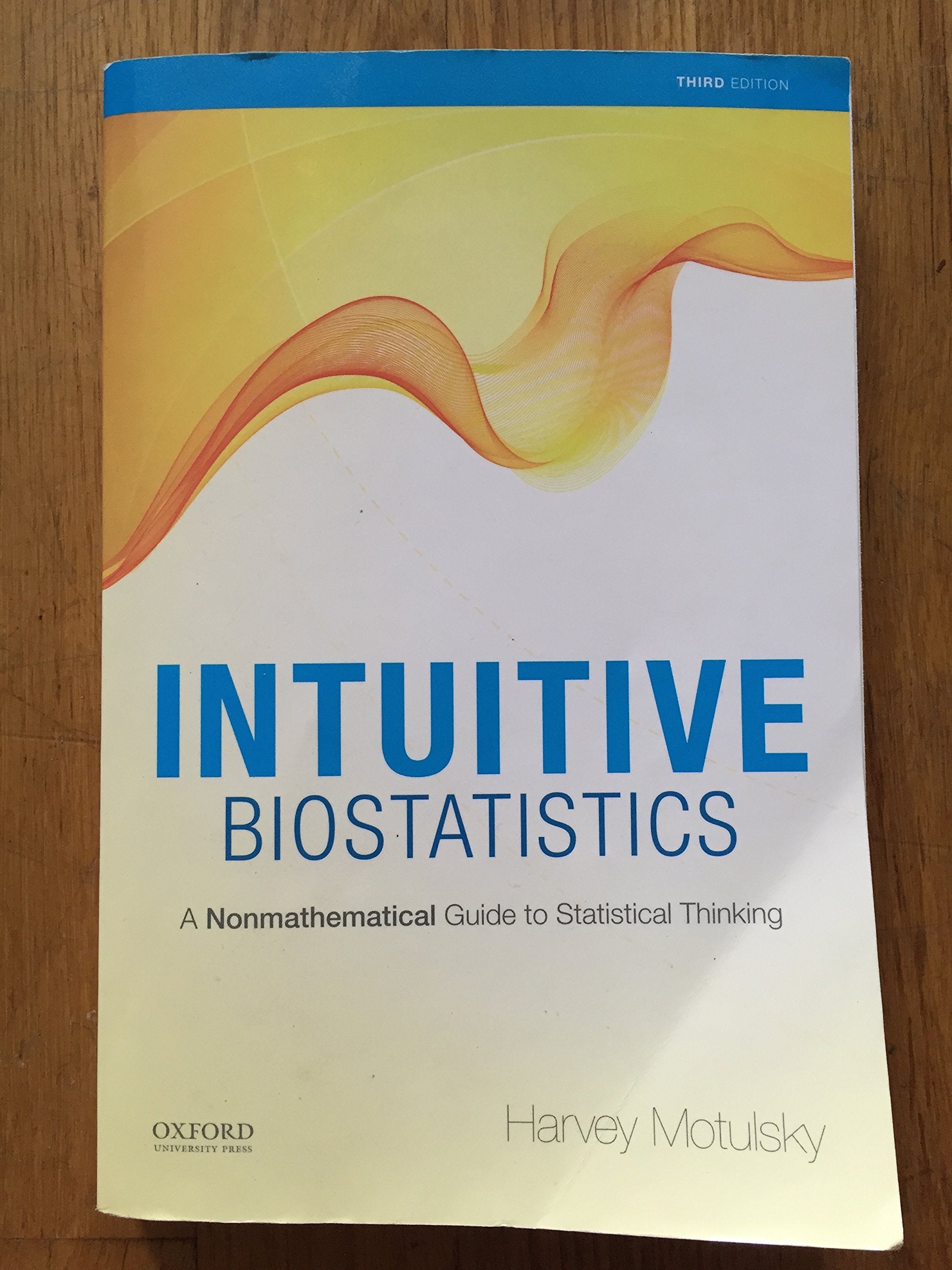
Intuitive Biostatistics: A Nonmathematical Guide To Statistical Thinking, 3Rd Edition
Sold by Ergodebooks, an authorized reseller.
Returns accepted within 30 days | support@ergodebooks.com
Shipping Information
- Free Standard Shipping — United States only
- Processing Time: 3–5 business days
- Estimated Delivery: 6–10 business days after dispatch
- Double-boxed, fully insured & discreetly packaged
- Tracking number sent via email once dispatched
Returns & Refund
Returns accepted within 30 days of delivery.
Damaged or Defective Item
Free return shipping + replacement or full refund
Wrong Item Received
Free return shipping + replacement or full refund
Change of Mind
Return shipping at customer's expense · 25% restocking fee applies
Payment Option

Thoroughly Revised And Updated, The Third Edition Of Intuitive Biostatistics: A Nonmathematical Guide To Statistical Thinking Retains And Refines The Core Perspectives Of The Previous Editions: A Focus On How To Interpret Statistical Results Rather Than On How To Analyze Data, Minimal Use Of Equations, And A Detailed Review Of Assumptions And Common Mistakes.With Its Engaging And Conversational Tone, This Unique Book Provides A Clear Introduction To Statistics For Undergraduate And Graduate Students In A Wide Range Of Fields And Also Serves As A Statistics Refresher For Working Scientists. It Is Especially Useful For Those Students In Healthscience Related Fields Who Have No Background In Biostatistics.Contentspart A: Introducing Statistics 1. Statistics And Probability Are Not Intuitive 2. The Complexities Of Probability 3. From Sample To Population Part B: Confidence Intervals 4. Confidence Interval Of A Proportion 5. Confidence Interval Of Survival Data 6. Confidence Interval Of Counted Data Part C: Continuous Variables 7. Graphing Continuous Data 8. Types Of Variables 9. Quantifying Scatter 10. The Gaussian Distribution 11. The Lognormal Distribution And Geometric Mean12. Confidence Interval Of A Mean 13. The Theory Of Confidence Intervals14. Error Bars Part D: P Values And Significance 15. Introducing P Values 16. Statistical Significance And Hypothesis Testing17. Relationship Between Confidence Intervals And Statistical Significance 18. Interpreting A Result That Is Statistically Significant 19. Interpreting A Result That Is Not Statistically Significant 20. Statistical Power21. Testing For Equivalence Or Noninferioritypart E: Challenges In Statistics 22. Multiple Comparisons Concepts 23. The Ubiquity Of Multiple Comparison24. Normality Tests25. Outliers 26. Choosing A Sample Sizepart F: Statistical Tests 27. Comparing Proportions28. Casecontrol Studies29. Comparing Survival Curves 30. Comparing Two Means: Unpaired T Test31. Comparing Two Paired Groups32. Correlation Part G: Fitting Models To Data 33. Simple Linear Regression34. Introducing Models 35. Comparing Models 36. Nonlinear Regression37. Multiple Regression 38. Logistic And Proportional Hazards Regressionpart H The Rest Of Statistics 39. Analysis Of Variance 40. Multiple Comparison Tests After Anova 41. Nonparametric Methods42. Sensitivity And Specificity And Receiveroperator Characteristic Curves 43. Metaanalysispart I Putting It All Together 44. The Key Concepts Of Statistics45. Statistical Traps To Avoid46. Capstone Example 47. Review Problems 48. Answers To Review Problems
⚠️ WARNING (California Proposition 65):
This product may contain chemicals known to the State of California to cause cancer, birth defects, or other reproductive harm.
For more information, please visit www.P65Warnings.ca.gov.
- Q: How many pages does the book have? A: The book has five hundred seventy-six pages. This length provides a comprehensive overview of biostatistics concepts.
- Q: What is the binding type of this book? A: The book is paperback bound. This makes it lightweight and easy to handle for reading and note-taking.
- Q: What are the dimensions of the book? A: The dimensions are approximately nine point two one inches long, six point one inches wide, and zero point nine one inches thick. These measurements make it convenient to carry in a bag.
- Q: What topics are covered in this biostatistics book? A: Topics include confidence intervals, statistical tests, and model fitting. It provides a nonmathematical approach to understanding statistical thinking.
- Q: Who is the author of the book? A: The book is authored by Harvey Motulsky. He is recognized for making statistics accessible to a broad audience.
- Q: How do I use this book for studying? A: You can use this book as a guide to understand statistical concepts. It's suitable for undergraduate and graduate students in health-related fields.
- Q: Is this book suitable for beginners in biostatistics? A: Yes, this book is suitable for beginners. It focuses on interpretation rather than complex calculations, making it ideal for those new to the subject.
- Q: Can I use this book for self-study? A: Yes, this book is excellent for self-study. Its engaging tone and structured content help reinforce learning of statistical principles.
- Q: How should I store this book to keep it in good condition? A: Store the book in a dry place and avoid direct sunlight. This will help preserve its binding and prevent any page damage.
- Q: Are there any special care instructions for this book? A: No special care instructions are required. Just handle it gently to prevent wear and tear.
- Q: What if the book arrives damaged? A: If the book arrives damaged, you can return it for a replacement. Ensure you keep the original packaging for the return process.
- Q: What is the return policy for this book? A: The return policy typically allows returns within a specified period. Check the seller’s guidelines for specific return window details.
- Q: Is this book appropriate for high school students? A: While it is aimed at college-level students, high school students with a strong interest in statistics may also find it beneficial.
- Q: What makes this book different from other statistics books? A: This book emphasizes interpretation over computation. It aims to make statistics intuitive without heavy reliance on equations.
- Q: Does the book include real-world examples? A: Yes, the book includes real-world examples to illustrate statistical concepts. These examples help bridge theory with practice.
- Q: Is there a glossary or index in the book? A: Yes, the book includes a glossary and an index. These features make it easier to locate specific terms and concepts.