If you have any questions, you are always welcome to contact us. We'll get back to you as soon as possible, withing 24 hours on weekdays.
Customer service
All questions about your order, return and delivery must be sent to our customer service team by e-mail at yourstore@yourdomain.com
Sale & Press
If you are interested in selling our products, need more information about our brand or wish to make a collaboration, please contact us at press@yourdomain.com
Help
If you have any questions, you are always welcome to contact us. We'll get back to you as soon as possible, withing 24 hours on weekdays.
Customer service
All questions about your order, return and delivery must be sent to our customer service team by e-mail at yourstore@yourdomain.com
Sale & Press
If you are interested in selling our products, need more information about our brand or wish to make a collaboration, please contact us at press@yourdomain.com
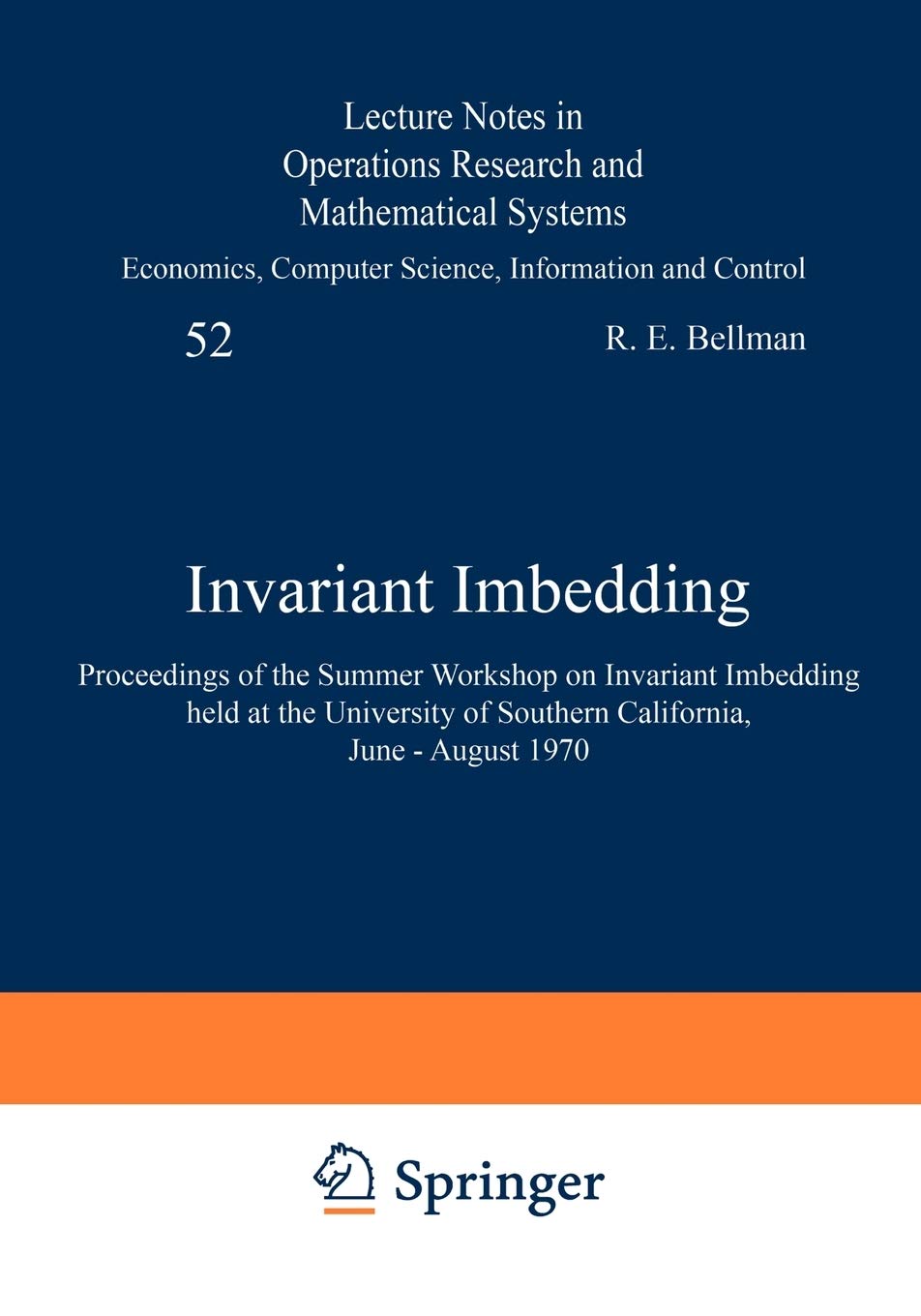
Imbedding is a powerful and versatile tool for problem solving. Rather than treat a question in isolation, we view it as a member of a family of related problems. Each member then becomes a stepping stone in a path to a simultaneous solution of the entire set of problems. As might be expected, there are many ways of accomplishing this imbedding. Time and space variables have been widely employed in the past, while modern approaches combine these structural features with others less immediate. Why should one search for alternate imbeddings when elegant classical formalisms already exist? There are many reasons. To begin with, different imbeddings are useful for different purposes. Some are well suited to the derivation of existence and uniqueness theorems, some to the derivation of conservation relations, some to perturbation techniques and sensitivity analysis, some to computa tional studies. The digital computer is designed for initial value problems; the analog computer for boundaryvalue problems. It is essential then to be flexible and possess the ability to use one device or the other, or both. In economics, engineering, biology and physics, some pro cesses lend themselves more easily to one type of imbedding rather than another. Thus, for example, stochastic decision processes are well adapted to dynamic programming. In any case, to go hunting in the wilds of the scientific world armed with only one arrow in one's quiver is quite foolhardy.
⚠️ WARNING (California Proposition 65):
This product may contain chemicals known to the State of California to cause cancer,
birth defects, or other reproductive harm.
For MAP (Minimum Advertised Price) violations and Intellectual Property (IP) or Trademark concerns, please contact:
support@ergodebooks.com
⚠️ California Proposition 65 Warning: Some products sold on this website may expose you to chemicals known to the State of California to cause cancer, birth defects, or other reproductive harm. For more information, visit www.P65Warnings.ca.gov.