
Title
Invisible Fences: Prose Poetry As A Genre In French And American Literature,Used
Sold by Ergodebooks, an authorized reseller.
Returns accepted within 30 days | support@ergodebooks.com
Shipping Information
- Free Standard Shipping — United States only
- Processing Time: 3–5 business days
- Estimated Delivery: 6–10 business days after dispatch
- Double-boxed, fully insured & discreetly packaged
- Tracking number sent via email once dispatched
Returns & Refund
Returns accepted within 30 days of delivery.
Damaged or Defective Item
Free return shipping + replacement or full refund
Wrong Item Received
Free return shipping + replacement or full refund
Change of Mind
Return shipping at customer's expense · 25% restocking fee applies
Payment Option

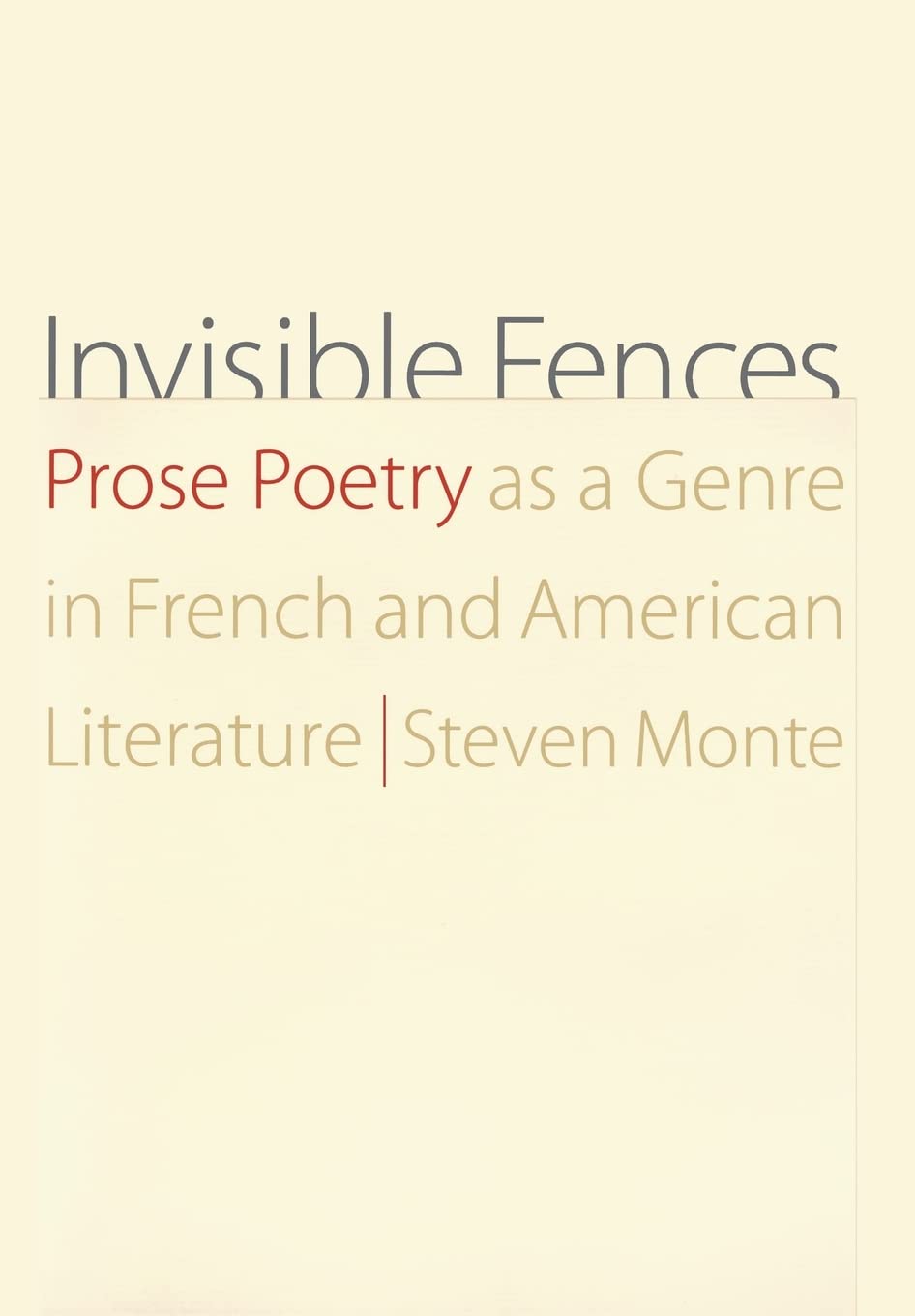
For all its recent popularity among poets and critics, prose poetry continues to raise more questions than it answers. How have prose poems been identified as such, and why have similar works been excluded from the genre? What happens when we read a work as a prose poem? How have prose genres such as the novel affected prose poetry and modern poetry in general? In Invisible Fences Steven Monte places prose poetry in historical and theoretical perspective by comparing its development in the French and American literary traditions. In spite of its apparent formal freedom, prose poetry is constrained by specific historical circumstances and is constantly engaged in border disputes with neighboring prose and poetic genres.Monte illuminates these constraints through an examination of works that have influenced the development of the prose poem as well as through a discussion of genre theory and detailed readings of poems ranging from Charles Baudelaire's 'La Solitude' to John Ashbery's 'The System.' Monte explores the ways in which literaryhistorical narratives affect interpretation: why, for example, prose poetry tends to be seen as a revolutionary genre and how this perspective influences readings of individual works. The American poets he discusses include Ralph Waldo Emerson, William Carlos Williams, T. S. Eliot, Gertrude Stein, and Ashbery; the French poets range from Baudelaire, Arthur Rimbaud, and Stephane Mallarm to Max Jacob. In exploring prose poetry as a genre, Invisible Fences offers new perspectives not only on modern poetry, but also on genre itself, challenging current theories of genre with a test case that asks for yet eludes definition.
⚠️ WARNING (California Proposition 65):
This product may contain chemicals known to the State of California to cause cancer, birth defects, or other reproductive harm.
For more information, please visit www.P65Warnings.ca.gov.
- Q: How many pages does the book have? A: The book has two hundred ninety-eight pages. This length provides a comprehensive exploration of prose poetry in both French and American literature.
- Q: What is the binding type of this book? A: The book is hardcover. This binding offers durability and makes it suitable for long-term use.
- Q: What are the dimensions of the book? A: The dimensions of the book are six inches in length, zero point eight three inches in width, and nine point zero two inches in height. These measurements make it a manageable size for reading.
- Q: Who is the author of the book? A: The author is Steven Monte. He provides a historical and theoretical perspective on prose poetry.
- Q: What genre does this book belong to? A: The book belongs to the Criticism and Theory genre. It examines prose poetry within the broader context of literary traditions.
- Q: Is this book suitable for beginners in poetry? A: Yes, the book is suitable for beginners. It offers insights into prose poetry that can be accessible for those new to the genre.
- Q: How do I read and interpret prose poetry? A: To read and interpret prose poetry, approach it as a blend of prose and poetic elements. Understanding the historical context enhances your interpretation.
- Q: What age group is this book appropriate for? A: The book is appropriate for adults and older teens. It addresses complex themes in poetry that require a mature understanding.
- Q: Can this book be used in academic settings? A: Yes, this book can be used in academic settings. Its detailed analysis makes it a valuable resource for students and scholars.
- Q: How should I care for this hardcover book? A: To care for this hardcover book, store it upright on a shelf. Keep it away from direct sunlight to prevent fading.
- Q: Is the book safe to handle frequently? A: Yes, the book is safe to handle frequently. Its hardcover design is durable, making it suitable for regular use.
- Q: What should I do if the book gets damaged? A: If the book gets damaged, assess the extent of the damage. Minor wear can be repaired, while significant damage may require a replacement.
- Q: Does this book come with a warranty? A: No, this book does not come with a warranty. However, it is expected to be in good condition upon purchase.
- Q: What if I receive the book in poor condition? A: If you receive the book in poor condition, contact the seller for return options. Most sellers will allow for returns or exchanges.
- Q: How can I compare this book to others in the same genre? A: You can compare this book by looking at its focus on prose poetry against others that may concentrate on traditional poetry forms. Each book may offer unique perspectives.
- Q: Is this book only for poetry enthusiasts? A: No, this book is not only for poetry enthusiasts. It also appeals to those interested in literary criticism and genre theory.