If you have any questions, you are always welcome to contact us. We'll get back to you as soon as possible, withing 24 hours on weekdays.
Customer service
All questions about your order, return and delivery must be sent to our customer service team by e-mail at yourstore@yourdomain.com
Sale & Press
If you are interested in selling our products, need more information about our brand or wish to make a collaboration, please contact us at press@yourdomain.com
Help
If you have any questions, you are always welcome to contact us. We'll get back to you as soon as possible, withing 24 hours on weekdays.
Customer service
All questions about your order, return and delivery must be sent to our customer service team by e-mail at yourstore@yourdomain.com
Sale & Press
If you are interested in selling our products, need more information about our brand or wish to make a collaboration, please contact us at press@yourdomain.com
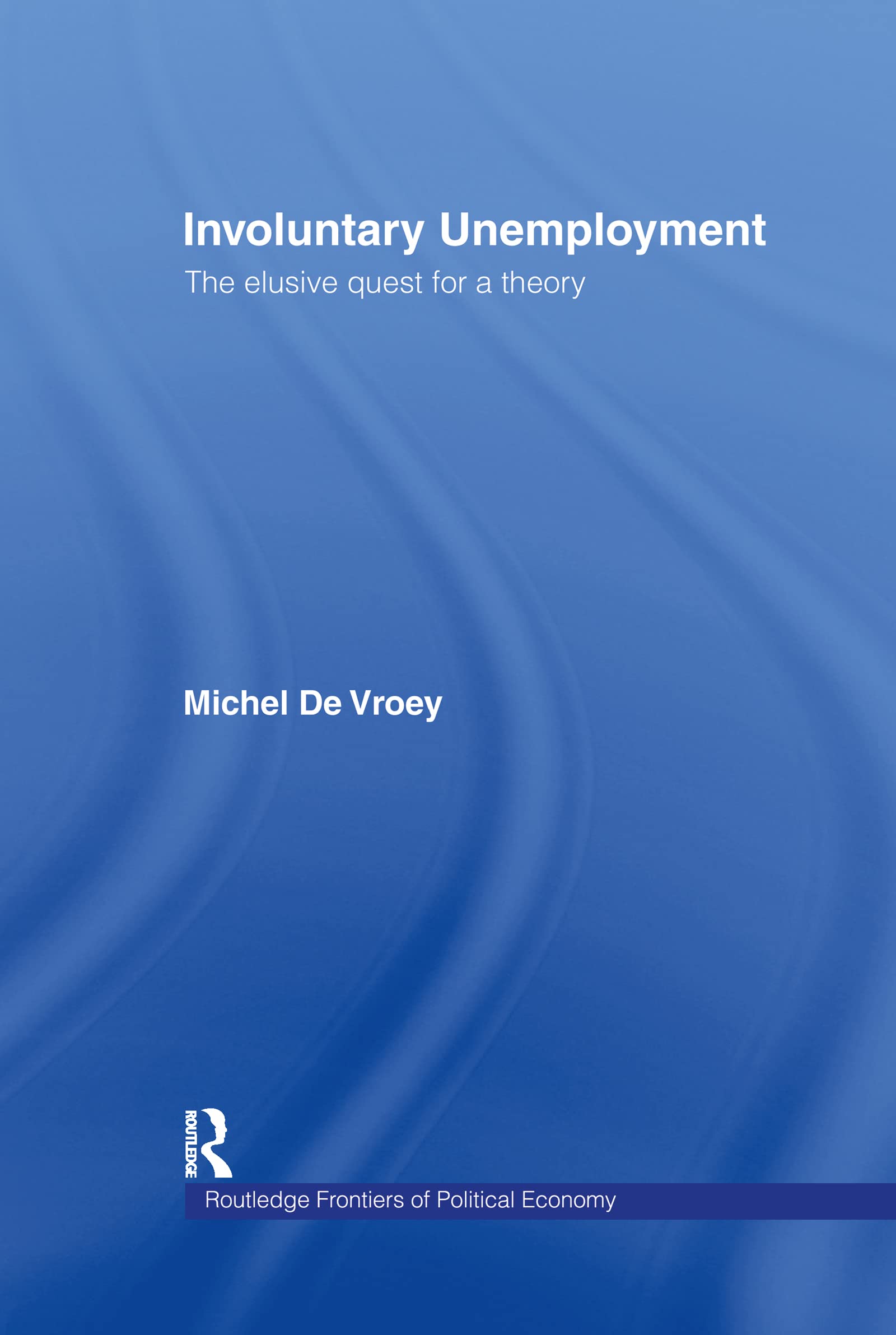
The Great Depression of the 1930s with its dramatic unemployment rates was one of the most striking economic events of the past century. It shook economists' beliefs in the existence of selfadjusting forces and prompted Keynes to write his masterwork, The General Theory of Employment, Interest and Money.Involuntary unemployment was the central concept of Keynes' book. However, after having been considered the sine qua non of economics for decades, it has gradually disappeared from textbooks and research. This book recounts and ponders this demise, asking whether the abandonment of the concept of involuntary unemployment is the manifestation of some inner defect of recent economic theory or is rather due to some intrinsic weakness of the concept itself, which makes it of little use when it comes to economic theorising.In order to disentangle these issues, the author critically reviews the different explanations of involuntary unemployment that have been offered from Keynes up to the end of the 1980s. After consideringThe General Theory, the author studies the works of pioneering macroeconomists such as Hicks, Modigliani, Lange, Leontief, Tobin, Klein and Hansen. An examination of the 'reappraisal of Keynes' and of the socalled disequilibrium school is followed by a discussion of Friedman's and Lucas' antiKeynesian attack. The final part of the book investigates a series of models purporting to revive the Keynesian project, namely implicit contract, efficiency wages, insideroutsider, coordination failures, and imperfect competition.
⚠️ WARNING (California Proposition 65):
This product may contain chemicals known to the State of California to cause cancer,
birth defects, or other reproductive harm.
For MAP (Minimum Advertised Price) violations and Intellectual Property (IP) or Trademark concerns, please contact:
support@ergodebooks.com
⚠️ California Proposition 65 Warning: Some products sold on this website may expose you to chemicals known to the State of California to cause cancer, birth defects, or other reproductive harm. For more information, visit www.P65Warnings.ca.gov.