
Title
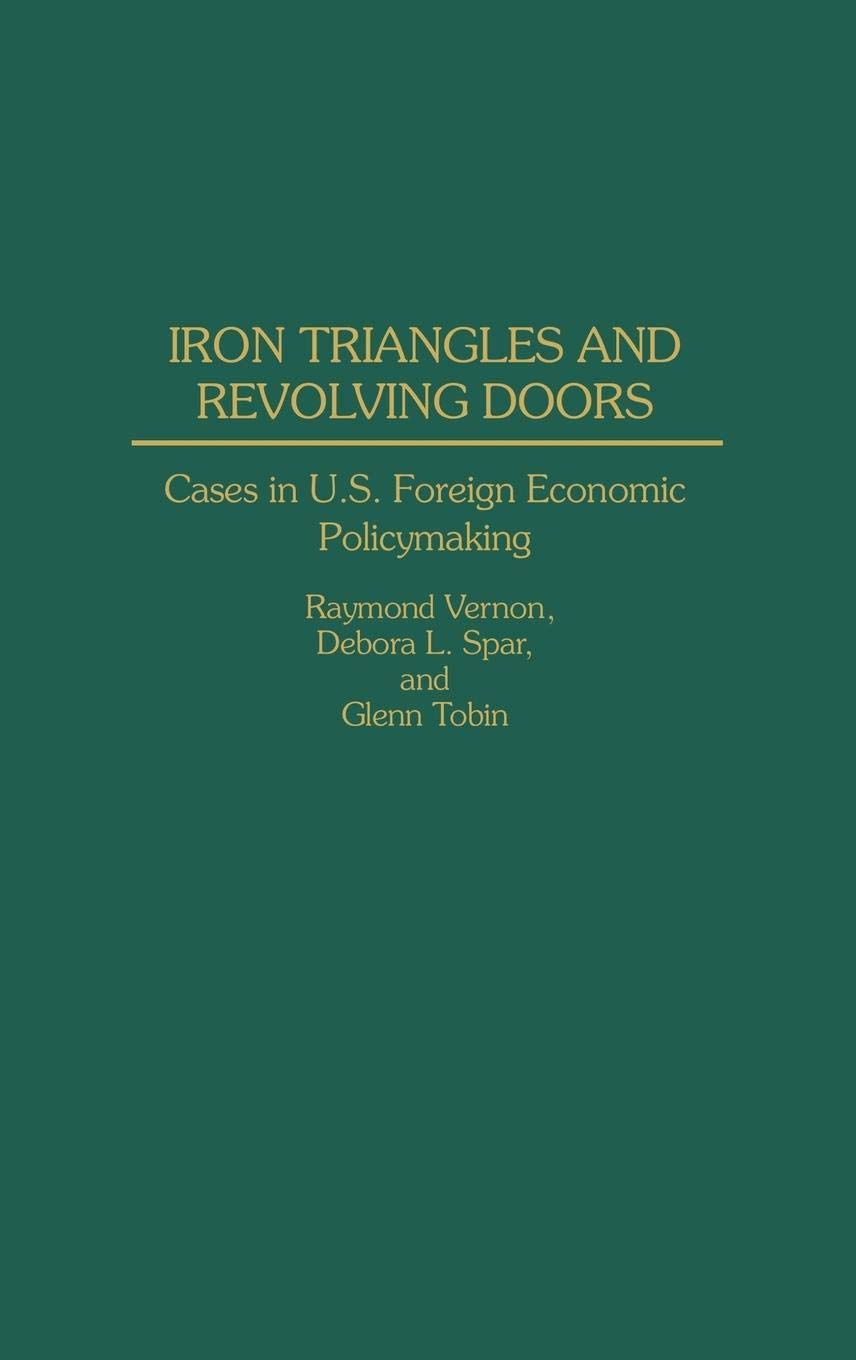
Iron Triangles and Revolving Doors: Cases in U.S. Foreign Economic Policymaking,Used
Sold by Ergodebooks, an authorized reseller.
Returns accepted within 30 days | support@ergodebooks.com
Shipping Information
- Free Standard Shipping — United States only
- Processing Time: 3–5 business days
- Estimated Delivery: 6–10 business days after dispatch
- Double-boxed, fully insured & discreetly packaged
- Tracking number sent via email once dispatched
Returns & Refund
Returns accepted within 30 days of delivery.
Damaged or Defective Item
Free return shipping + replacement or full refund
Wrong Item Received
Free return shipping + replacement or full refund
Change of Mind
Return shipping at customer's expense · 25% restocking fee applies
Payment Option

In a rapidly shrinking world, governments everywhere find themselves increasingly obliged to deal with international economic issues. When dealing with such issues, their processes of decisionmaking prove strikingly different from those employed in the handling of political or strategic problems. This unique volume by Raymond Vernon, Debora L. Spar, and Glenn Tobin provides a closeup view of the decisionmaking process within the U.S. establishment as it has wrestled with a series of greatly publicized economic issues in recent years. The book synthesizes a literature that has been accumulating over three decades, deriving from this literature a model of the processes of decisionmaking in the field of U.S. foreign economic policy. Five detailed case studies are presented, each covering a major economic plan or agreement that raised significant controversy.Since the process by which economic decisions are reached involves institutions and characteristics quite different from those encountered in political decisionmaking, Iron Triangles and Revolving Doors emphasizes the persistent regularities to be found in the United States when it comes to economic decisionmaking. The opening chapter offers a model of the characteristics of the foreign economic policymaking process. The next five chapters examine the U.S.Canada Free Trade Agreement; the battle over the codevelopment of the FSX fighter plane with Japan; the problem of international debt and the creation of the Brady plan; and U.S. trade policy and security export controls in light of the ToshibaKongsberg affair. Each of these cases is linked to the overall model of U.S. economic policy presented by the authors. This volume will be an excellent text for university or graduate courses in foreign economic policy, U.S. foreign policy, and international political economy. It will also be of interest to political scientists, economists, government officials, policy analysts, and others looking for insights into economic decisionmaking.
⚠️ WARNING (California Proposition 65):
This product may contain chemicals known to the State of California to cause cancer, birth defects, or other reproductive harm.
For more information, please visit www.P65Warnings.ca.gov.