If you have any questions, you are always welcome to contact us. We'll get back to you as soon as possible, withing 24 hours on weekdays.
Customer service
All questions about your order, return and delivery must be sent to our customer service team by e-mail at yourstore@yourdomain.com
Sale & Press
If you are interested in selling our products, need more information about our brand or wish to make a collaboration, please contact us at press@yourdomain.com
Help
If you have any questions, you are always welcome to contact us. We'll get back to you as soon as possible, withing 24 hours on weekdays.
Customer service
All questions about your order, return and delivery must be sent to our customer service team by e-mail at yourstore@yourdomain.com
Sale & Press
If you are interested in selling our products, need more information about our brand or wish to make a collaboration, please contact us at press@yourdomain.com
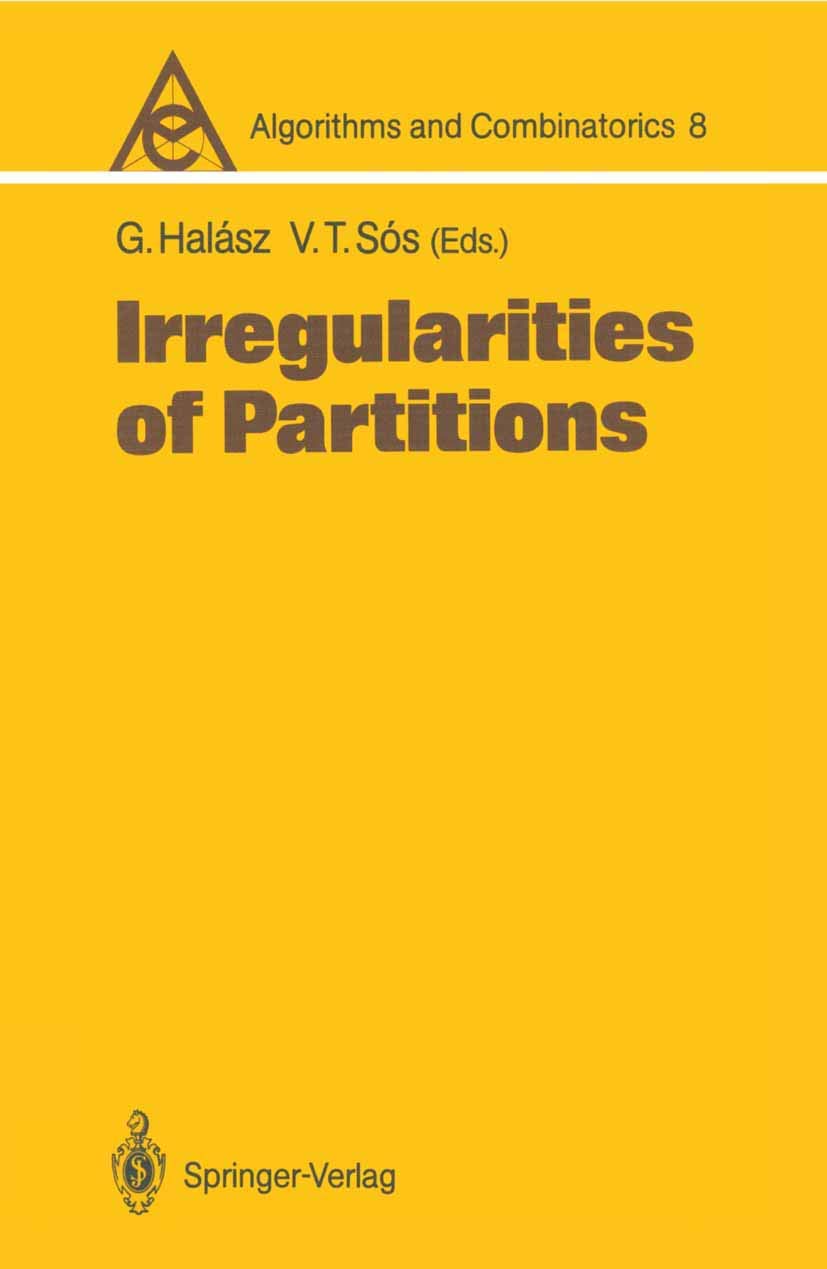
The problem of uniform distribution of sequences initiated by Hardy, Little wood and Weyl in the 1910's has now become an important part of number theory. This is also true, in relation to combinatorics, of what is called Ramsey theory, a theory of about the same age going back to Schur. Both concern the distribution of sequences of elements in certain collection of subsets. But it was not known until quite recently that the two are closely interweaving bear ing fruits for both. At the same time other fields of mathematics, such as ergodic theory, geometry, information theory, algorithm theory etc. have also joined in. (See the survey articles: V. T. S6s: Irregularities of partitions, Lec ture Notes Series 82, London Math. Soc. , Surveys in Combinatorics, 1983, or J. Beck: Irregularities of distributions and combinatorics, Lecture Notes Series 103, London Math. Soc. , Surveys in Combinatorics, 1985. ) The meeting held at Fertod, Hungary from the 7th to 11th of July, 1986 was to emphasize this development by bringing together a few people working on different aspects of this circle of problems. Although combinatorics formed the biggest contingent (see papers 2, 3, 6, 7, 13) some number theoretic and analytic aspects (see papers 4, 10, 11, 14) generalization of both (5, 8, 9, 12) as well as irregularities of distribution in the geometric theory of numbers (1), the most important instrument in bringing about the above combination of ideas are also represented.
⚠️ WARNING (California Proposition 65):
This product may contain chemicals known to the State of California to cause cancer,
birth defects, or other reproductive harm.
For MAP (Minimum Advertised Price) violations and Intellectual Property (IP) or Trademark concerns, please contact:
support@ergodebooks.com
⚠️ California Proposition 65 Warning: Some products sold on this website may expose you to chemicals known to the State of California to cause cancer, birth defects, or other reproductive harm. For more information, visit www.P65Warnings.ca.gov.