
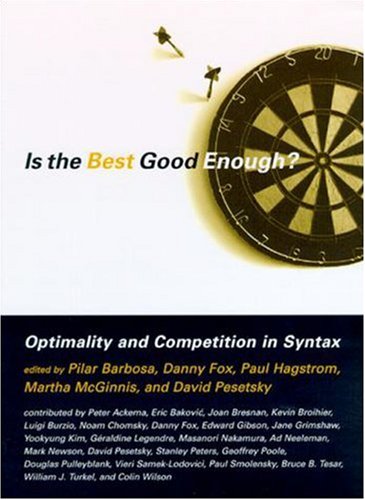
Title
Is the Best Good Enough? Optimality and Competition in Syntax,Used
Sold by Ergodebooks, an authorized reseller.
Returns accepted within 30 days | support@ergodebooks.com
Shipping Information
- Free Standard Shipping — United States only
- Processing Time: 3–5 business days
- Estimated Delivery: 6–10 business days after dispatch
- Double-boxed, fully insured & discreetly packaged
- Tracking number sent via email once dispatched
Returns & Refund
Returns accepted within 30 days of delivery.
Damaged or Defective Item
Free return shipping + replacement or full refund
Wrong Item Received
Free return shipping + replacement or full refund
Change of Mind
Return shipping at customer's expense · 25% restocking fee applies
Payment Option

Recent developments in linguistic theory have led to a reconsideration of the role of optimality in the overall architecture of the grammar. Emerging from this research is the idea that different components of the grammar interact to yield the best choice from a set of candidate derivations. This idea departs from traditional approaches to the output of linguistic levels in generative grammar, in which rules, principles, and constraints interact to determine the grammatical status of each linguistic object independent of the status of possible competitors.In the past five years, interest in the linguistic role of optimality has been sparked by the sharpened notions of "economy" in Chomsky's Minimalist Program and by Prince and Smolensky's Optimality Theory, originally developed for phonology. Work on these ideas has raised many new questions. These include new versions of an old debate between constraints on derivations and constraints on representations, and entirely new questions about the nature of the candidate set, as well as questions about learnability and computability. Writing from a broad range of empirical and theoretical perspectives, the contributors to this volume examine the role of competition in syntax and in syntactic interfaces with semantics, phonology, and pragmatics, as well as implications for language acquisition and processing.ContributorsPeter Ackema, Eric J. Bakovic, Joan Bresnan, Kevin Broihier, Luigi Burzio, Noam Chomsky, Danny Fox, Edward Gibson, Jane Grimshaw, Yookyung Kim, Geraldine Legendre, Masanori Nakamura, Ad Neeleman, Mark Newson, David Pesetsky, Stanley Peters, Geoffrey Poole, Douglas Pulleyblank, Vieri SamekLodovici, Paul Smolensky, Bruce Tesar, William J. Turkel, Colin WilsonA copublication of The MIT Press and MIT Working Papers in Linguistics.
⚠️ WARNING (California Proposition 65):
This product may contain chemicals known to the State of California to cause cancer, birth defects, or other reproductive harm.
For more information, please visit www.P65Warnings.ca.gov.