
Title
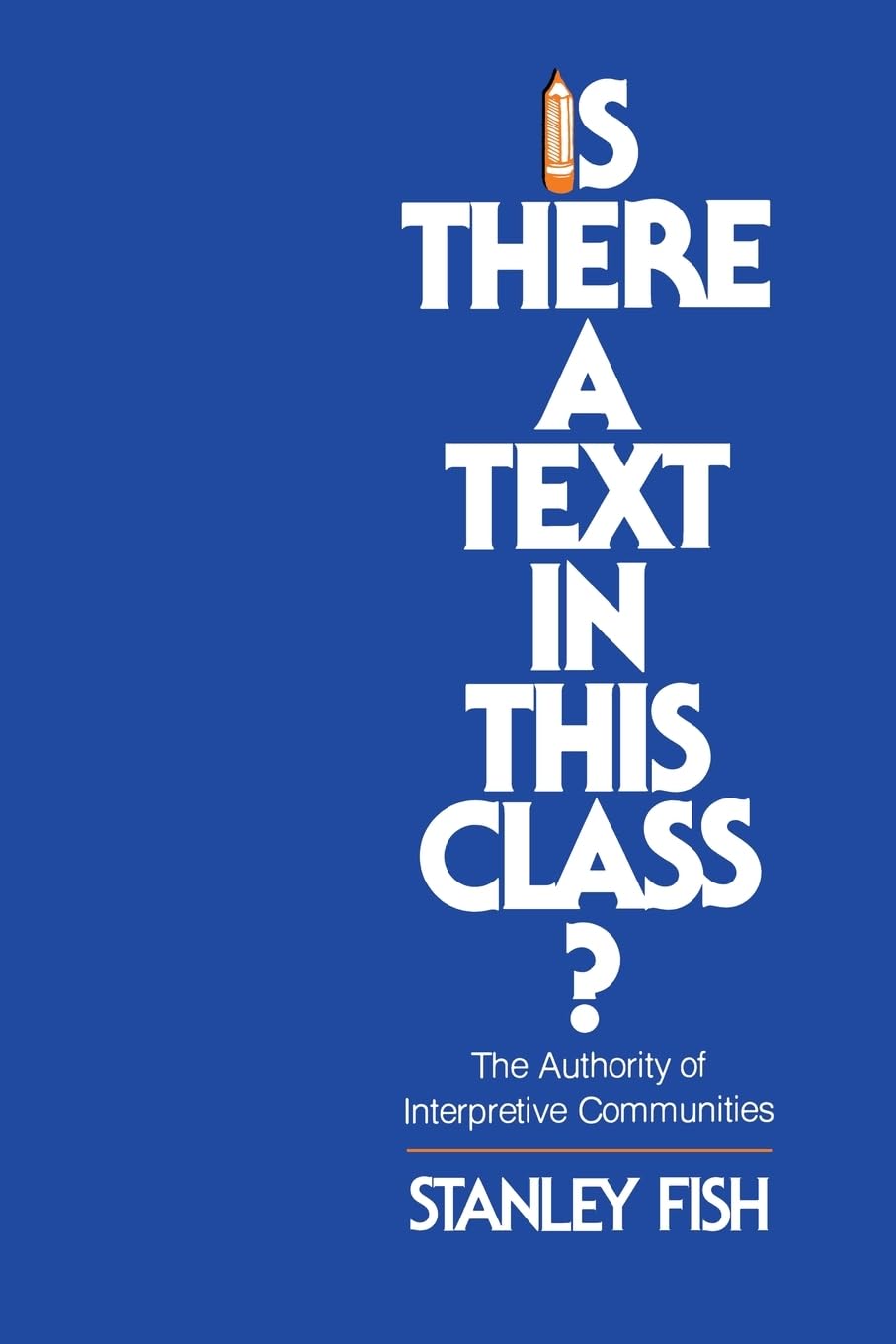
Is There a Text in This Class? The Authority of Interpretive Communities,New
Sold by Ergodebooks, an authorized reseller.
Returns accepted within 30 days | support@ergodebooks.com
Shipping Information
- Free Standard Shipping — United States only
- Processing Time: 3–5 business days
- Estimated Delivery: 6–10 business days after dispatch
- Double-boxed, fully insured & discreetly packaged
- Tracking number sent via email once dispatched
Returns & Refund
Returns accepted within 30 days of delivery.
Damaged or Defective Item
Free return shipping + replacement or full refund
Wrong Item Received
Free return shipping + replacement or full refund
Change of Mind
Return shipping at customer's expense · 25% restocking fee applies
Payment Option

Stanley Fish is one of Americas most stimulating literary theorists. In this book, he undertakes a profound reexamination of some of criticisms most basic assumptions. He penetrates to the core of the modern debate about interpretation, explodes numerous misleading formulations, and offers a stunning proposal for a new way of thinking about the way we read.Fish begins by examining the relation between a reader and a text, arguing against the formalist belief that the text alone is the basic, knowable, neutral, and unchanging component of literary experience. But in arguing for the right of the reader to interpret and in effect create the literary work, he skillfully avoids the old trap of subjectivity. To claim that each reader essentially participates in the making of a poem or novel is not, he shows, an invitation to unchecked subjectivity and to the endless proliferation of competing interpretations. For each reader approaches a literary work not as an isolated individual but as part of a community of readers. Indeed, he writes, it is interpretive communities, rather than either the text or reader, that produce meanings.The book is developmental, not static. Fish at all times reveals the evolutionary aspect of his workthe manner in which he has assumed new positions, altered them, and then moved on. Previously published essays are introduced by headnotes which relate them to the central notion of interpretive communities as it emerges in the final chapters. In the course of refining his theory, Fish includes rather than excludes the thinking of other critics and shows how often they agree with him, even when he and they may appear to be most dramatically at odds. Engaging, lucid, provocative, this book will immediately find its place among the seminal works of modern literary criticism.
⚠️ WARNING (California Proposition 65):
This product may contain chemicals known to the State of California to cause cancer, birth defects, or other reproductive harm.
For more information, please visit www.P65Warnings.ca.gov.