
Title
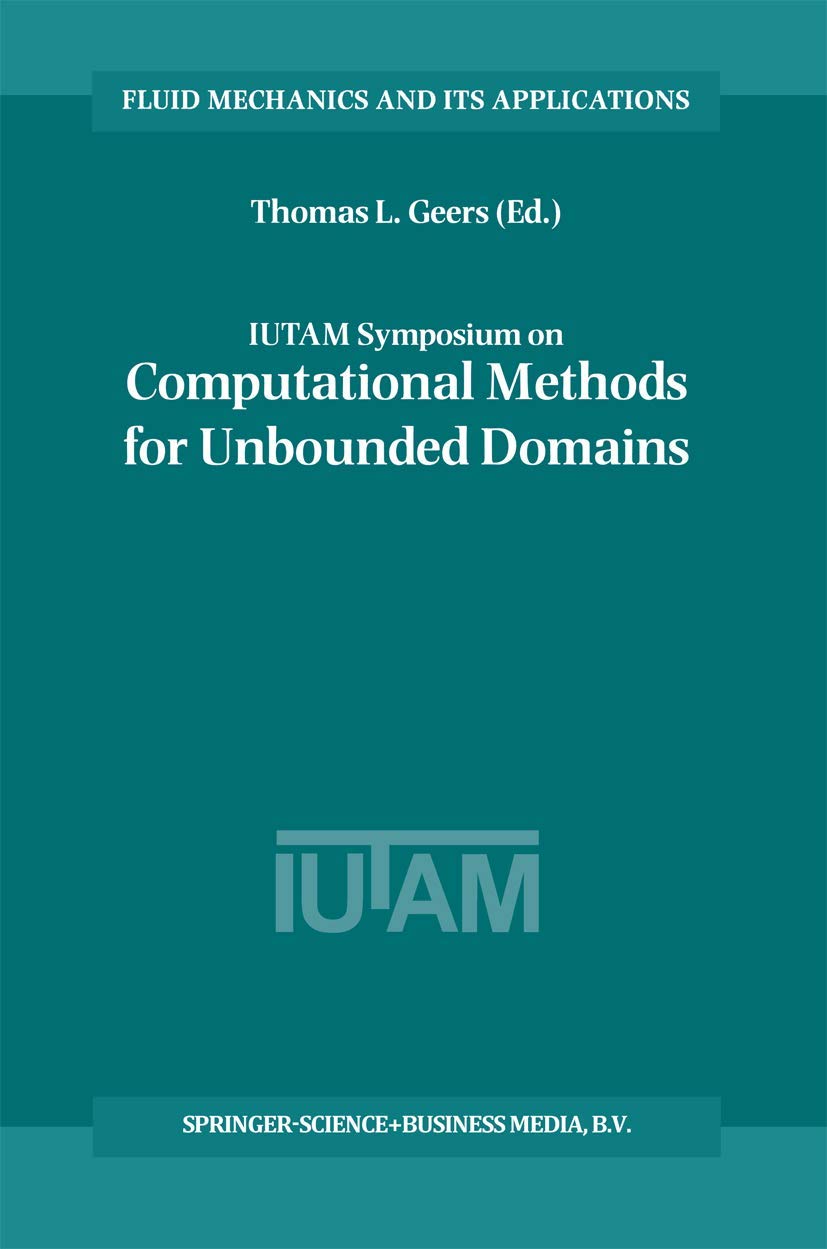
IUTAM Symposium on Computational Methods for Unbounded Domains (Fluid Mechanics and Its Applications, 49),New
Sold by Ergodebooks, an authorized reseller.
Returns accepted within 30 days | support@ergodebooks.com
Shipping Information
- Free Standard Shipping — United States only
- Processing Time: 3–5 business days
- Estimated Delivery: 6–10 business days after dispatch
- Double-boxed, fully insured & discreetly packaged
- Tracking number sent via email once dispatched
Returns & Refund
Returns accepted within 30 days of delivery.
Damaged or Defective Item
Free return shipping + replacement or full refund
Wrong Item Received
Free return shipping + replacement or full refund
Change of Mind
Return shipping at customer's expense · 25% restocking fee applies
Payment Option

During 2731 July 1997, thirtyseven researchers in acoustics, aeronautics, elastodynamics, electromagnetics, hydrodynamics and mathematics participated in a Symposium on Computa tional Methods for Unbounded Domains. The symposium was sponsored by the International Union of Theoretical and Applied Mechanics and was held at the University of Colorado in the United States of America. The symposium was opened by Dr. Richard Byyny, Chancellor of the University's Boulder Campus, who concluded his remarks by reading a letter from Professor Bruno A. Boley, JUT AM Representative on the Scientific Committee. Thirtythree papers were presented. About twothirds of these focused on the classical wave equation of acoustics; however, three papers dealt with hydrodynamic surface waves, two with electromagnetic waves, three with elastodynamic waves, and four with waves in aero dynamics. Approximately twothirds of the papers addressed steadystate problems, with the rest treating problems in the time domain. Extended abstracts of the papers appear in this volume, arranged in alphabetical order according to the last name of the presenting author. A key unifying aspect of the symposium was the creation of four working groups that labored in parallel to formulate benchmark problems for evaluating computational boundaries. The working groups reviewed the papers presented each day, searching for benchmark candidates. Then they considered other possibilites and organized the ensemble into logical categories. At the end of the symposium, each group presented its benchmark candidates to the assembly of participants, which subsequently made a preliminary consolidation of the benchmarks.
⚠️ WARNING (California Proposition 65):
This product may contain chemicals known to the State of California to cause cancer, birth defects, or other reproductive harm.
For more information, please visit www.P65Warnings.ca.gov.