
Title
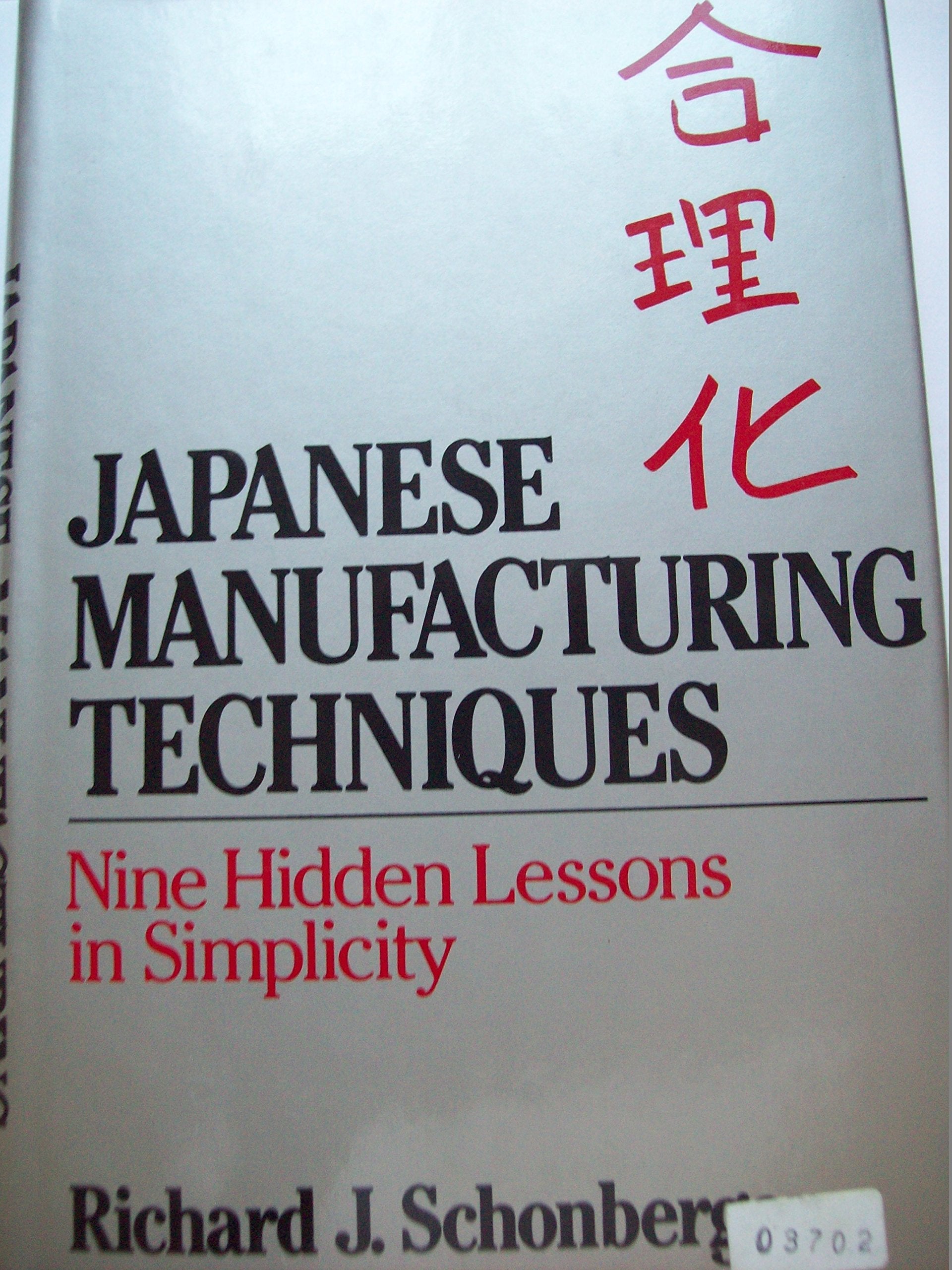
Japanese Manufacturing Techniques: Nine Hidden Lessons in Simplicity,Used
Sold by Ergodebooks, an authorized reseller.
Returns accepted within 30 days | support@ergodebooks.com
Shipping Information
- Free Standard Shipping — United States only
- Processing Time: 3–5 business days
- Estimated Delivery: 6–10 business days after dispatch
- Double-boxed, fully insured & discreetly packaged
- Tracking number sent via email once dispatched
Returns & Refund
Returns accepted within 30 days of delivery.
Damaged or Defective Item
Free return shipping + replacement or full refund
Wrong Item Received
Free return shipping + replacement or full refund
Change of Mind
Return shipping at customer's expense · 25% restocking fee applies
Payment Option

Japanese productivity and quality standards have fired the imagination of American managers, but until now there has been little explanation of how to do it how to apply Japanese methods at the actual operating level of U.S. manufacturing plants. This book shows you how, exposing otherwise wellinformed westernized readers to a new world of management ideas. Author Richard J. Schonberger demonstrates that the Japanese formula for success is based on a number of specific, interrelated techniques stunning in their simplicity and he shows how these techniques can be put to work in American industries today. Here, in a clear, handbook format, are nine "lessons" for American manufacturers, introducing scores of techniques aimed at simplifying the overlycomplex purchasing, inventory, assemblyfine, and qualitycontrol processes of U.S. firms. At the heart of Japanese manufacturing success are two overlapping strategies: "justintime" production and "total quality control." Some American manufacturers already know a little about these methods, but Richard Schonberger provides the most comprehensive description of these techniques available: how they developed, how they all fit together, why they are so potent, and how they "snowball" unleashing a powerful chain reaction of productivity and quality control improvements each time more simplification is introduced. Japanese Manufacturing Techniques will change the way you think. Much of the received wisdom of American management "justincase" order quantities, statistical sampling for quality Control, and large inventory buffer stocks, for example is dismissed by the Japanese as muri, muda, mura: excess, waste, unevenness. In many cases, the Japanese technique is exactly the opposite of American practice ("justintime" ordering, quality control at the source, and elimination of buffer stocks altogether). By emphasizing practical techniques, Schonberger shows how you can implement new methods right away without waiting for government policy or market conditions or worker behavior to change. The techniques themselves will improve your productivity and quality, provide strategic advantages in gaining market share, and transform worker behavior. And the author backs his nine lessons with concrete examples of how Japanese techniques are being applied in U.S. plants today. Nearly 20 tables and figures illustrate the "lessons" given here, and a special appendix describes in full the Toyotadeveloped kanban inventory system, with the first explanation in English of singlecard versus dualcard kanban. This remarkable book carries you beyond theories and concepts. Its for practical managers who want results: better quality control and greater productivity. Implement these simple steps, and you can begin improving your divisions performance now.
⚠️ WARNING (California Proposition 65):
This product may contain chemicals known to the State of California to cause cancer, birth defects, or other reproductive harm.
For more information, please visit www.P65Warnings.ca.gov.
- Q: What is the main focus of 'Japanese Manufacturing Techniques'? A: The book focuses on Japanese productivity and quality standards, offering insights into how American manufacturers can apply these methods to improve their operations.
- Q: Who is the author of this book? A: The author is Richard J. Schonberger, a recognized expert in manufacturing techniques and management.
- Q: What are the key themes discussed in the book? A: Key themes include 'just-in-time' production, total quality control, and techniques for simplifying complex manufacturing processes.
- Q: How many pages does the book contain? A: The book contains 260 pages.
- Q: Is this book suitable for beginners in manufacturing? A: Yes, the book is written in a clear, handbook format, making it accessible for both beginners and experienced professionals in manufacturing.
- Q: What kind of examples does the book provide? A: It includes concrete examples of how Japanese techniques are currently being applied in U.S. manufacturing plants.
- Q: What is the binding type of this book? A: The book is available in hardcover binding.
- Q: When was 'Japanese Manufacturing Techniques' published? A: The book was published on November 1, 1982.
- Q: Are there any visual aids in the book? A: Yes, the book includes nearly 20 tables and figures that illustrate the concepts and techniques discussed.
- Q: What is the significance of the kanban inventory system mentioned in the book? A: The kanban inventory system is a crucial aspect of Japanese manufacturing, and the book provides the first English explanation of both single-card and dual-card kanban systems.