
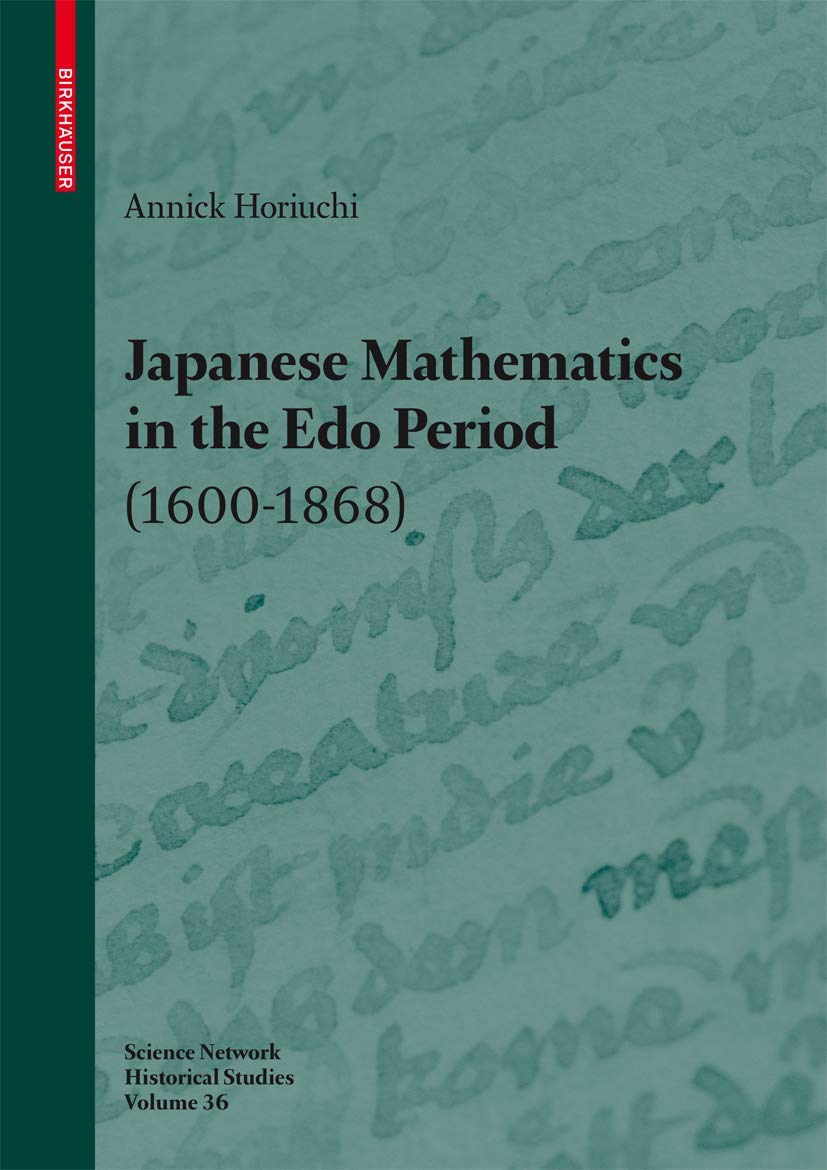
Title


Japanese Mathematics In The Edo Period (16001868): A Study Of The Works Of Seki Takakazu (?1708) And Takebe Katahiro (1664173
Sold by Ergodebooks, an authorized reseller.
Returns accepted within 30 days | support@ergodebooks.com
Shipping Information
- Free Standard Shipping — United States only
- Processing Time: 3–5 business days
- Estimated Delivery: 6–10 business days after dispatch
- Double-boxed, fully insured & discreetly packaged
- Tracking number sent via email once dispatched
Returns & Refund
Returns accepted within 30 days of delivery.
Damaged or Defective Item
Free return shipping + replacement or full refund
Wrong Item Received
Free return shipping + replacement or full refund
Change of Mind
Return shipping at customer's expense · 25% restocking fee applies
Payment Option

The Book Presents The Main Features Of The Wasan Tradition, Which Is The Indigenous Mathematics That Developed In Japan During The Edo Period. (16001868). It Begins With A Description Of The First Mathematical Textbooks Published In The 17Th Century, Then Shifts To The Work Of The Two Leading Mathematicians Of This Tradition, Seki Takakazu And Takebe Katahiro. The Book Provides Substantial Information On The Historical And Intellectual Context, The Role Played By The Chinese Mathematical Treatises Introduced At The Late 16Th Century, And An Analysis Of Sekis And Takebes Contribution To The Development Of Algebra And Calculus In Japan.
⚠️ WARNING (California Proposition 65):
This product may contain chemicals known to the State of California to cause cancer, birth defects, or other reproductive harm.
For more information, please visit www.P65Warnings.ca.gov.
- Q: What is the binding type of this book? A: This book has a hardcover binding. Hardcover books are known for their durability and longevity.
- Q: How many pages does this book contain? A: This book contains three hundred seventy-seven pages. It offers an in-depth exploration of Japanese mathematics.
- Q: What are the dimensions of this book? A: The dimensions of this book are six point two six inches in length, one inch in width, and nine point five inches in height. These measurements make it a manageable size for reading.
- Q: Who is the author of this book? A: The author of this book is Annick Horiuchi. She has extensively studied the historical context of mathematics in Japan.
- Q: What is the main focus of this book? A: The main focus of this book is the study of Japanese mathematics during the Edo period. It specifically examines the works of Seki Takakazu and Takebe Katahiro.
- Q: Is this book suitable for casual readers? A: Yes, this book is suitable for casual readers interested in mathematics and history. It provides valuable insights while being accessible.
- Q: What topics are covered in this book? A: This book covers topics related to wasan mathematics, historical context, and the contributions of notable mathematicians. It situates mathematical achievements within Tokugawa Japan.
- Q: How can I benefit from reading this book? A: You can benefit from reading this book by gaining a deeper understanding of the history of mathematics in Japan. It connects mathematical concepts with their cultural and historical significance.
- Q: What is the recommended reading level for this book? A: This book is recommended for readers with a general interest in history and mathematics. It is suitable for both academic and general audiences.
- Q: How should this book be stored to maintain its condition? A: This book should be stored upright on a shelf away from direct sunlight. Proper storage helps prevent damage to the cover and pages.
- Q: Is there any special care needed for this book? A: No special care is needed, but keeping it in a dry, clean environment is advisable. Avoid exposing it to moisture or extreme temperatures.
- Q: Can I lend this book to others? A: Yes, you can lend this book to others. Just ensure that it is returned in good condition to maintain its quality.
- Q: What if this book arrives damaged? A: If this book arrives damaged, you should contact the seller for a return or exchange. Most sellers have policies for damaged items.
- Q: Is there a warranty for this book? A: No, there is typically no warranty for books. However, return policies may apply depending on the seller.
- Q: What should I do if I have trouble understanding the content? A: If you have trouble understanding the content, consider seeking supplementary materials or discussion groups. Engaging with others can enhance comprehension.
- Q: What makes this book unique compared to others on mathematics? A: This book is unique because it combines mathematical analysis with historical context, focusing on the Edo period's scholars. It provides a distinctive perspective on wasan.