
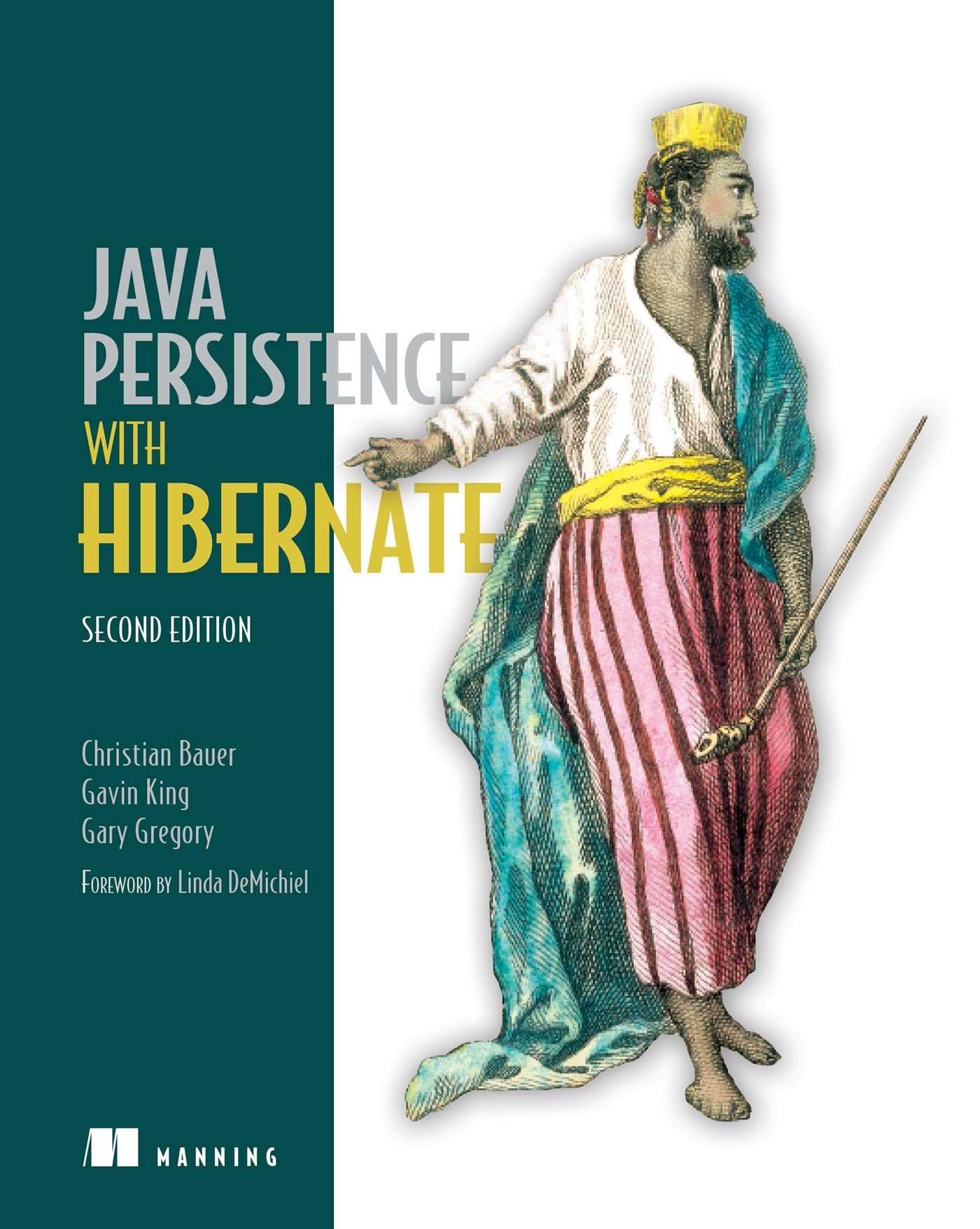
Title
Java Persistence with Hibernate,Used
Sold by Ergodebooks, an authorized reseller.
Returns accepted within 30 days | support@ergodebooks.com
Shipping Information
- Free Standard Shipping — United States only
- Processing Time: 1–3 business days
- Estimated Delivery: 3–5 business days after dispatch
- Double-boxed, fully insured & discreetly packaged
- Tracking number sent via email once dispatched
- Orders over $250 require signature upon delivery. Taxes calculated at checkout.
Returns & Refund
Returns accepted within 30 days of delivery.
Damaged or Defective Item
Free return shipping + replacement or full refund
Wrong Item Received
Free return shipping + replacement or full refund
Change of Mind
Return shipping at customer's expense · 25% restocking fee applies
Payment Option

SummaryJava Persistence with Hibernate, Second Edition explores Hibernate by developing an application that ties together hundreds of individual examples. In this revised edition, authors Christian Bauer, Gavin King, and Gary Gregory cover Hibernate 5 in detail with the Java Persistence 2.1 standard (JSR 338). All examples have been updated for the latest Hibernate and Java EE specification versions.About the TechnologyPurchase of the print book includes a free eBook in PDF, Kindle, and ePub formats from Manning Publications.Persistencethe ability of data to outlive an instance of a programis central to modern applications. Hibernate, the most popular Java persistence tool, offers automatic and transparent object/relational mapping, making it a snap to work with SQL databases in Java applications.About the BookJava Persistence with Hibernate, Second Edition explores Hibernate by developing an application that ties together hundreds of individual examples. You'll immediately dig into the rich programming model of Hibernate, working through mappings, queries, fetching strategies, transactions, conversations, caching, and more. Along the way you'll find a wellillustrated discussion of best practices in database design and optimization techniques. In this revised edition, authors Christian Bauer, Gavin King, and Gary Gregory cover Hibernate 5 in detail with the Java Persistence 2.1 standard (JSR 338). All examples have been updated for the latest Hibernate and Java EE specification versions.What's Inside Object/relational mapping concepts Efficient database application design Comprehensive Hibernate and Java Persistence reference Integration of Java Persistence with EJB, CDI, JSF, and JAXRS * Unmatched breadth and depthAbout the ReaderThe book assumes a working knowledge of Java.About the AuthorsChristian Bauer is a member of the Hibernate developer team and a trainer and consultant. Gavin King is the founder of the Hibernate project and a member of the Java Persistence expert group (JSR 220). Gary Gregory is a principal software engineer working on application servers and legacy integration.Table of Contents PART 1 GETTING STARTED WITH ORM Understanding object/relational persistence Starting a project Domain models and metadata PART 2 MAPPING STRATEGIES Mapping persistent classes Mapping value types Mapping inheritance Mapping collections and entity associations Advanced entity association mappings Complex and legacy schemas PART 3 TRANSACTIONAL DATA PROCESSING Managing data Transactions and concurrency Fetch plans, strategies, and profiles Filtering data PART 4 WRITING QUERIES Creating and executing queries The query languages Advanced query options Customizing SQL
⚠️ WARNING (California Proposition 65):
This product may contain chemicals known to the State of California to cause cancer, birth defects, or other reproductive harm.
For more information, please visit www.P65Warnings.ca.gov.
- Q: What is the main focus of 'Java Persistence with Hibernate'? A: The book primarily explores Hibernate by developing an application with numerous examples, covering Hibernate 5 and the Java Persistence 2.1 standard in detail.
- Q: Who are the authors of this book? A: The authors are Christian Bauer, Gavin King, and Gary Gregory, who are experienced in Hibernate and Java Persistence.
- Q: What topics does the book cover? A: It covers object/relational mapping concepts, efficient database application design, Hibernate reference, and integration with EJB, CDI, JSF, and JAX-RS.
- Q: Is there an eBook included with the print version? A: Yes, the purchase of the print book includes a free eBook in PDF, Kindle, and ePub formats.
- Q: What is the recommended reader's background for this book? A: The book assumes that readers have a working knowledge of Java.
- Q: How many pages does 'Java Persistence with Hibernate' have? A: The book has a total of 610 pages.
- Q: What is the binding type of this book? A: The book is available in paperback binding.
- Q: When was the second edition of this book published? A: The second edition was published on November 8, 2015.
- Q: Does the book contain best practices for database design? A: Yes, it includes a well-illustrated discussion of best practices in database design and optimization.
- Q: What is the edition of this book? A: This book is the second edition.