
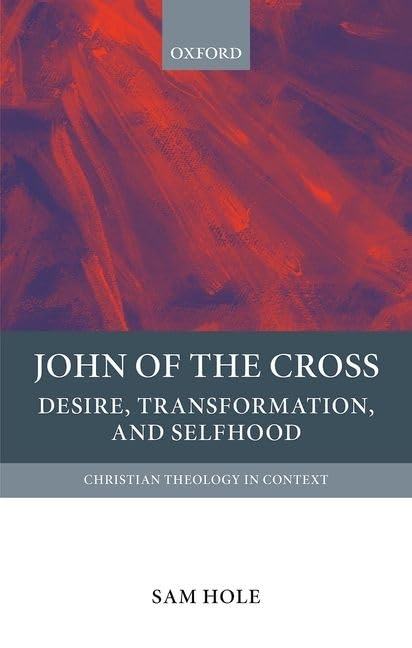
Title
John of the Cross: Desire, Transformation, and Selfhood (Christian Theology in Context),New
Sold by Ergodebooks, an authorized reseller.
Returns accepted within 30 days | support@ergodebooks.com
Shipping Information
- Free Standard Shipping — United States only
- Processing Time: 3–5 business days
- Estimated Delivery: 6–10 business days after dispatch
- Double-boxed, fully insured & discreetly packaged
- Tracking number sent via email once dispatched
Returns & Refund
Returns accepted within 30 days of delivery.
Damaged or Defective Item
Free return shipping + replacement or full refund
Wrong Item Received
Free return shipping + replacement or full refund
Change of Mind
Return shipping at customer's expense · 25% restocking fee applies
Payment Option

Through the 'dark night of the soul' to the depiction of the eroticallycharged union of the soul and God, the poetry and prose works of the Spanish friar John of the Cross (15421591) offer a striking account of the transformation of the individual in the course of the Christian life. John of the Cross: Desire, Transformation, and Selfhood argues that these writings are animated by John's own creative and subtly conceptualized notion of erotic desire. John's understanding of desire has the potential to enrich recent theological discussion of the subject, but it has been curiously neglected in past scholarship. To correct this lacuna, this study undertakes a detailed historical analysis in three parts. Firstly, it attends to the patristic, medieval, and sixteenthcentury Spanish influences on John's writings, showing how John reworks a long tradition of biblical, Christian, and Platonic reflection on the concept. Secondly, it traces the importance of desire through John's writings, demonstrating how he develops the theme through his poetry, his anthropology of the soul, and his account of the spiritual ascent. Thirdly, it explores the reception of his writings in the twentieth century, demonstrating how particular modern philosophical and theological commitments have prevented scholars from recognising the rich and distinctive shape of John's theological vision. John's account of the transformation of the self, with its hopeful vision of the graced transformation of the soul's desires, has significance beyond the constrained modern categories of systematic theology, Christian spirituality, pastoral theology, and mysticismit is a vision that is worthy of recovery today.
⚠️ WARNING (California Proposition 65):
This product may contain chemicals known to the State of California to cause cancer, birth defects, or other reproductive harm.
For more information, please visit www.P65Warnings.ca.gov.