
Title
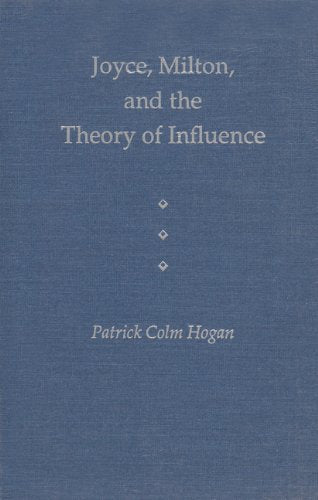
Joyce, Milton, and the Theory of Influence (The Florida James Joyce Series),Used
Sold by Ergodebooks, an authorized reseller.
Returns accepted within 30 days | support@ergodebooks.com
Shipping Information
- Free Standard Shipping — United States only
- Processing Time: 3–5 business days
- Estimated Delivery: 6–10 business days after dispatch
- Double-boxed, fully insured & discreetly packaged
- Tracking number sent via email once dispatched
Returns & Refund
Returns accepted within 30 days of delivery.
Damaged or Defective Item
Free return shipping + replacement or full refund
Wrong Item Received
Free return shipping + replacement or full refund
Change of Mind
Return shipping at customer's expense · 25% restocking fee applies
Payment Option

From the Foreword:'[Hogan's] fresh approach to the often tenuous aspects of literary influence provides him with a tool with which to view both Milton and Joyce anew, and in the process offers literary critics a theoretical method that can be extended to other authors as well.''Fully examines the relationship between these two giants; it also provocatively sketches a sophisticated theory of literary influence that avoids the Freudian pitfalls of Bloom on the one hand and the gassy tenuousness of poststructuralist intertextuality on the other. Hogan is a gifted writer with a lively and engaging prose style.'R. B. Kershner, University of FloridaPatrick Hogan examines the complex and conflicted relation of James Joyce's worksprimarily the epic novels Ulysses and Finnegans Waketo one of the most important and influential epics in English, Milton's Paradise Lost, and to other Milton works.Though Stephen Dedalus expresses his poetic ambition as 'rewriting Paradise Lost,' though he teaches 'Lycidas,' and though Milton is amply present in Finnegans Wake, virtually nothing has been written on this important literary relationship. Hogan traces the deep structural affinities that link the writers, arguing that Milton provided a crucial model for Joyce to create his great 'works of mourning,' Ulysses and Finnegans Wake.In addition, Hogan sets the novels in a larger tradition of European and Middle Eastern retellings of the fall of humankind, including eighteenth and nineteenthcentury revisions of Paradise Lost. From this perspective, he analyzes the structure and technique of Ulysses and of Finnegans Wake and interprets key passages in a way that helps make these works comprehensible even to a novice reader.As part of his study Hogan draws on psychoanalysis, cognitive science, Sanskrit aesthetics, and cultural materialism to formulate a theory of influence with implications that reach beyond the study of Joyce and Milton.Patrick Colm Hogan is associate professor of English and associate head of the Department of English at the University of Connecticut. He is the author of The Politics of Interpretation: Ideology, Professionalism, and the Study of Literature and On Interpretation: Meaning and Inference in Law, Psychoanalysis, and Literature, and the coeditor of Criticism and Lacan: Essays and Dialogue on Language, Structure, and the Unconscious, and Literary India: Comparative Studies in Aesthetics, Colonialism, and Culture.
⚠️ WARNING (California Proposition 65):
This product may contain chemicals known to the State of California to cause cancer, birth defects, or other reproductive harm.
For more information, please visit www.P65Warnings.ca.gov.