If you have any questions, you are always welcome to contact us. We'll get back to you as soon as possible, withing 24 hours on weekdays.
Customer service
All questions about your order, return and delivery must be sent to our customer service team by e-mail at yourstore@yourdomain.com
Sale & Press
If you are interested in selling our products, need more information about our brand or wish to make a collaboration, please contact us at press@yourdomain.com
Help
If you have any questions, you are always welcome to contact us. We'll get back to you as soon as possible, withing 24 hours on weekdays.
Customer service
All questions about your order, return and delivery must be sent to our customer service team by e-mail at yourstore@yourdomain.com
Sale & Press
If you are interested in selling our products, need more information about our brand or wish to make a collaboration, please contact us at press@yourdomain.com
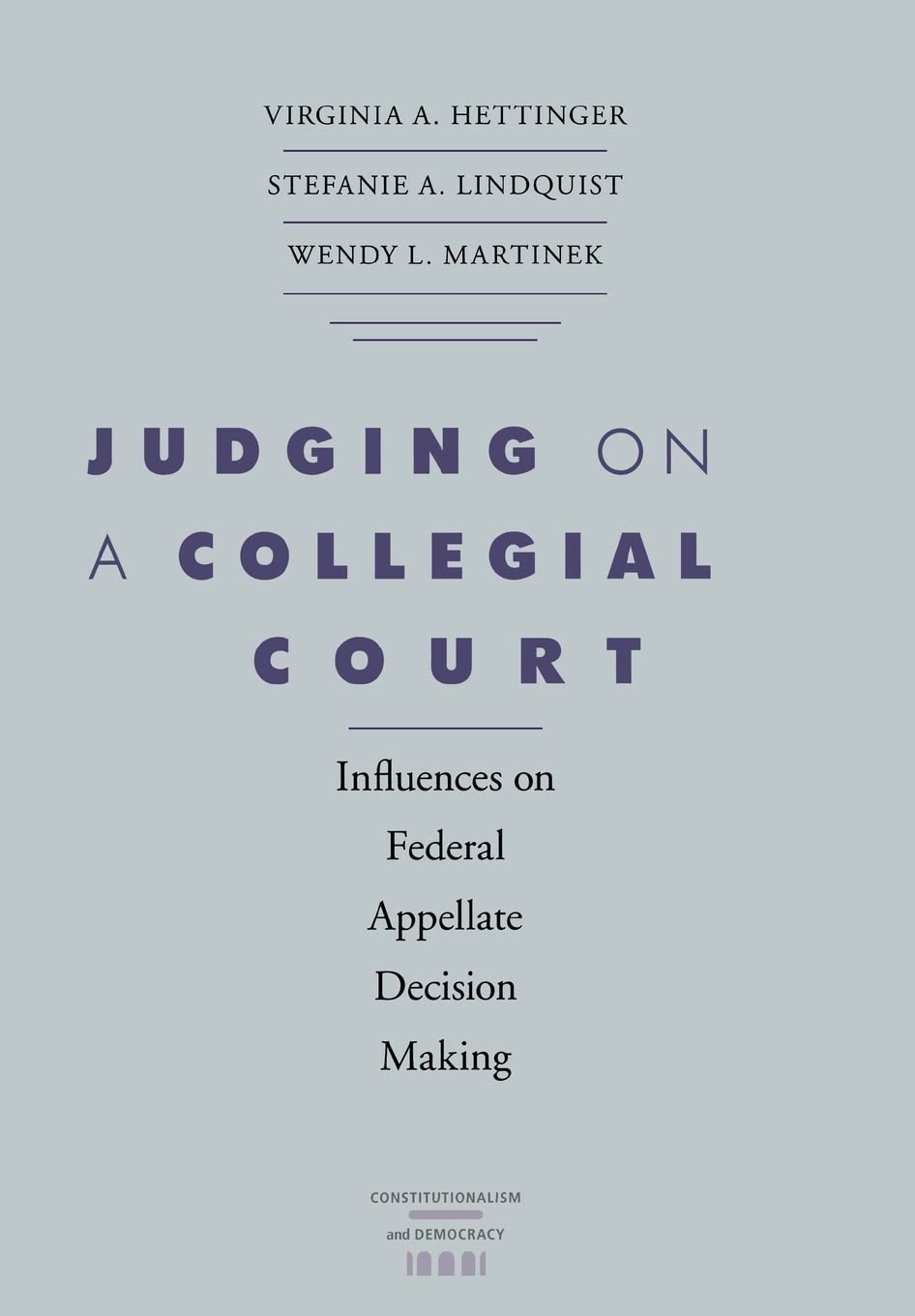
in the professional world as a starting point for collaboration; rather than leaving decisions to just one person, dissent offers the opportunity to rethink or reinvent an idea, leading, one hopes, to a better result. When dissensus occurs in a federal court, however, it raises the question of whether this difference of opinion maintains the integrity of the judiciary or undermines its legitimacy. In Judging on a Collegial Court: Influences on Federal Appellate Decision Making, Virginia Hettinger, Stefanie Lindquist, and Wendy Martinek examine the dynamic that gives rise to such dissensus in federal appeals courts, revealing how the appellate process shapes the content and the consistency of the law.The authors examine horizontal dissensus in the minority of cases in which there are dissenting or concurringas opposed to unanimousopinions. Primarily investigating why judges on the appeals courts agree or disagree with one another regarding the outcomes of the cases before them, the authors also examine vertical dissensus and ask why judges affirm or reverse lower court judges whose cases are decided on appeal. Focusing on the behavioral aspects of disagreement within a panel and between the levels of the federal judicial hierarchy, the authors reveal the impact of individual attitudes or preferences on judicial decisionmaking, and hence on political divisions in the broader society.
⚠️ WARNING (California Proposition 65):
This product may contain chemicals known to the State of California to cause cancer,
birth defects, or other reproductive harm.
For MAP (Minimum Advertised Price) violations and Intellectual Property (IP) or Trademark concerns, please contact:
support@ergodebooks.com
⚠️ California Proposition 65 Warning: Some products sold on this website may expose you to chemicals known to the State of California to cause cancer, birth defects, or other reproductive harm. For more information, visit www.P65Warnings.ca.gov.