
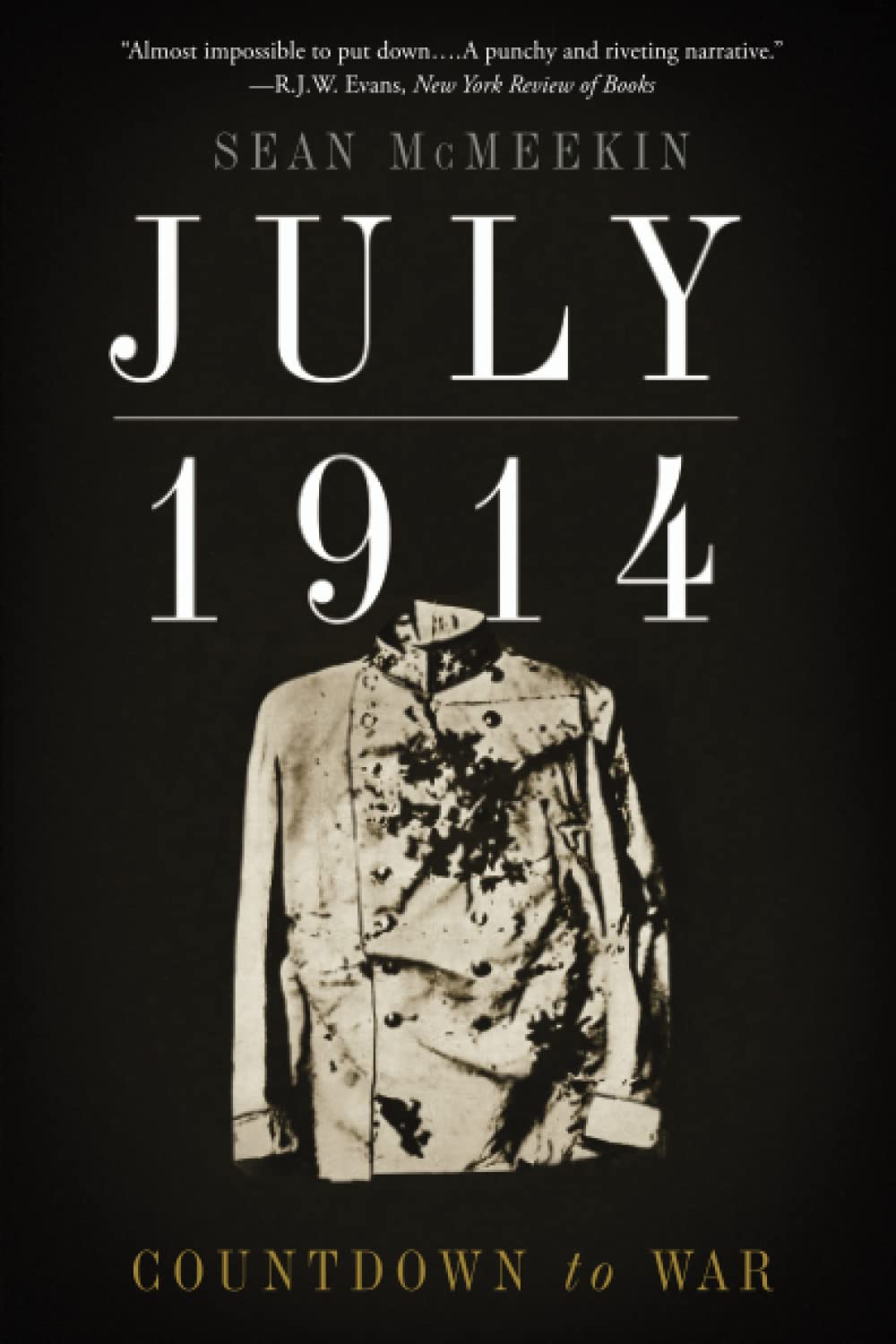
Title
July, 1914,Used
Sold by Ergodebooks, an authorized reseller.
Returns accepted within 30 days | support@ergodebooks.com
Shipping Information
- Free Standard Shipping — United States only
- Processing Time: 3–5 business days
- Estimated Delivery: 6–10 business days after dispatch
- Double-boxed, fully insured & discreetly packaged
- Tracking number sent via email once dispatched
Returns & Refund
Returns accepted within 30 days of delivery.
Damaged or Defective Item
Free return shipping + replacement or full refund
Wrong Item Received
Free return shipping + replacement or full refund
Change of Mind
Return shipping at customer's expense · 25% restocking fee applies
Payment Option

When a Serbianbacked assassin gunned down Archduke Franz Ferdinand in late June 1914, the world seemed unmoved. Even Ferdinand's own uncle, Franz Josef I, was notably ambivalent about the death of the Hapsburg heir, saying simply, 'It is God's will.' Certainly, there was nothing to suggest that the episode would lead to conflict much less a world war of such massive and horrific proportions that it would fundamentally reshape the course of human events.As acclaimed historian Sean McMeekin reveals in July 1914, World War I might have been avoided entirely had it not been for a small group of statesmen who, in the month after the assassination, plotted to use Ferdinand's murder as the trigger for a longawaited showdown in Europe. The primary culprits, moreover, have long escaped blame. While most accounts of the war's outbreak place the bulk of responsibility on German and AustroHungarian militarism, McMeekin draws on surprising new evidence from archives across Europe to show that the worst offenders were actually to be found in Russia and France, whose belligerence and duplicity ensured that war was inevitable.Whether they plotted for war or rode the whirlwind nearly blind, each of the men involved from Austrian Foreign Minister Leopold von Berchtold and German Chancellor Bethmann Hollweg to Russian Foreign Minister Sergei Sazonov and French president Raymond Poincar sought to capitalize on the fallout from Ferdinand's murder, unwittingly leading Europe toward the greatest cataclysm it had ever seen.A revolutionary account of the genesis of World War I, July 1914 tells the gripping story of Europe's countdown to war from the bloody opening act on June 28th to Britain's final plunge on August 4th, showing how a single month and a handful of men changed the course of the twentieth century.
⚠️ WARNING (California Proposition 65):
This product may contain chemicals known to the State of California to cause cancer, birth defects, or other reproductive harm.
For more information, please visit www.P65Warnings.ca.gov.
- Q: What is the main theme of 'July, 1914'? A: 'July, 1914' explores how a single assassination set off a chain reaction that led to World War I, highlighting the actions of statesmen from various countries and their roles in escalating tensions.
- Q: Who is the author of 'July, 1914'? A: The book is authored by Sean McMeekin, a historian known for his detailed analysis of World War I.
- Q: What type of binding does 'July, 1914' have? A: 'July, 1914' is available in paperback binding, making it suitable for comfortable reading.
- Q: How many pages are in 'July, 1914'? A: 'July, 1914' consists of 481 pages, providing an in-depth examination of the events leading up to World War I.
- Q: When was 'July, 1914' published? A: 'July, 1914' was published on April 29, 2014, and is a reprint edition.
- Q: What can I learn from 'July, 1914'? A: Readers can gain insights into the geopolitical dynamics of early 20th-century Europe and how miscalculations by key figures contributed to the outbreak of a global conflict.
- Q: Is 'July, 1914' suitable for academic study? A: 'July, 1914' is well-researched and includes new archival evidence, making it suitable for academic study as well as general interest.
- Q: What are some key features of 'July, 1914'? A: Key features of 'July, 1914' include a comprehensive narrative of events, analysis of various historical figures, and a unique perspective on the causes of World War I.
- Q: Is 'July, 1914' a fiction or non-fiction book? A: 'July, 1914' is a non-fiction book that provides a historical account of the events leading to World War I.
- Q: Can 'July, 1914' be read as a standalone book? A: Yes, 'July, 1914' can be read independently as it focuses on a specific historical moment, though it may benefit from some background knowledge of World War I.