If you have any questions, you are always welcome to contact us. We'll get back to you as soon as possible, withing 24 hours on weekdays.
Customer service
All questions about your order, return and delivery must be sent to our customer service team by e-mail at yourstore@yourdomain.com
Sale & Press
If you are interested in selling our products, need more information about our brand or wish to make a collaboration, please contact us at press@yourdomain.com
Help
If you have any questions, you are always welcome to contact us. We'll get back to you as soon as possible, withing 24 hours on weekdays.
Customer service
All questions about your order, return and delivery must be sent to our customer service team by e-mail at yourstore@yourdomain.com
Sale & Press
If you are interested in selling our products, need more information about our brand or wish to make a collaboration, please contact us at press@yourdomain.com
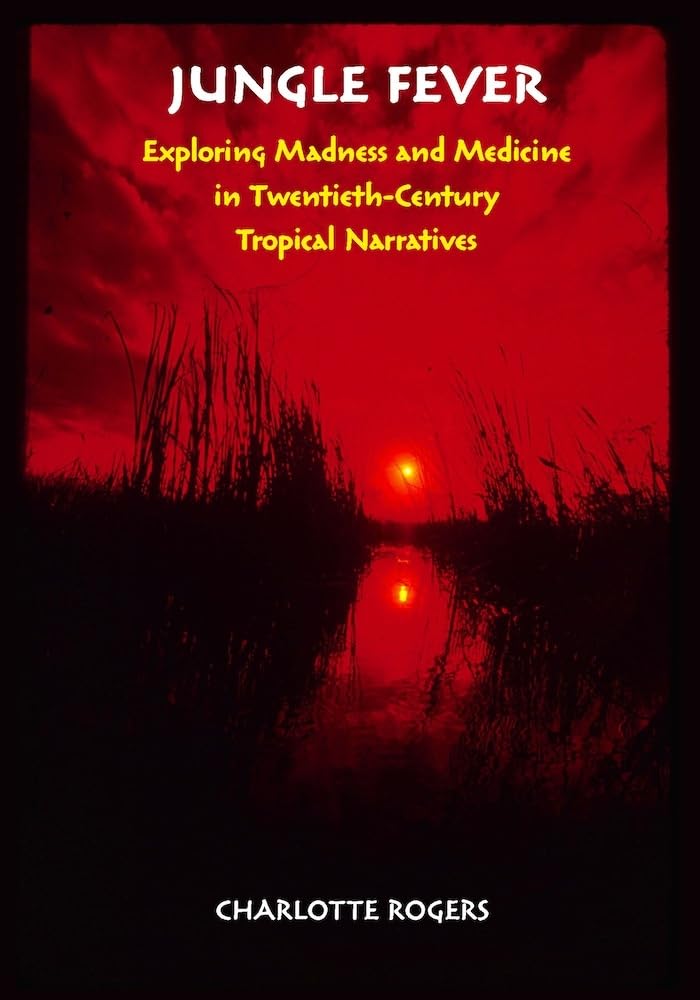
The sinister "jungle"that illdefined and amorphous place where civilization has no foothold and survival is always in doubtis the terrifying setting for countless works of the imagination. Films like Apocalypse Now, television shows like Lost, and of course stories like Heart of Darkness all pursue the essential question of why the unknown world terrifies adventurer and spectator alike. In Jungle Fever, Charlotte Rogers goes deep into five books that first defined the jungle as a violent and maddening place. The reader finds urban explorers venturing into the wilderness, encountering and living among the "native" inhabitants, and eventually losing their minds.The canonical works of authors such as Joseph Conrad, Andre Malraux, Jose Eustasio Rivera, and others present jungles and wildernesses as fundamentally corrupting and dangerous. Rogers explores how the methods these authors use to communicate the physical and psychological maladies that afflict their characters evolved symbiotically with modern medicine. While the wilderness challenges Conrad's and Malraux's European travelers to question their civility and mental stability, Latin American authors such as Alejo Carpentier deftly turn pseudoscientific theories into their greatest asset, as their characters transform madness into an essential creative spark.Ultimately, Jungle Fever suggests that the greatest horror of the jungle is the unknown regions of the character's own mind.
⚠️ WARNING (California Proposition 65):
This product may contain chemicals known to the State of California to cause cancer,
birth defects, or other reproductive harm.
For MAP (Minimum Advertised Price) violations and Intellectual Property (IP) or Trademark concerns, please contact:
support@ergodebooks.com
⚠️ California Proposition 65 Warning: Some products sold on this website may expose you to chemicals known to the State of California to cause cancer, birth defects, or other reproductive harm. For more information, visit www.P65Warnings.ca.gov.