
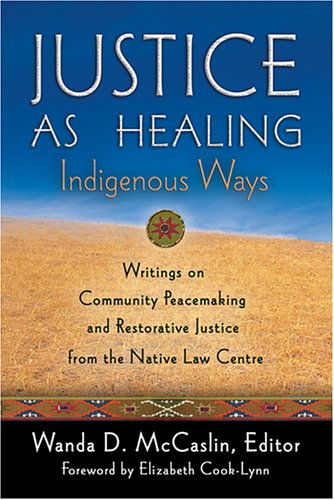
Title
Justice As Healing: Indigenous Ways,New
Sold by Ergodebooks, an authorized reseller.
Returns accepted within 30 days | support@ergodebooks.com
Shipping Information
- Free Standard Shipping — United States only
- Processing Time: 3–5 business days
- Estimated Delivery: 6–10 business days after dispatch
- Double-boxed, fully insured & discreetly packaged
- Tracking number sent via email once dispatched
Returns & Refund
Returns accepted within 30 days of delivery.
Damaged or Defective Item
Free return shipping + replacement or full refund
Wrong Item Received
Free return shipping + replacement or full refund
Change of Mind
Return shipping at customer's expense · 25% restocking fee applies
Payment Option

Restorative justice traces its roots to Indigenous traditions worldwide, yet few books in the field present Indigenous voices speaking directly about Native ways of responding to harms. Justice As Healing: Indigenous Ways does just that. It is a collection of articles from the Justice As Healing newsletter produced by the Native Law Centre of Canada at the University of Saskatchewan. Drawing on a decade of Native writing on restorative justice and on communitybased, healing responses to conflicts and crimes, this substantive book features fortyfive articles from community members, scholars, judges, lawyers, and Elders, most of whom are Indigenous.Some of the featured contributors include:S James Anaya, professor of Human Rights Law and Policy at the University of Arizona and Associate Justice for the Court of Appeals of the YavapaiPrescott Indian TribeEdward Benton Banai, Wisconsin Ojibway of the Fish Clan and a spiritual teacher of the Lac Court Orielles Band of the Ojibway TribeGeorge Blue Bird, Lakota language speaker, writer and artistWilliam Commanda, traditional Algonquin Elder from Kitigan Zibi, Quebec and respected spokesperson and spiritual leader at national and international gatheringsEricaIrene A. Daes, a Greek, chair of the United Nations Working Group on Indigenous PopulationsJames Sakej Youngblood Henderson, Chickasaw, a leading tribal philosopher, advocate, and strategist for North American Native PeoplesBria Huculak, Provincial Court Judge of SaskatchewanAda Pecos Melton, enrolled member of the Pueblo of Jemez in New Mexico, president of the American Indian Development AssociatesTed Moses, Grand Chief of the Grand Council of the Crees and former Cree Ambassador to the United NationsNin Tomas, a senior Maori academic and member of the faculty of law at the University of AucklandEdward C. Valandra, Sincangu Lakota, author and assistant professor in the Native Studies department at the University of California DavisChief Justice Robert Yazzie (retired) of the Supreme Court of the Navaho Nation
⚠️ WARNING (California Proposition 65):
This product may contain chemicals known to the State of California to cause cancer, birth defects, or other reproductive harm.
For more information, please visit www.P65Warnings.ca.gov.
- Q: What is the main focus of 'Justice As Healing: Indigenous Ways'? A: The book focuses on restorative justice through Indigenous perspectives, presenting articles that highlight Native responses to harm and conflict.
- Q: Who are some of the contributors to this book? A: Contributors include notable figures such as S James Anaya, Edward Benton Banai, and Chief Justice Robert Yazzie, among others, many of whom are Indigenous.
- Q: How many pages does 'Justice As Healing: Indigenous Ways' have? A: The book contains a total of 458 pages.
- Q: What type of binding does this book have? A: This book is available in paperback binding.
- Q: In what condition is this book sold? A: The book is sold as 'New', ensuring it is in excellent condition for readers.
- Q: When was 'Justice As Healing: Indigenous Ways' published? A: The book was published on January 1, 2005.
- Q: What category does this book fall under? A: It falls under the category 'Customs & Traditions', focusing on Indigenous approaches to justice.
- Q: Is there a specific author for this book? A: Yes, the book is authored by Wanda D. McCaslin.
- Q: What is the significance of the book's content? A: The book's content is significant as it showcases Indigenous voices and provides insights into community-based healing practices through restorative justice.
- Q: Can this book be used for academic purposes? A: Yes, the book is suitable for academic study, particularly for those interested in law, Indigenous studies, and restorative justice.