
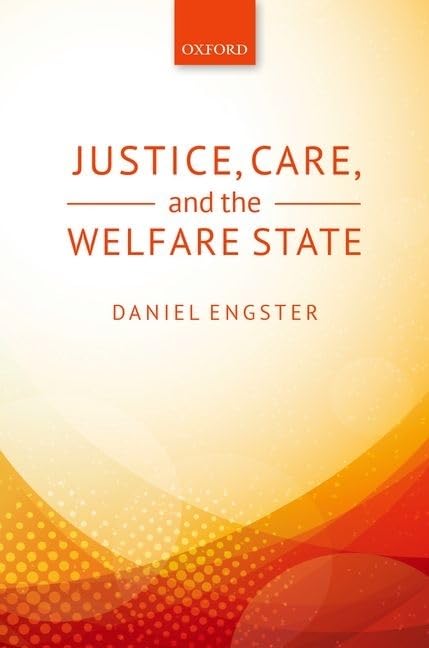
Title
Justice, Care, and the Welfare State,Used
Sold by Ergodebooks, an authorized reseller.
Returns accepted within 30 days | support@ergodebooks.com
Shipping Information
- Free Standard Shipping — United States only
- Processing Time: 3–5 business days
- Estimated Delivery: 6–10 business days after dispatch
- Double-boxed, fully insured & discreetly packaged
- Tracking number sent via email once dispatched
Returns & Refund
Returns accepted within 30 days of delivery.
Damaged or Defective Item
Free return shipping + replacement or full refund
Wrong Item Received
Free return shipping + replacement or full refund
Change of Mind
Return shipping at customer's expense · 25% restocking fee applies
Payment Option

Western welfare states are in a period of significant transition. Changes in the nature of work and the family, the growing elderly population, and other developments over the past fifty years have rendered existing welfare policies largely outofstep with economic and social conditions. While welfare state reform clearly raises important questions about justice and social policy, political philosophers have been slow to address it.Justice, Care, and the Welfare State takes up the important task of developing a theory of justice to guide contemporary welfare state reform. Applying normative political philosophy to public policy issues, it addresses questions such as: What role, if any, should states play in supporting families? Should the state support national health care and, if so, why and in what form? What does society owe to the elderly? What role should welfare states play in supporting disabled people? What obligations does the state have toward the poor?As distinct from many works of political philosophy, Justice, Care, and the Welfare State draws on empirical data about the populations and circumstances of existing Western societies and offers concrete policy advice for reforming welfare policies. Noting that many of the challenges confronting people in postindustrial societies involve issues of care, Engster draws on a public ethics of care to develop his theory of welfare state justice, outlining specific policy proposals in the areas of the family, education, health care, old age pensions and longterm care, disability, and poverty and unemployment.The book offers important insights into how Western welfare states can be reformed in light of recent economic and social changes in order better to promote justice. It should be of interest to political philosophers, welfare state scholars, public policy analysts, and others interested in thinking about contemporary policy reform and justice.
⚠️ WARNING (California Proposition 65):
This product may contain chemicals known to the State of California to cause cancer, birth defects, or other reproductive harm.
For more information, please visit www.P65Warnings.ca.gov.