
Title
Kabuki Dancer,Used
Sold by Ergodebooks, an authorized reseller.
Returns accepted within 30 days | support@ergodebooks.com
Shipping Information
- Free Standard Shipping — United States only
- Processing Time: 3–5 business days
- Estimated Delivery: 6–10 business days after dispatch
- Double-boxed, fully insured & discreetly packaged
- Tracking number sent via email once dispatched
Returns & Refund
Returns accepted within 30 days of delivery.
Damaged or Defective Item
Free return shipping + replacement or full refund
Wrong Item Received
Free return shipping + replacement or full refund
Change of Mind
Return shipping at customer's expense · 25% restocking fee applies
Payment Option

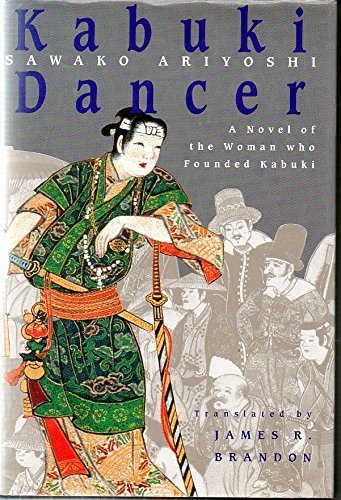
To be kabuki in Japan once meant to be outrageous, daring, flaunting convention. It was in sixteenthcentury Japan, as Shakespeare was writing his masterworks half a world away, that the spirit of Kabuki theater was born out of a single woman's passions and dedication to her art. In Kabuki Dancer, the popular Japanese novelist Sawako Ariyoshi (The Doctor's Wife, The River Ki, The Twilight Years) retells the story of Okuni, the legendary temple dancer who first performed among jugglers and freak shows on a stage along the riverbank in the heart of the Imperial city of Kyoto. Blending the rhythms and movements of religious festivals with the words of popular love songs she and her troupe became sensations. Their affairs and rivalries, infatuations and jealousies, were transformed into the very fabric of their performance, as it began its evolution into the classic drama of today. Against a backdrop of civil war, dynastic conflict, and social turmoil, Okuni and her companions and lovers, together with their audience of artisans, merchants, and aristocrats, struggled to survive the birth pangs of a glorious yet sometimes deadly new age. Based on fact, transmuted into powerful and moving artistic expression, Kabuki Dancer is at once a turbulent love story, a recreation of an exotic and colorful historical period, and an almost mythic representation of the miraculous moment in which an immortal artform appears.
⚠️ WARNING (California Proposition 65):
This product may contain chemicals known to the State of California to cause cancer, birth defects, or other reproductive harm.
For more information, please visit www.P65Warnings.ca.gov.
- Q: What is the main theme of 'Kabuki Dancer'? A: 'Kabuki Dancer' explores the life of Okuni, a legendary temple dancer in Japan, highlighting her struggles and triumphs during a transformative period in Japanese theater.
- Q: Who is the author of 'Kabuki Dancer'? A: The book is written by Sawako Ariyoshi, a notable Japanese novelist known for her works that delve into historical and cultural narratives.
- Q: What is the publication date of 'Kabuki Dancer'? A: 'Kabuki Dancer' was published on January 1, 1994.
- Q: Is 'Kabuki Dancer' a hardcover edition? A: Yes, 'Kabuki Dancer' is available in hardcover binding.
- Q: How many pages does 'Kabuki Dancer' have? A: 'Kabuki Dancer' contains 348 pages.
- Q: What are the key features of 'Kabuki Dancer'? A: The key features include being a used book in good condition, offering a deep narrative of Kabuki theater's origins and an engaging historical backdrop.
- Q: What genre does 'Kabuki Dancer' belong to? A: 'Kabuki Dancer' falls under the genre of Literature & Fiction, specifically focusing on historical fiction.
- Q: Is 'Kabuki Dancer' suitable for readers interested in Japanese culture? A: Yes, 'Kabuki Dancer' provides rich insights into Japanese culture, particularly the art of Kabuki theater and its historical context.
- Q: What can readers expect from the storyline of 'Kabuki Dancer'? A: Readers can expect an engaging blend of a turbulent love story and a depiction of the vibrant yet challenging cultural landscape of 16th-century Japan.
- Q: Is 'Kabuki Dancer' based on real events? A: 'Kabuki Dancer' is based on factual events, particularly the life of Okuni, transforming historical facts into a compelling narrative.