
Title
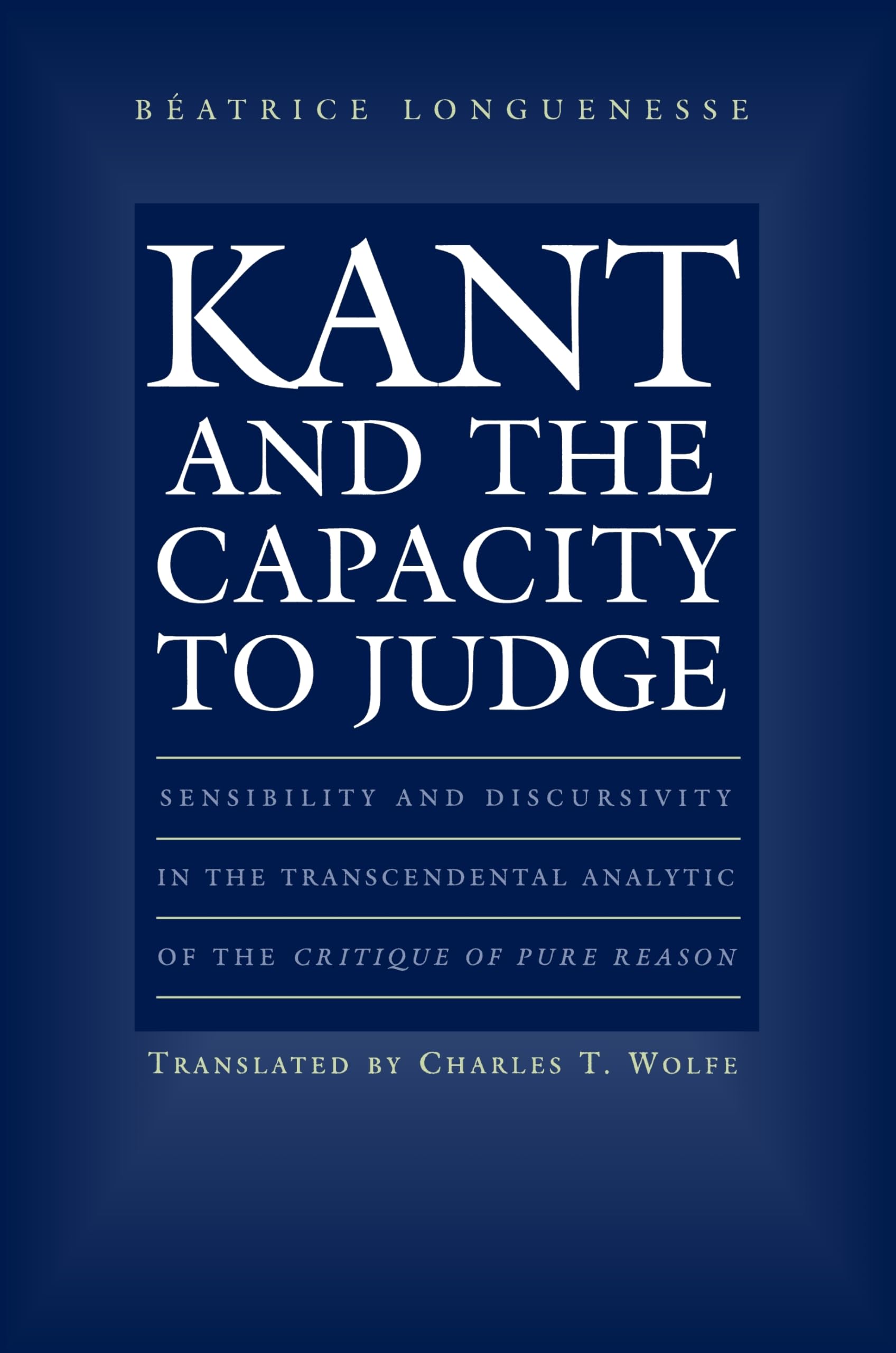
Kant And The Capacity To Judge: Sensibility And Discursivity In The Transcendental Analytic Of The Critique Of Pure Reason,Used
Sold by Ergodebooks, an authorized reseller.
Returns accepted within 30 days | support@ergodebooks.com
Shipping Information
- Free Standard Shipping — United States only
- Processing Time: 3–5 business days
- Estimated Delivery: 6–10 business days after dispatch
- Double-boxed, fully insured & discreetly packaged
- Tracking number sent via email once dispatched
Returns & Refund
Returns accepted within 30 days of delivery.
Damaged or Defective Item
Free return shipping + replacement or full refund
Wrong Item Received
Free return shipping + replacement or full refund
Change of Mind
Return shipping at customer's expense · 25% restocking fee applies
Payment Option

Kant claims to have established his table of categories or 'pure concepts of the understanding' according to the 'guiding thread' provided by logical forms of judgment. By drawing extensively on Kant's logical writings, Batrice Longuenesse analyzes this controversial claim, and then follows the thread through its continuation in the transcendental deduction of the categories, the transcendental schemata, and the principles of pure understanding. The result is a systematic, persuasive new interpretation of the Critique of Pure Reason.Longuenesse shows that although Kant adopts his inventory of the forms of judgment from logic textbooks of his time, he is nevertheless original in selecting just those forms he holds to be indispensable to our ability to relate representations to objects. Kant gives formal representation to this relation between conceptual thought and its objects by introducing the term 'x' into his analysis of logical forms to stand for the object that is 'thought under' the concepts that are combined in judgment. This 'x' plays no role in Kant's forms of logical inference, but instead plays a role in clarifying the relation between logical forms (forms of concept subordination) and combinations ('syntheses') of perceptual data, necessary for empirical cognition.Considering Kant's logical forms of judgment thus helps illuminate crucial aspects of the Transcendental Analytic as a whole, while revealing the systematic unity between Kant's theory of judgment in the first Critique and his analysis of 'merely reflective' (aesthetic and teleological) judgments in the third Critique.
⚠️ WARNING (California Proposition 65):
This product may contain chemicals known to the State of California to cause cancer, birth defects, or other reproductive harm.
For more information, please visit www.P65Warnings.ca.gov.