If you have any questions, you are always welcome to contact us. We'll get back to you as soon as possible, withing 24 hours on weekdays.
Customer service
All questions about your order, return and delivery must be sent to our customer service team by e-mail at yourstore@yourdomain.com
Sale & Press
If you are interested in selling our products, need more information about our brand or wish to make a collaboration, please contact us at press@yourdomain.com
Help
If you have any questions, you are always welcome to contact us. We'll get back to you as soon as possible, withing 24 hours on weekdays.
Customer service
All questions about your order, return and delivery must be sent to our customer service team by e-mail at yourstore@yourdomain.com
Sale & Press
If you are interested in selling our products, need more information about our brand or wish to make a collaboration, please contact us at press@yourdomain.com
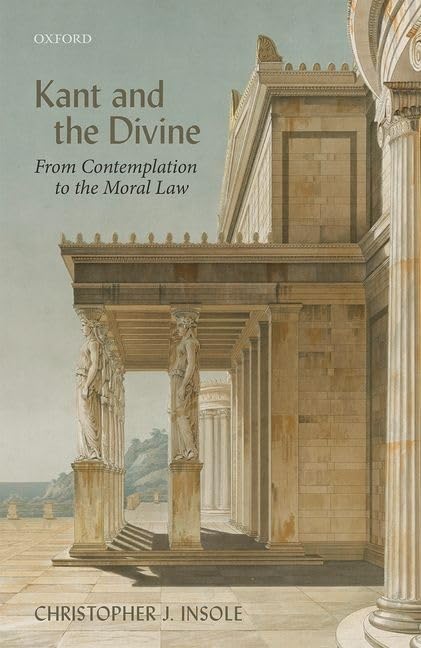
The book offers a definitive study of the development of Kant's conception of the highest good, from his earliest work, to his dying days. Insole argues that Kant believes in God, but that Kant is not a Christian, and that this opens up an important and neglected dimension of Western Philosophy.Kant is not a Christian, because he cannot accept Christianity's traditional claims about the relationship between divine action, grace, human freedom and happiness. Christian theologians who continue to affirm these traditional claims (and many do), therefore have grounds to be suspicious of Kant as an interpreter of Christian doctrine.As well as setting out a theological critique of Kant, Insole offers a new defence of the power, beauty, and internal coherence of Kant's nonChristian philosophical religiosity, 'within the limits of reason alone', which reason itself has some divine features. This neglected strand of philosophical religiosity deserves to be engaged with by both philosophers, and theologians. The Kant revealed in this book reminds us of a perennial task of philosophy, going back to Plato, where philosophy is construed as a way of life, oriented towards happiness, achieved through a properly expansive conception of reason and happiness. When we understand this philosophical religiosity, many standard 'problems' in the interpretation of Kant can be seen in a new light, and resolved. Kant witnesses to a strand of philosophy that leans into the category of the divine, at the edges of what we can say about reason, freedom, autonomy, and happiness.
⚠️ WARNING (California Proposition 65):
This product may contain chemicals known to the State of California to cause cancer,
birth defects, or other reproductive harm.
For MAP (Minimum Advertised Price) violations and Intellectual Property (IP) or Trademark concerns, please contact:
support@ergodebooks.com
⚠️ California Proposition 65 Warning: Some products sold on this website may expose you to chemicals known to the State of California to cause cancer, birth defects, or other reproductive harm. For more information, visit www.P65Warnings.ca.gov.