
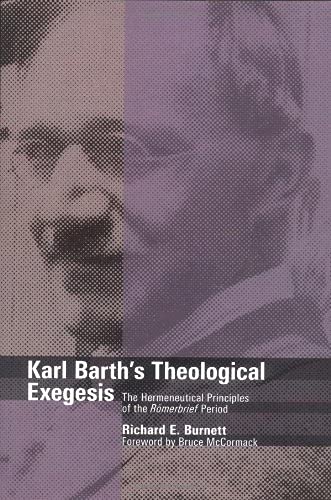
Title
Karl Barth's Theological Exegesis: The Hermeneutical Principles of the Romerbrief Period,Used
Sold by Ergodebooks, an authorized reseller.
Returns accepted within 30 days | support@ergodebooks.com
Shipping Information
- Free Standard Shipping — United States only
- Processing Time: 3–5 business days
- Estimated Delivery: 6–10 business days after dispatch
- Double-boxed, fully insured & discreetly packaged
- Tracking number sent via email once dispatched
Returns & Refund
Returns accepted within 30 days of delivery.
Damaged or Defective Item
Free return shipping + replacement or full refund
Wrong Item Received
Free return shipping + replacement or full refund
Change of Mind
Return shipping at customer's expense · 25% restocking fee applies
Payment Option

Foreword by Bruce McCormackFor many students of Scripture and Christian theology, Karl Barth's break with liberalism is the most important event that has occurred in theology in over 200 years. In Karl Barth's Theological Exegesis Richard E. Burnett provides the first detailed look at this watershed event, showing how Barth read the Bible before and after his break with liberalism, how he came to read the Bible differently than most of his contemporaries, and why Barth's contribution is still significant today.As Burnett explains, the crux of Barth's legacy is his abandonment of the hermeneutical tradition of Schleiermacher, which had had such a profound influence on Christian thought in the nineteenth and twentieth centuries. This hermeneutical tradition, which began with Herder and extended through Dilthey, Troeltsch, Wobbermin, Wernle, and Barth himself prior to 1915, is characterized by its attempt to integrate broad aspects of interpretation, to establish universally valid rules of interpretation on the basis of a general anthropology, and by its reliance on empathy.Barth's discovery that 'the being of God is the hermeneutical problem' implied that the object to be known should determine the way taken in knowing. This fundamental insight brought about a hermeneutical revolution that gave priority to content over method, to actual exegesis over hermeneutical theory. The development of Barth's new approach to Scripture is especially evident in his Rmerbrief period, during which he developed a set of principles for properly reading Scripture. Burnett focuses on these principles, which have never been discussed at length or viewed specifically in relationship to Schleiermacher, and presents a study that challenges both 'neoorthodox' and 'postmodern' readings of Barth.This is a crucial piece of scholarship. Not only is it the first major book in English on Barth's hermeneutics, but it also employs pioneering research in Barth studies. Burnett includes in his discussion important material only recently discovered in Switzerland and made available here in English for the first time namely, six preface drafts that Barth wrote for his famous Romans commentary, which some regard as the greatest theological work of all time.In making a major contribution to Barth studies, this volume will also inform scholars, pastors, and students whose interests range from modern Christian theology to the history of biblical interpretation.
⚠️ WARNING (California Proposition 65):
This product may contain chemicals known to the State of California to cause cancer, birth defects, or other reproductive harm.
For more information, please visit www.P65Warnings.ca.gov.
- Q: What is the main focus of Karl Barth's Theological Exegesis? A: The book primarily examines Karl Barth's hermeneutical principles during his Römerbrief period, highlighting his break with liberalism and its implications for biblical interpretation.
- Q: Who is the author of this book? A: The author is Richard E. Burnett, who provides a detailed analysis of Barth's theological exegesis.
- Q: What is the significance of Barth's hermeneutical revolution? A: Barth's hermeneutical revolution emphasizes the content of Scripture over interpretive methods, fundamentally changing how the Bible is understood.
- Q: Is this book suitable for beginners in theology? A: While the book provides valuable insights, it may be more beneficial for readers with some prior knowledge of theology and biblical studies due to its scholarly depth.
- Q: How many pages does the book contain? A: The book has a total of 328 pages.
- Q: What is the binding type of this book? A: The book is available in hardcover binding, which offers durability and a professional appearance.
- Q: When was Karl Barth's Theological Exegesis first published? A: The book was first published on June 1, 2004.
- Q: What unique materials are included in the book? A: The book includes important material recently discovered in Switzerland, including six preface drafts for Barth's Romans commentary.
- Q: What category does this book fall under? A: The book is categorized under Exegesis & Hermeneutics.
- Q: What condition is the book in? A: The item is listed as being in very good condition.