

Title
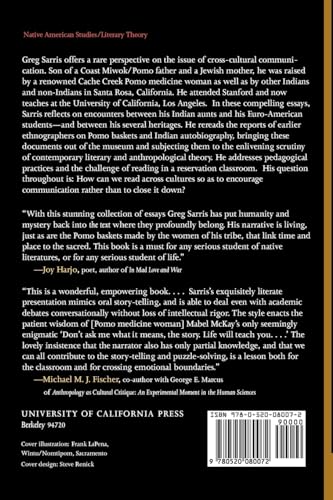

KEEPING SLUG WOMAN ALIVE: A Holistic Approach to American Indian Texts,Used
Sold by Ergodebooks, an authorized reseller.
Returns accepted within 30 days | support@ergodebooks.com
Shipping Information
- Free Standard Shipping — United States only
- Processing Time: 3–5 business days
- Estimated Delivery: 6–10 business days after dispatch
- Double-boxed, fully insured & discreetly packaged
- Tracking number sent via email once dispatched
Returns & Refund
Returns accepted within 30 days of delivery.
Damaged or Defective Item
Free return shipping + replacement or full refund
Wrong Item Received
Free return shipping + replacement or full refund
Change of Mind
Return shipping at customer's expense · 25% restocking fee applies
Payment Option

This remarkable collection of eight essays offers a rare perspective on the issue of crosscultural communication. Greg Sarris is concerned with American Indian texts, both oral and written, as well as with other American Indian cultural phenomena such as basketry and religion. His essays cover a range of topics that include orality, art, literary criticism, and pedagogy, and demonstrate that people can see more than just 'what things seem to be.' Throughout, he asks: How can we read across cultures so as to encourage communication rather than to close it down?Sarris maintains that cultural practices can be understood only in their living, changing contexts. Central to his approach is an understanding of storytelling, a practice that embodies all the indeterminateness, structural looseness, multivalence, and richness of culture itself. He describes encounters between his Indian aunts and EuroAmerican students and the challenge of reading in a reservation classroom; he brings the reports of earlier ethnographers out of museums into the light of contemporary literary and anthropological theory.Sarris's perspective is exceptional: son of a Coast Miwok/Pomo father and a Jewish mother, he was raised by Mabel McKaya renowned Cache Creek Pomo basketweaver and medicine womanand by others, Indian and nonIndian, in Santa Rosa, California. Educated at Stanford, he is now a university professor and recently became Chairman of the Federated Coast Miwok tribe. His own story is woven into these essays and provides valuable insights for anyone interested in crosscultural communication, including educators, theorists of language and culture, and general readers.
⚠️ WARNING (California Proposition 65):
This product may contain chemicals known to the State of California to cause cancer, birth defects, or other reproductive harm.
For more information, please visit www.P65Warnings.ca.gov.