
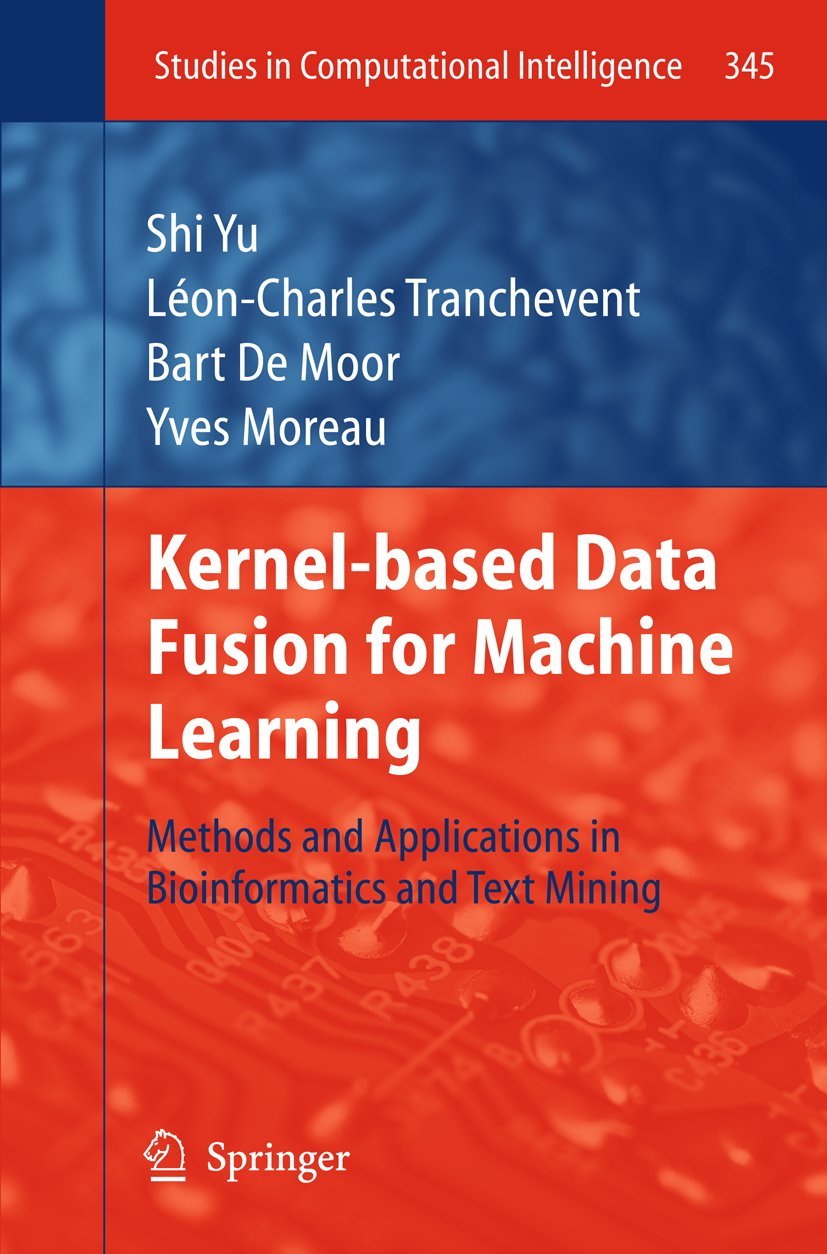
Title
Kernelbased Data Fusion for Machine Learning: Methods and Applications in Bioinformatics and Text Mining (Studies in Computatio,Used
Sold by Ergodebooks, an authorized reseller.
Returns accepted within 30 days | support@ergodebooks.com
Shipping Information
- Free Standard Shipping — United States only
- Processing Time: 3–5 business days
- Estimated Delivery: 6–10 business days after dispatch
- Double-boxed, fully insured & discreetly packaged
- Tracking number sent via email once dispatched
Returns & Refund
Returns accepted within 30 days of delivery.
Damaged or Defective Item
Free return shipping + replacement or full refund
Wrong Item Received
Free return shipping + replacement or full refund
Change of Mind
Return shipping at customer's expense · 25% restocking fee applies
Payment Option

Product Description Data fusion problems arise frequently in many different fields. This book provides a specific introduction to data fusion problems using support vector machines. In the first part, this book begins with a brief survey of additive models and Rayleigh quotient objectives in machine learning, and then introduces kernel fusion as the additive expansion of support vector machines in the dual problem. The second part presents several novel kernel fusion algorithms and some real applications in supervised and unsupervised learning. The last part of the book substantiates the value of the proposed theories and algorithms in MerKator, an open software to identify disease relevant genes based on the integration of heterogeneous genomic data sources in multiple species. The topics presented in this book are meant for researchers or students who use support vector machines. Several topics addressed in the book may also be interesting to computational biologists who want to tackle data fusion challenges in real applications. The background required of the reader is a good knowledge of data mining, machine learning and linear algebra. Review From the reviews:The book provides an introduction to data fusion problems using support vector machines (SVMs). The book is meant for researchers, scientists and engineers using SVMs, or other statistical learning methods, but it also may be used as a reference material for graduate courses in machine learning and data mining. (Florin Gorunescu, Zentralblatt MATH, Vol. 1227, 2012) From the Back Cover Data fusion problems arise frequently in many different fields. This book provides a specific introduction to data fusion problems using support vector machines. In the first part, this book begins with a brief survey of additive models and Rayleigh quotient objectives in machine learning, and then introduces kernel fusion as the additive expansion of support vector machines in the dual problem. The second part presents several novel kernel fusion algorithms and some real applications in supervised and unsupervised learning. The last part of the book substantiates the value of the proposed theories and algorithms in MerKator, an open software to identify disease relevant genes based on the integration of heterogeneous genomic data sources in multiple species. The topics presented in this book are meant for researchers or students who use support vector machines. Several topics addressed in the book may also be interesting to computational biologists who want to tackle data fusion challenges in real applications. The background required of the reader is a good knowledge of data mining, machine learning and linear algebra.
⚠️ WARNING (California Proposition 65):
This product may contain chemicals known to the State of California to cause cancer, birth defects, or other reproductive harm.
For more information, please visit www.P65Warnings.ca.gov.