
Title
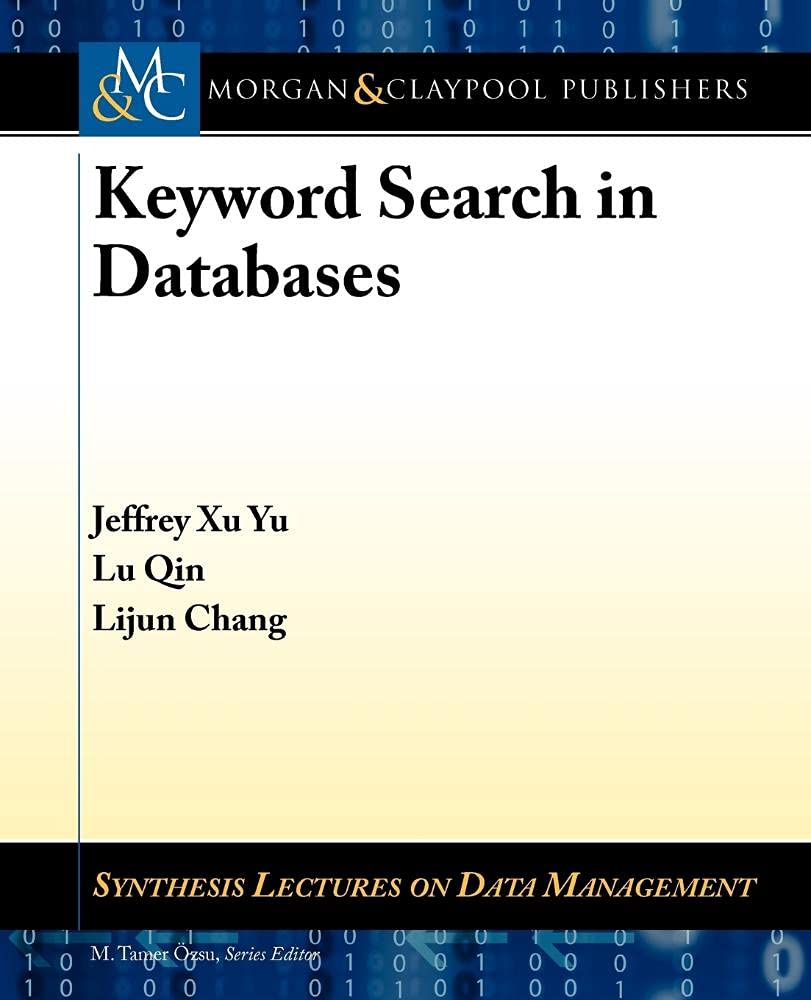
Keyword Search in Databases (Synthesis Lectures on Data Management, 1),Used
Sold by Ergodebooks, an authorized reseller.
Returns accepted within 30 days | support@ergodebooks.com
Shipping Information
- Free Standard Shipping — United States only
- Processing Time: 3–5 business days
- Estimated Delivery: 6–10 business days after dispatch
- Double-boxed, fully insured & discreetly packaged
- Tracking number sent via email once dispatched
Returns & Refund
Returns accepted within 30 days of delivery.
Damaged or Defective Item
Free return shipping + replacement or full refund
Wrong Item Received
Free return shipping + replacement or full refund
Change of Mind
Return shipping at customer's expense · 25% restocking fee applies
Payment Option

It has become highly desirable to provide users with flexible ways to query/search information over databases as simple as keyword search like Google search. This book surveys the recent developments on keyword search over databases, and focuses on finding structural information among objects in a database using a set of keywords. Such structural information to be returned can be either trees or subgraphs representing how the objects, that contain the required keywords, are interconnected in a relational database or in an XML database. The structural keyword search is completely different from finding documents that contain all the usergiven keywords. The former focuses on the interconnected object structures, whereas the latter focuses on the object content. The book is organized as follows. In Chapter 1, we highlight the main research issues on the structural keyword search in different contexts. In Chapter 2, we focus on supporting structural keyword search in a relational database management system using the SQL query language. We concentrate on how to generate a set of SQL queries that can find all the structural information among records in a relational database completely, and how to evaluate the generated set of SQL queries efficiently. In Chapter 3, we discuss graph algorithms for structural keyword search by treating an entire relational database as a large data graph. In Chapter 4, we discuss structural keyword search in a large treestructured XML database. In Chapter 5, we highlight several interesting research issues regarding keyword search on databases. The book can be used as either an extended survey for people who are interested in the structural keyword search or a reference book for a postgraduate course on the related topics. Table of Contents: Introduction / SchemaBased Keyword Search on Relational Databases / GraphBased Keyword Search / Keyword Search in XML Databases / Other Topics for Keyword Search on Databases
⚠️ WARNING (California Proposition 65):
This product may contain chemicals known to the State of California to cause cancer, birth defects, or other reproductive harm.
For more information, please visit www.P65Warnings.ca.gov.