
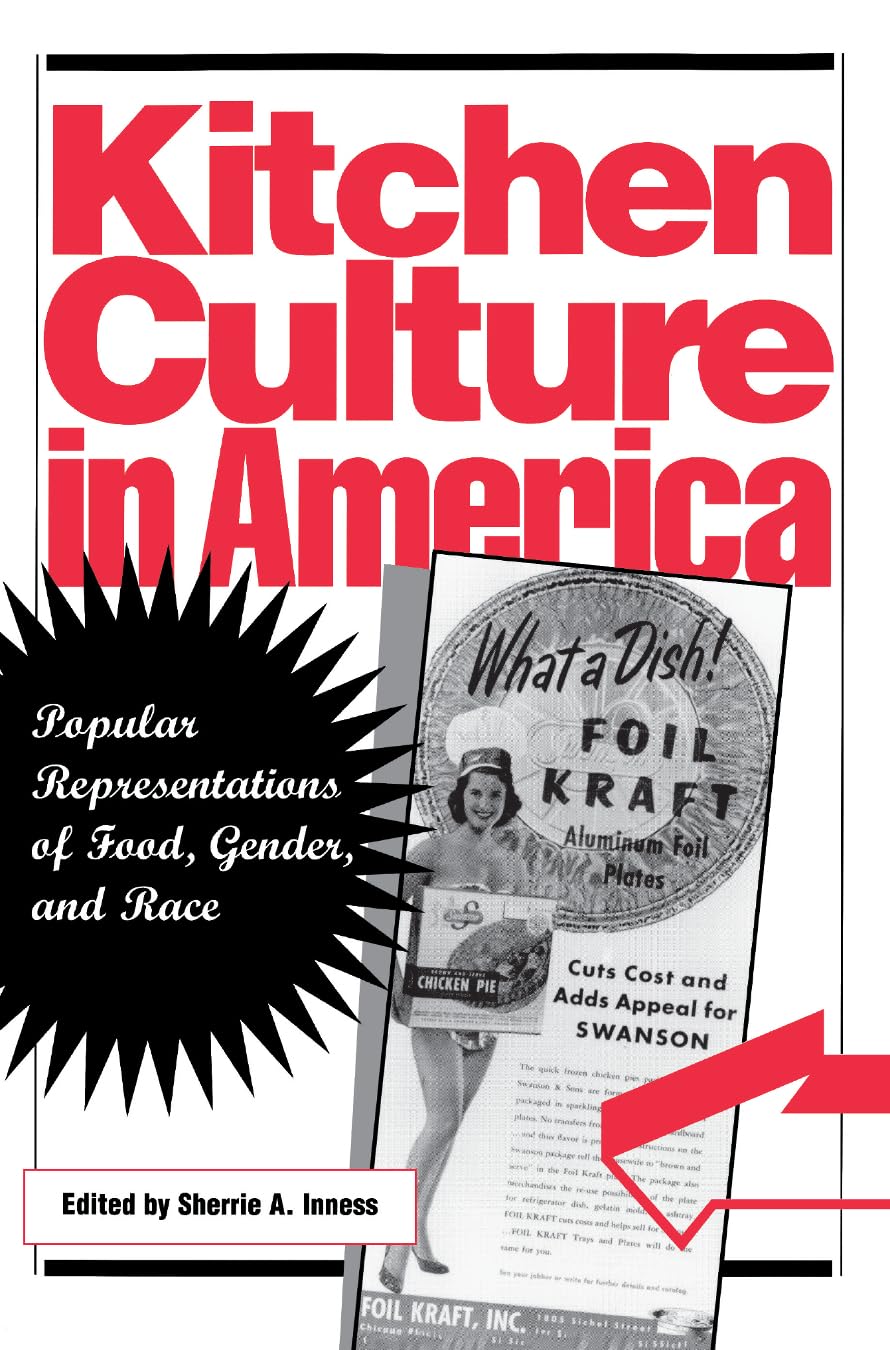
Title
Kitchen Culture In America: Popular Representations Of Food, Gender, And Race,Used
Sold by Ergodebooks, an authorized reseller.
Returns accepted within 30 days | support@ergodebooks.com
Shipping Information
- Free Standard Shipping — United States only
- Processing Time: 3–5 business days
- Estimated Delivery: 6–10 business days after dispatch
- Double-boxed, fully insured & discreetly packaged
- Tracking number sent via email once dispatched
Returns & Refund
Returns accepted within 30 days of delivery.
Damaged or Defective Item
Free return shipping + replacement or full refund
Wrong Item Received
Free return shipping + replacement or full refund
Change of Mind
Return shipping at customer's expense · 25% restocking fee applies
Payment Option

At supermarkets across the nation, customers waiting in linemostly femaleflip through magazines displayed at the checkout stand. What we find on those magazine racks are countless images of food and, in particular, women: moms preparing lunch for the team, college roommates baking together, working women whipping up a meal in under an hour, dieters happy to find a lowfat ice cream that tastes great. In everything from billboards and product packaging to cooking shows, movies, and even sex guides, food has a presence that conveys powerful gendercoded messages that shape our society.Kitchen Culture in America is a collection of essays that examine how women's roles have been shaped by the principles and practice of consuming and preparing food. Exploring popular representations of food and gender in American society from 1895 to 1970, these essays argue that kitchen culture accomplishes more than just passing down cooking skills and wellloved recipes from generation to generation. Kitchen culture instructs women about how to behave like 'correctly' gendered beings. One chapter reveals how juvenile cookbooks, a popular genre for over a century, have taught boys and girls not only the basics of cooking, but also the fine distinctions between their expected roles as grown men and women.Several essays illuminate the ways in which food manufacturers have used gender imagery to define women first and foremost as consumers. Other essays, informed by current debates in the field of material culture, investigate how certain commodities like candy, which in the early twentieth century was advertised primarily as a feminine pleasure, have been culturally constructed. The book also takes a look at the complex relationships among food, gender, class, and race or ethnicityas represented, for example, in the popular Southern black Mammy figure. In all of the essays, Kitchen Culture in America seeks to show how food serves as a marker of identity in American society.
⚠️ WARNING (California Proposition 65):
This product may contain chemicals known to the State of California to cause cancer, birth defects, or other reproductive harm.
For more information, please visit www.P65Warnings.ca.gov.
- Q: How many pages does this book have? A: This book has two hundred ninety-six pages. It provides a comprehensive exploration of food culture and gender in America.
- Q: What are the dimensions of the book? A: The book measures five point seventy-five inches in length, zero point seventy-five inches in width, and nine point twenty-five inches in height. These dimensions make it a convenient size for handling.
- Q: What type of binding does this book have? A: This book is paperback bound. This binding type is flexible and lightweight, suitable for casual reading.
- Q: What is the main theme of the book? A: The main theme is the intersection of food, gender, and culture in America. It analyzes how culinary practices shape societal gender roles.
- Q: Who is the author of this book? A: The author is Sherrie A. Inness. She is known for her scholarly work on gender studies and cultural analysis.
- Q: What time period does this book cover? A: The book covers the time period from eighteen ninety-five to nineteen seventy. It examines the evolution of kitchen culture during this era.
- Q: How do I use this book for research? A: You can use this book as a reference for studies on gender roles and food culture. It offers valuable essays and analyses relevant to social sciences.
- Q: Is this book suitable for academic use? A: Yes, this book is suitable for academic use. It contains scholarly essays that are well-researched and referenced for deeper understanding.
- Q: What audience is this book intended for? A: This book is intended for readers interested in gender studies, cultural studies, and food history. It appeals to both academics and general readers.
- Q: How should I store this book? A: Store this book in a cool, dry place away from direct sunlight. This will help preserve its condition and prevent damage.
- Q: Can I clean the book if it gets dirty? A: Yes, you can gently wipe the cover with a dry cloth. Avoid using water or cleaning solutions to protect the pages.
- Q: What if the book arrives damaged? A: If the book arrives damaged, you should contact the seller for a return or exchange. Most sellers have policies in place for such situations.
- Q: Is there a warranty for this book? A: No, there is no warranty for this book. However, most sellers offer a return policy for damaged or unsatisfactory items.
- Q: How do I handle the book to keep it in good condition? A: Handle the book with clean hands and avoid bending the spine excessively. This will help prevent wear and tear.
- Q: Are there any illustrations or photographs in the book? A: The book primarily consists of essays without illustrations or photographs. It focuses on written content and analysis.