
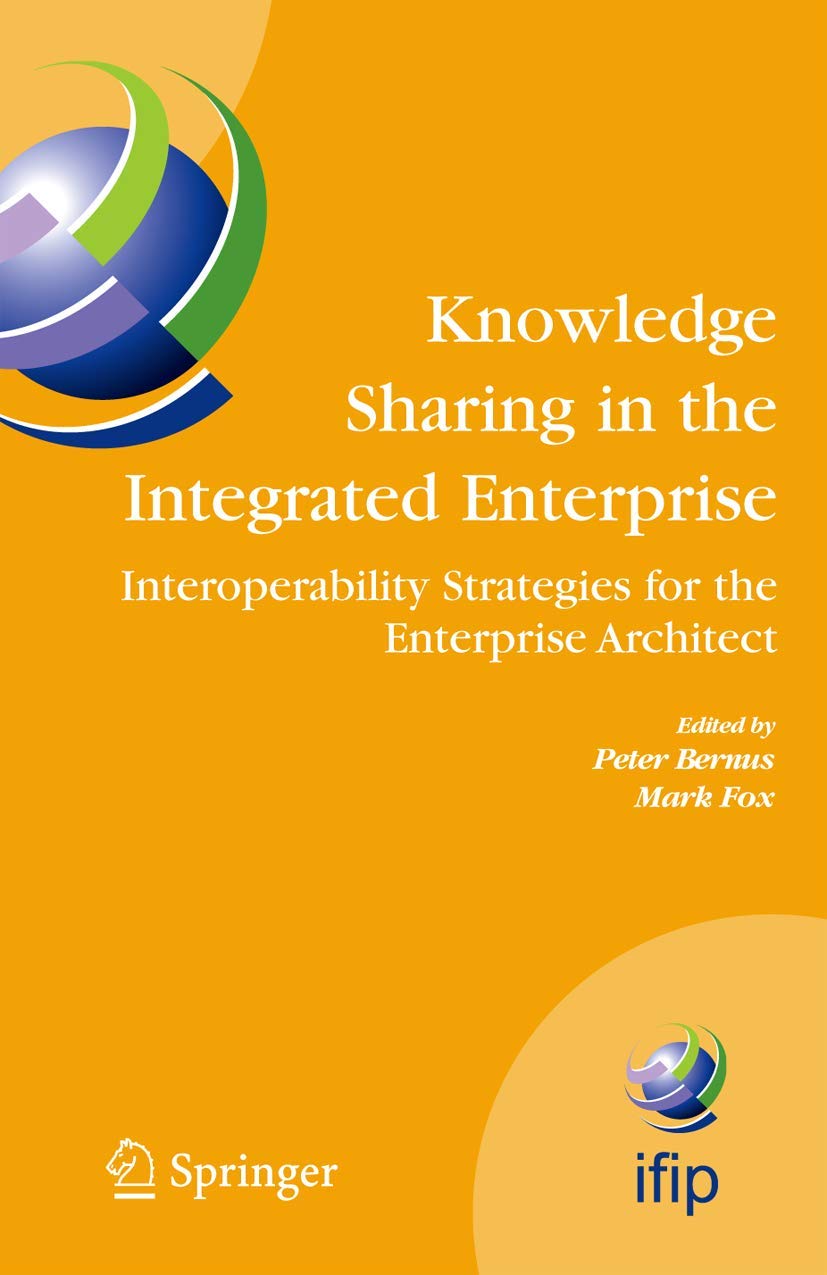
Title
Knowledge Sharing in the Integrated Enterprise: Interoperability Strategies for the Enterprise Architect (IFIP Advances in Infor,Used
Sold by Ergodebooks, an authorized reseller.
Returns accepted within 30 days | support@ergodebooks.com
Shipping Information
- Free Standard Shipping — United States only
- Processing Time: 3–5 business days
- Estimated Delivery: 6–10 business days after dispatch
- Double-boxed, fully insured & discreetly packaged
- Tracking number sent via email once dispatched
Returns & Refund
Returns accepted within 30 days of delivery.
Damaged or Defective Item
Free return shipping + replacement or full refund
Wrong Item Received
Free return shipping + replacement or full refund
Change of Mind
Return shipping at customer's expense · 25% restocking fee applies
Payment Option

Enterprise Architects, in their endeavor to achieve Enterprise Integration, have limited guidance on how best to use Enterprise Models and Modeling Tools to support their practice. It is widely recognized that the practice of engineering enterprises needs a number of models, but how to maintain the relation between these models with ease is still a problem. Model interoperability is an issue on multiople counts: How to interchange models between enterprise modeling tools? How to maintain the interdependencies between models whether they describe the enterprise on the same level (but from different points of view), or from the same point of view (but on different levels of abstraction and granularity)? How to maintain a coherent and evolving set of enterprise models in support onf continuous change processes? How to use and reuse enterprise models as a knowledge resource?The answers to these questions are of great importance to anyone who is implementing ISO9001:2000 requirements, whether through using enterprise architecture practice or not although it can be argued that a well executed architecture practice should satisfy ISO9001 without additional effort.This volume attacks the problem on three fronts:1. Authors working in international standardisation and tool development as well as in enterprise modeling research present the latest developments in semantic integration;2. Authors who are practitioners of, or conducting active research in, enterprise architecting methodologies give an account on the latest developments and strategic directions in architecture frameworks and methodologies;3. Authors who use or develop information integration infrastructures present best practice and future trends of this aspect of enterprise integration.Chapters of this book include contributions to the International Conference on Enterprise Integration and Modelling Technology (ICEIMT'04), and those presented at the Design of Information Infrastructure Systems for Manufacturing (DIISM'04) Workshop. While DIISM is traditionally oriented at supporting manufacturing practice, the results have a far greater domain of applicability.
⚠️ WARNING (California Proposition 65):
This product may contain chemicals known to the State of California to cause cancer, birth defects, or other reproductive harm.
For more information, please visit www.P65Warnings.ca.gov.