
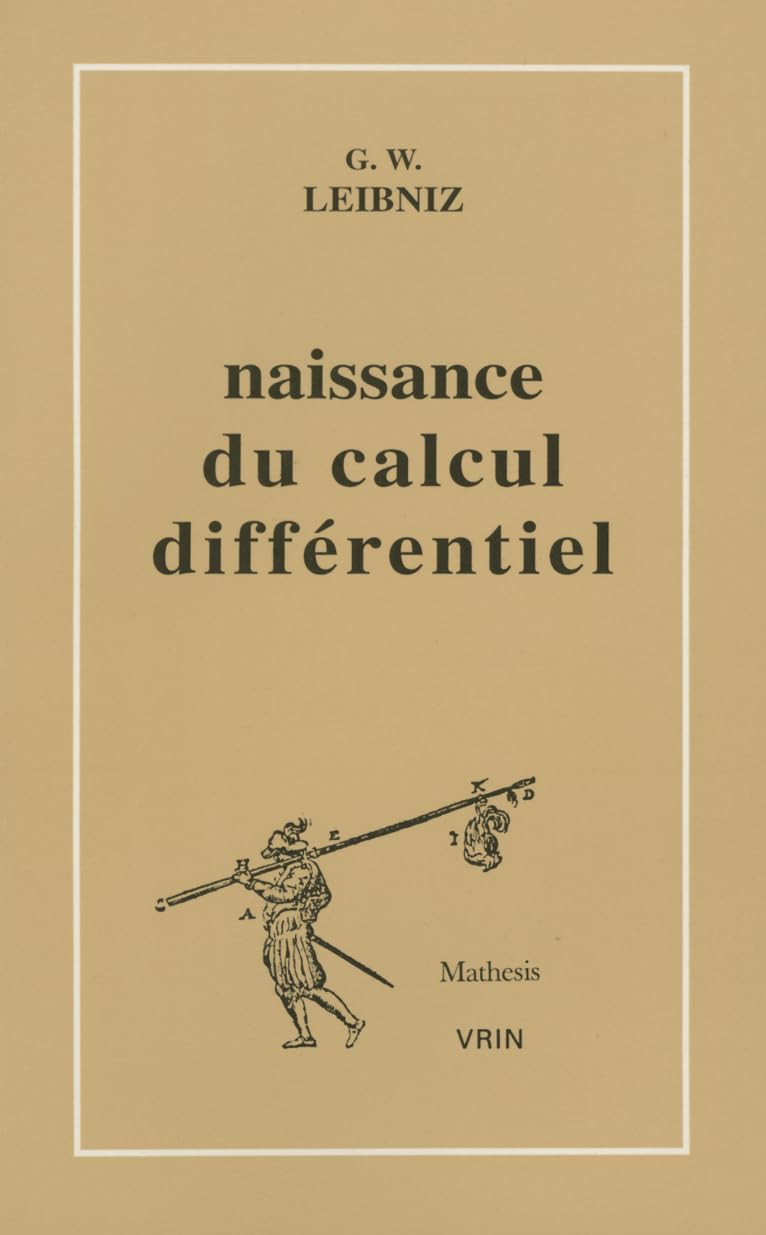
Title
La Naissance Du Calcul Differentiel: 26 Articles Des Acta Eruditorum (Mathesis) (French Edition)
Processing time: 1-3 days
US Orders Ships in: 3-5 days
International Orders Ships in: 8-12 days
Return Policy: 15-days return on defective items
Payment Option

En 1684 Le Tout Nouveau Periodique Edite A Leipzig, Les Acta Eruditorum, Publie Le Texte Fondateur Du Calcul Leibnizien: Nova Methodus Pro Maximis Et Minimis. Ce N'Etait Pas Le Premier Article De Leibniz Dans Cette Revue Et Ce Ne Sera Pas Le Dernier. De 1682 A 1713 S'Echelonnent Des Publications, Aujourd'Hui Classiques, Sur L'Isochrone, La Chainette, La Brachystochrone, Etc. Ce Volume En Reunit Vingtsix, En Majorite Traduites Pour La Premiere Fois En Langue Francaise. Leur Selection Fut Essentiellement Guidee Par La Volonte De Mettre A La Portee Du Lecteur Les Principaux Ecrits Mathematiques De Leibniz Consacres Au Calcul Differentiel Et Integral. Outre Les Resultats Scientifiques, On Decouvrira Dans Ces Textes L'Interet Epistemologique De Leibniz Pour L'Invention, La Methode, L'Histoire Et Son Souci D'Une Ethique De La Recherche.
⚠️ WARNING (California Proposition 65):
This product may contain chemicals known to the State of California to cause cancer, birth defects, or other reproductive harm.
For more information, please visit www.P65Warnings.ca.gov.
- Q: What is the page count of this book? A: This book contains five hundred four pages. It includes a collection of significant writings by Leibniz.
- Q: What is the binding type of this book? A: This book is published in paperback binding. This makes it lightweight and easy to handle.
- Q: What are the dimensions of this book? A: The dimensions of this book are eight point four six inches in length, one point one eight inches in width, and five point three one inches in height.
- Q: Is this book suitable for beginners in mathematics? A: Yes, this book is suitable for beginners. It includes foundational articles on differential calculus by Leibniz.
- Q: How should I read this book for best understanding? A: You should read this book in a quiet setting to focus on the complex mathematical concepts. Taking notes can help with retention.
- Q: What reading level is this book appropriate for? A: This book is appropriate for readers with an advanced high school level or above. Familiarity with calculus concepts is beneficial.
- Q: How should I store this book to keep it in good condition? A: Store this book in a cool, dry place and avoid direct sunlight. Keeping it on a shelf upright will help prevent bending.
- Q: Can this book be cleaned if it gets dirty? A: Yes, you can gently wipe the cover with a damp cloth. Avoid using harsh chemicals to protect the book's surface.
- Q: Is this book safe for children? A: Yes, the book is safe for children. However, it may be more suitable for older children with an interest in mathematics.
- Q: What if the book arrives damaged? A: If the book arrives damaged, you can request a replacement or refund through the retailer's return policy.
- Q: Is there a warranty for this book? A: No, there is no warranty for this book. However, you can return it if it is damaged upon arrival.
- Q: What other works by Leibniz are included in this book? A: This book includes significant writings on topics like Isochrones and Brachystochrones, showcasing Leibniz's contributions to calculus.
- Q: How does this book compare to other mathematics books? A: This book focuses specifically on Leibniz's works, making it unique for those interested in the historical context of calculus.
- Q: Is this book a good choice for someone studying philosophy? A: Yes, this book is a great choice for philosophy students. It explores epistemological themes related to mathematics and ethics.
- Q: What is the author’s background? A: The author, Gottfried Wilhelm Leibniz, was a prominent mathematician and philosopher known for developing calculus independently of Newton.
- Q: Are there illustrations or diagrams in this book? A: No, this book does not contain illustrations or diagrams. It primarily includes text-based articles and analyses.