
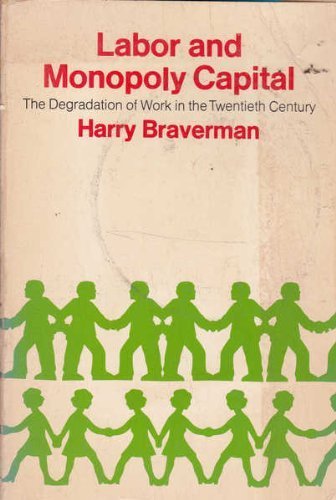
Title
Labor And Monopoly Capital: The Degradation Of Work In The Twentieth Century
Sold by Ergodebooks, an authorized reseller.
Returns accepted within 30 days | support@ergodebooks.com
Shipping Information
- Free Standard Shipping — United States only
- Processing Time: 3–5 business days
- Estimated Delivery: 6–10 business days after dispatch
- Double-boxed, fully insured & discreetly packaged
- Tracking number sent via email once dispatched
Returns & Refund
Returns accepted within 30 days of delivery.
Damaged or Defective Item
Free return shipping + replacement or full refund
Wrong Item Received
Free return shipping + replacement or full refund
Change of Mind
Return shipping at customer's expense · 25% restocking fee applies
Payment Option

This Widely Acclaimed Book, First Published In 1974, Was A Classic From Its First Day In Print. Written In A Direct, Inviting Way By Harry Braverman, Whose Years As An Industrial Worker Gave Him Rich Personal Insight Into Work, Labor And Monopoly Capital Overturned The Reigning Ideologies Of Academic Sociology. This New Edition Features An Introduction By John Bellamy Foster That Sets The Work In Historical And Theoretical Context, As Well As Two Rare Articles By Braverman, The Degradation Of Work In The Twentieth Century (1975) And Two Comments (1976), That Add Much To Our Understanding Of The Book.
⚠️ WARNING (California Proposition 65):
This product may contain chemicals known to the State of California to cause cancer, birth defects, or other reproductive harm.
For more information, please visit www.P65Warnings.ca.gov.
- Q: How many pages does the book have? A: The book has four hundred sixty-five pages. This provides an in-depth exploration of labor and capitalism in the twentieth century.
- Q: What type of binding does this book have? A: The book is paperback bound. This makes it lightweight and flexible, ideal for easy handling during reading.
- Q: Who is the author of the book? A: The author is Harry Braverman. He provides unique insights based on his experience as an industrial worker.
- Q: How do I read this book? A: You can read this book by purchasing it from a retailer or borrowing it from a library. It is suitable for both casual readers and academic study.
- Q: Is this book suitable for beginners? A: Yes, the book is suitable for beginners. Its direct writing style makes complex themes accessible to all readers.
- Q: What themes are explored in this book? A: The book explores themes of labor, capitalism, and the degradation of work. It provides a critical analysis of these subjects in the twentieth century.
- Q: How should I store this book? A: Store the book in a cool, dry place. Keeping it away from direct sunlight will help preserve its condition over time.
- Q: Can I lend this book to someone? A: Yes, you can lend this book. Just ensure it is returned in good condition to maintain its readability.
- Q: How do I care for my paperback book? A: To care for your paperback book, keep it clean and handle it gently. Avoid bending the cover or pages to prevent damage.
- Q: What if the book arrives damaged? A: If the book arrives damaged, you should contact the seller for a return or exchange. Most retailers have policies for such issues.
- Q: Is this book available in digital format? A: Yes, the book may be available in digital format. Check online retailers or eBook platforms for availability.
- Q: What is the main argument of the book? A: The main argument is that labor has been degraded due to capitalist practices. Braverman challenges existing sociological ideologies.
- Q: Are there additional articles included in this edition? A: Yes, this edition includes two rare articles by Harry Braverman. They provide further context and insight into the book's themes.
- Q: Is there an introduction in this new edition? A: Yes, there is an introduction by John Bellamy Foster. It places the work in a historical and theoretical context.
- Q: What genre does this book belong to? A: The book belongs to the genre of sociology and labor studies. It is often used in academic settings for its critical analysis.
- Q: Can this book be used for academic purposes? A: Yes, this book is widely used in academic settings. Its insights into labor and capitalism make it a valuable resource for students.