
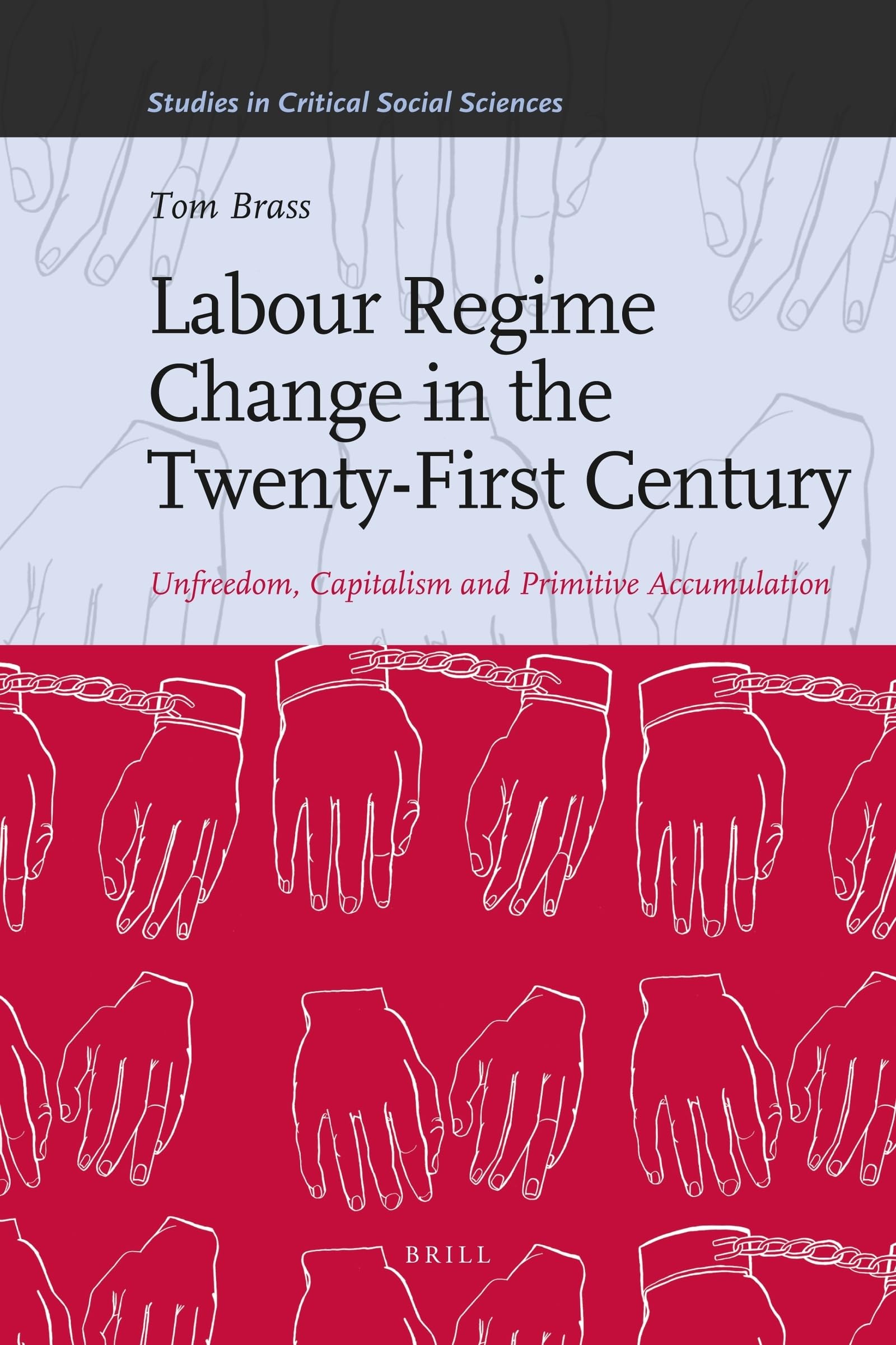
Title
Labour Regime Change in the TwentyFirst Century: Unfreedom, Capitalism and Primitive Accumulation (Studies in Critical Social S,Used
Sold by Ergodebooks, an authorized reseller.
Returns accepted within 30 days | support@ergodebooks.com
Shipping Information
- Free Standard Shipping — United States only
- Processing Time: 3–5 business days
- Estimated Delivery: 6–10 business days after dispatch
- Double-boxed, fully insured & discreetly packaged
- Tracking number sent via email once dispatched
Returns & Refund
Returns accepted within 30 days of delivery.
Damaged or Defective Item
Free return shipping + replacement or full refund
Wrong Item Received
Free return shipping + replacement or full refund
Change of Mind
Return shipping at customer's expense · 25% restocking fee applies
Payment Option

Review'[T]he volume is a timely and important contribution to the literature (especially its Marxist variant) on unfree labour, with a wealth of theoretical and empirical detail, and I would recommend it to anyone interested in the issue of unfreedom in contemporary labour markets. [...] [T]he concept of 'class struggle from above' [by capital against labour] is hugely important in our current conjuncture, when any attempts to rein in the excesses of capital are framed as 'class warfare' or a 'politics of envy'.' Kendra Strauss, in: Capital & Class 36/3 (2012), pp. 554'The nature of labour freedom and unfreedom in capitalism is a highly controversial topic. One of the bestknown specialists in radical development studies and political economy, Tom Brass in his new book Labour regime change [...] has consistently called attention to the fact that a fully functioning capitalism is compatible with unfree labour. [...] Brass's detailed theoretical exposition of the connection between capitalism and labour (un)freedom including his attempted history of the concept and a critical examination of various Marxists have conceptualized unfree labour has enriched my own understanding as it undoubtedly would that of many others. Anyone who wants to comprehend the nature of labour regime must read his work.' Raju Das, in: The Journal of Contemporary Asia'Tom Brass, one of the United Kingdom's leading Marxist scholars has written a brilliant, theoretically informed, comprehensive critique of past and present, Marxist and nonMarxist writers of capitalist labor regimes and puts forth an alternative theoreticalconceptual framework ... Brass's book is a landmark study that is especially relevant to the emergence of a new genre of development studies which will return the class struggle and the transition to socialism into the center of theory and practice.' James Petras, in Science and Society 77/3 (2013)Product DescriptionThe object is to assess the validity, in the light of current economic development, of the epistemology structuring different historical interpretations linking capitalism, unfreedom and primitive accumulation. Conventional wisdom is that regarding the incompatibility between capitalism and unfreedom an unbroken continuity links Marxism to Adam Smith, Malthus, Mill and Max Weber. Challenging this, it is argued Marxism accepts that, where class struggle is global, capitalist producers employ workers who are unfree. The reasons are traced to the conceptualization by Smith of labour as value, by Hegel of labour as property, and by Marx of labourpower as commodity that can be bought/sold. From this stems the free/unfree distinction informing the process of becoming, being, remaining, and acting as a proletariat.From the Back CoverThe object is to assess the validity, in the light of current economic development, of the epistemology structuring different historical interpretations linking capitalism, unfreedom and primitive accumulation. Conventional wisdom is that regarding the incompatibility between capitalism and unfreedom an unbroken continuity links Marxism to Adam Smith, Malthus, Mill and Max Weber. Challenging this, it is argued Marxism accepts that, where class struggle is global, capitalist producers employ workers who are unfree. The reasons are traced to the conceptualization by Smith of labour as value, by Hegel of labour as property, and by Marx of labourpower as commodity that can be bought/sold. From this stems the free/unfree distinction informing the process of becoming, being, remaining, and acting as a proletariat.About the AuthorTom Brass, D.Phil (1982) formerly lectured in the SPS Faculty at Cambridge University and directed studies for Queens' College. He edited The Journal of Peasant Studies for almost two decades, and has published extensively on agrarian issues and rural labour relations.
⚠️ WARNING (California Proposition 65):
This product may contain chemicals known to the State of California to cause cancer, birth defects, or other reproductive harm.
For more information, please visit www.P65Warnings.ca.gov.