

Title

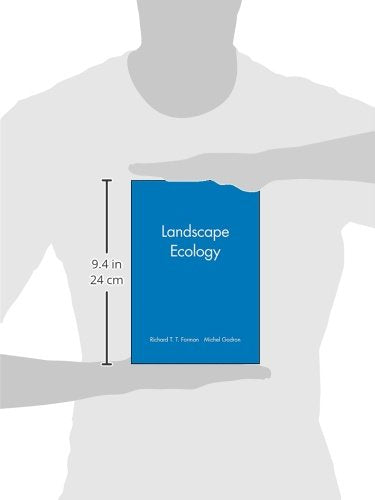
Landscape Ecology,Used
Sold by Ergodebooks, an authorized reseller.
Returns accepted within 30 days | support@ergodebooks.com
Shipping Information
- Free Standard Shipping — United States only
- Processing Time: 3–5 business days
- Estimated Delivery: 6–10 business days after dispatch
- Double-boxed, fully insured & discreetly packaged
- Tracking number sent via email once dispatched
Returns & Refund
Returns accepted within 30 days of delivery.
Damaged or Defective Item
Free return shipping + replacement or full refund
Wrong Item Received
Free return shipping + replacement or full refund
Change of Mind
Return shipping at customer's expense · 25% restocking fee applies
Payment Option

This important new workthe first of its kindfocuses on the distribution patterns of landscape elements or ecosystems; the flows of animals, plants, energy, mineral nutrients and water; and the ecological changes in the landscape over time. Includes over 1,200 references from current ecology, geography, forestry, and wildlife biologcy literature.
⚠️ WARNING (California Proposition 65):
This product may contain chemicals known to the State of California to cause cancer, birth defects, or other reproductive harm.
For more information, please visit www.P65Warnings.ca.gov.
- Q: How many pages are in 'Landscape Ecology'? A: There are six hundred forty-eight pages in 'Landscape Ecology'. This extensive work covers a wide range of topics related to landscape patterns and ecological changes.
- Q: What is the binding type of this book? A: The binding type is paperback. This makes it lightweight and flexible for easy reading and handling.
- Q: What are the dimensions of 'Landscape Ecology'? A: The dimensions are six point six nine inches in length, one point three eight inches in width, and nine point four five inches in height. These measurements make it a convenient size for bookshelves and portability.
- Q: Who is the author of 'Landscape Ecology'? A: The author is Richard T. T. Forman. He is known for his contributions to landscape ecology and environmental science.
- Q: What is the primary focus of 'Landscape Ecology'? A: The primary focus is on the distribution patterns of landscape elements and ecosystems. It also examines ecological changes over time and the flows of various natural components.
- Q: Is 'Landscape Ecology' suitable for beginners? A: Yes, it is suitable for beginners as well as professionals. The book is written to be accessible while also providing in-depth information for advanced studies in ecology.
- Q: How can I apply the concepts from 'Landscape Ecology'? A: You can apply the concepts by studying ecosystems in your area or by using the principles in environmental planning and management. Understanding landscape patterns can help in conservation efforts.
- Q: Is there a recommended reading level for this book? A: The recommended reading level is for adults and advanced students. It is particularly useful for those studying ecology, geography, and environmental science.
- Q: How should I store 'Landscape Ecology' to keep it in good condition? A: Store it upright on a bookshelf away from direct sunlight. Avoid moisture to protect the pages and binding.
- Q: Is this book safe for children? A: No, this book is not specifically designed for children. It contains advanced ecological concepts that are better suited for adults and older students.
- Q: What if I receive a damaged copy of 'Landscape Ecology'? A: If you receive a damaged copy, you should contact the seller for a return or exchange. Make sure to keep the original packaging for a smoother return process.
- Q: Does 'Landscape Ecology' cover contemporary ecological issues? A: Yes, it includes over one thousand two hundred references from current literature. This ensures that it addresses contemporary ecological challenges and research.
- Q: Can 'Landscape Ecology' help in landscape planning? A: Yes, it provides valuable insights into landscape elements and ecological interactions, making it a useful resource for landscape planning and management.
- Q: What are the main themes explored in 'Landscape Ecology'? A: The main themes include distribution patterns, ecological flows, and changes within landscapes over time. These themes are critical for understanding ecosystem dynamics.
- Q: Is 'Landscape Ecology' published by a reputable publisher? A: Yes, it is published by Wiley, which is known for its high-quality academic and professional publications.
- Q: Does this book include illustrations or diagrams? A: Yes, 'Landscape Ecology' contains illustrations and diagrams that help to explain complex ecological concepts visually, enhancing understanding.