
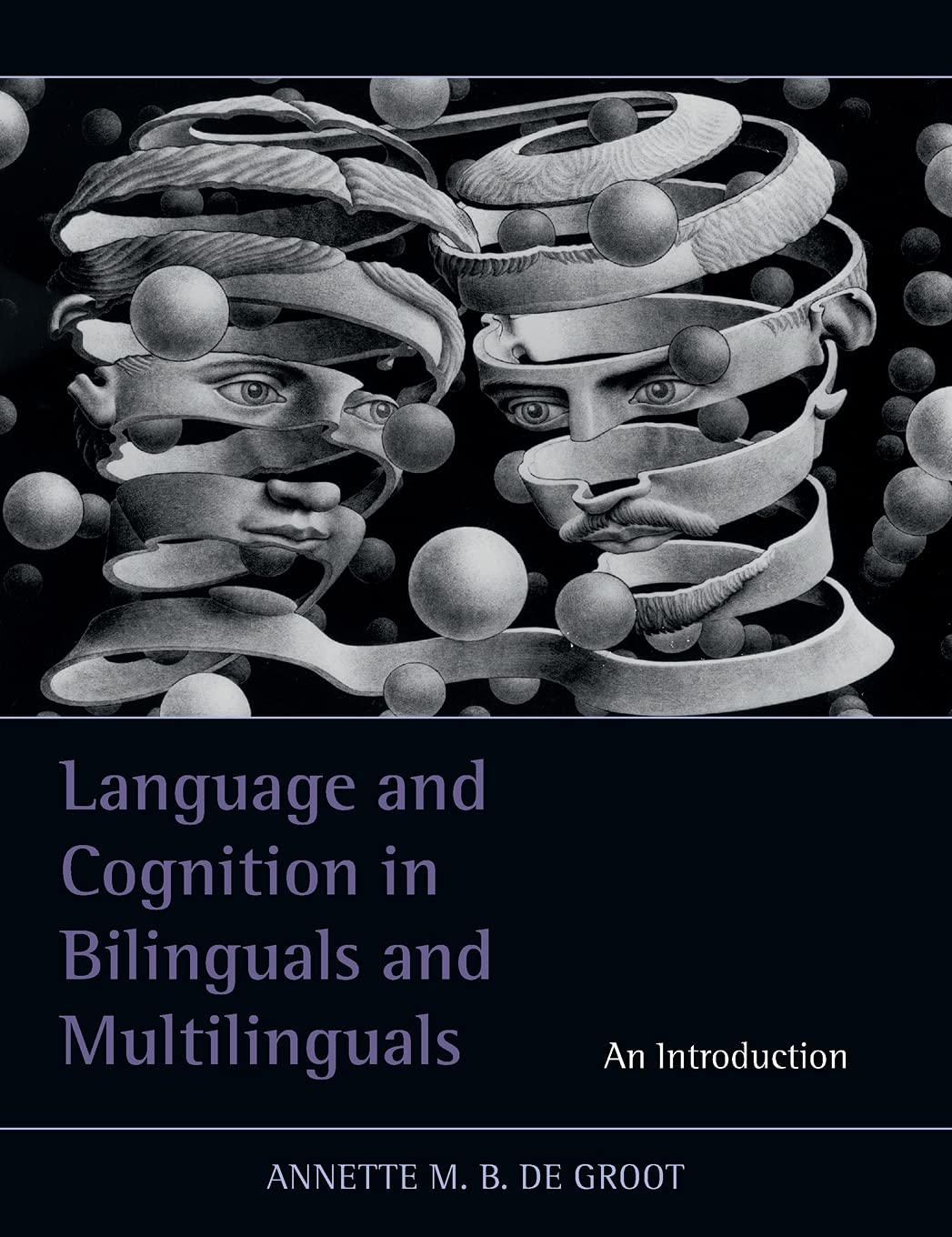
Title
Language and Cognition in Bilinguals and Multilinguals: An Introduction,Used
Sold by Ergodebooks, an authorized reseller.
Returns accepted within 30 days | support@ergodebooks.com
Shipping Information
- Free Standard Shipping — United States only
- Processing Time: 3–5 business days
- Estimated Delivery: 6–10 business days after dispatch
- Double-boxed, fully insured & discreetly packaged
- Tracking number sent via email once dispatched
Returns & Refund
Returns accepted within 30 days of delivery.
Damaged or Defective Item
Free return shipping + replacement or full refund
Wrong Item Received
Free return shipping + replacement or full refund
Change of Mind
Return shipping at customer's expense · 25% restocking fee applies
Payment Option

Psycholinguistics the field of science that examines the mental processes and knowledge structures involved in the acquisition, comprehension, and production of language had a strong monolingual orientation during the first four decades following its emergence around 1950. The awareness that a large part of mankind speaks more than one language that this may impact both on the way each individual language is used and on the thought processes of bilinguals and multilinguals, and that, consequently, our theories on human linguistic ability and its role in nonlinguistic cognition are incomplete and, perhaps, false has led to a steep growth of studies on bilingualism and multilingualism since around 1995.This textbook introduces the reader to the field of study that examines language acquisition, comprehension and production from the perspective of the bilingual and multilingual speaker. It furthermore provides an introduction to studies that investigate the implications of being bilingual on various aspects of nonlinguistic cognition. The major topics covered are the development of language in children growing up in a bilingual environment either from birth or relatively soon after, late foreign language learning, and word recognition, sentence comprehension, speech production, and translation processes in bilinguals. Furthermore, the ability of bilinguals and multilinguals to generally produce language in the 'intended' language is discussed, as is the cognitive machinery that enables this. Finally, the consequences of bilingualism and multilingualism for nonlinguistic cognition and findings and views regarding the biological basis of bilingualism and multilingualism are presented.The textbooks primary readership are students and researchers in Cognitive Psychology, Linguistics, and Applied Linguistics, but teachers of language and translators and interpreters who wish to become better informed on the cognitive and biological basis of bilingualism and multilingualism will also benefit from it.
⚠️ WARNING (California Proposition 65):
This product may contain chemicals known to the State of California to cause cancer, birth defects, or other reproductive harm.
For more information, please visit www.P65Warnings.ca.gov.