
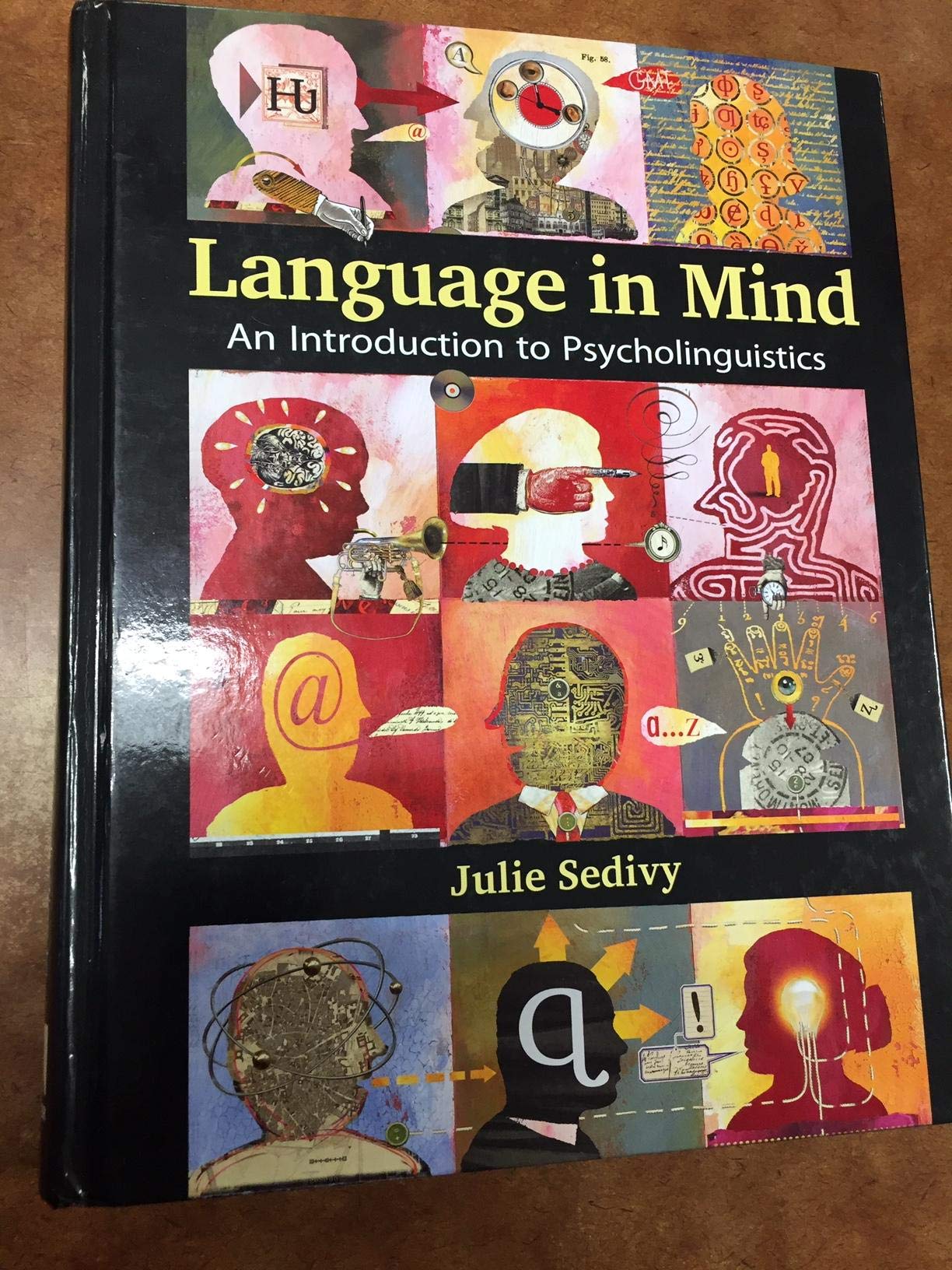
Title
Language In Mind: An Introduction To Psycholinguistics,Used
Sold by Ergodebooks, an authorized reseller.
Returns accepted within 30 days | support@ergodebooks.com
Shipping Information
- Free Standard Shipping — United States only
- Processing Time: 3–5 business days
- Estimated Delivery: 6–10 business days after dispatch
- Double-boxed, fully insured & discreetly packaged
- Tracking number sent via email once dispatched
Returns & Refund
Returns accepted within 30 days of delivery.
Damaged or Defective Item
Free return shipping + replacement or full refund
Wrong Item Received
Free return shipping + replacement or full refund
Change of Mind
Return shipping at customer's expense · 25% restocking fee applies
Payment Option

The Field Of Psycholinguistics Has Grown Considerably Over The Past Decades, And Is Of Relevance To Various Disciplines. Courses In Psycholinguistics/Psychology Of Language Range From Large, Lowerlevel Courses To Specialized Seminarstyle Courses, Taught Within Psychology Departments, Linguistics Departments, And Other Departments Or Programs That Deal With Aspects Of Language And Communication. This New Book Provides A Broad, Introductory Survey To Psycholinguistics That Will Remain Relevant To Students Whether Or Not They Continue On In The Field. Language In Mind Addresses Important Questions And Approaches, Reflecting A Variety Of Theoretical Orientations And Viewpoints And Provoking A Sense Of Curiosity About Language And The Structures In The Mind And Brain That Give Rise To It. Intriguing Storiespresented In An Accessible, Energetic Writing Styleset The Stage With A Question; Students Then Work Through A Series Of Theoretical Refinements And Counterarguments, Guided Through These Unfolding Stories With The Help Of Suggested Classroom Demonstrations And Activities. The Result Is A Creative, Pleasurable, And Deep Level Of Engagement By The Student. Throughout, The Author Communicates The Dynamic And Evolving Nature Of The Field, Synthesizing The Key Ideas Underpinning Psycholinguistics Research. This Approach, In Conjunction With The Presentation Of Actual Sample Stimuli And Results, Prepares Students To Be More Successful Consumers Of Primary Source Material.Key Features*Wellcrafted Prose Presents The Material In A Plotdriven Way That Makes Students (And Instructors) Want To Read The Text.*A Range Of Simple To Indepth 'Fieldwork' And Inclass Web Activities And Projects Encourages Students To Work With Data, To Notice Patterns And Generalizations, And To Generate Hypotheses. Brief Summaries In The Text Are Supported By Materials On The Book'S Companion Website.*Special Boxes (1) Provide Sample Stimuli And Key Data, To Assist Students In Reconstructing The Logic Of Complex Experiments And (2) Address Specific Methods Implemented By Researchers.*'Language At Large' Text Modules Relate Key Concepts To Fascinating Examples Pertinent To The World Outside Of Academiae.G., Advertising, Popular Culture, The Law. These Modules Are Intended To Reinforce Newlylearned Concepts And To Stimulate Thinking About How Abstract Ideas Can Be Applied To Concrete Questions. Additional, Updated Examples, Some Drawn From The Author'S Various Blogs, Will Reside On The Companion Website.*Endofchapter 'Digging Deeper' Modules Present Topics Of Outstanding Debate In The Literature And Point To Additional Readings. Students Are Encouraged To Consider What Kind Of Data Or Experimental Design Might Help Advance The Debate. The Modular Structure Of These Sections Gives Instructors The Flexibility To Assign Them Or Not, Without Sacrificing Students' Grasp Of Material In Subsequent Chapters.*Fullcolor Illustrations Support The Concepts Presented In The Text, And Create A Visually Compelling Layout.Resourcesfor The Studentcompanion Websitethe Companion Website For Language In Mind Includes: All The Web Activities And Projects From The Textbook, Including Supporting Materials; Additional 'Language At Large' Modules, Updated Frequently; Web Links; Web Essays; And Annotated Bibliographies.For The Instructortest Banka Test Bank Is Now Available For Language In Mind. The Test Bank Includes A Wide Range Of Questions For Chapters 212 Of The Textbook. Each Chapter Includes Both Multiplechoice And Shortanswer Questions, At A Range Of Bloom'S Taxonomy Levels. All Questions Are Referenced To Specific Textbook Headings. The Test Bank Is Provided Both In Microsoft Word Format And In Blackboard Diploma Format (Software Included).Instructor'S Resource Library This Resource Includes All Figures (Lineart Illustrations And Photographs) And Tables From The Textbook, Provided As Both High And Lowresolution Jpegs. All Have Been Fo
⚠️ WARNING (California Proposition 65):
This product may contain chemicals known to the State of California to cause cancer, birth defects, or other reproductive harm.
For more information, please visit www.P65Warnings.ca.gov.
- Q: How many pages does the book have? A: The book has five hundred fifty-eight pages. This extensive length allows for a thorough exploration of psycholinguistics.
- Q: What is the binding type of this book? A: The book is available in hardcover. This ensures durability and a professional appearance for academic settings.
- Q: What are the dimensions of the book? A: The book measures eleven point two inches in length, one point two inches in width, and eight point eight two inches in height. These dimensions make it a manageable size for reading and transport.
- Q: Who is the author of this book? A: The author is Julie Sedivy. She provides a comprehensive introduction to the field of psycholinguistics.
- Q: What is the main subject of this book? A: The book focuses on psycholinguistics. It provides insights into how language is processed in the mind.
- Q: What academic disciplines is this book suitable for? A: The book is suitable for students in psychology, linguistics, and communication studies. It serves as an introductory text for various academic programs.
- Q: How can I apply the concepts learned in this book? A: You can apply the concepts by engaging in class activities and discussions. The book includes practical exercises and demonstrations to enhance understanding.
- Q: Is this book suitable for beginners in psychology? A: Yes, it is suitable for beginners. The book presents complex ideas in an accessible manner, making it easy for new students to grasp.
- Q: What types of activities does the book include? A: The book includes fieldwork and in-class web activities. These activities encourage students to engage with real data and develop hypotheses.
- Q: Does this book provide additional resources for students? A: Yes, it includes a Companion Website. The website offers supplementary materials, activities, and updated examples to enhance the learning experience.
- Q: How do I care for this book? A: Keep it in a dry, cool place to maintain its condition. Avoid exposure to direct sunlight to prevent fading.
- Q: Is this book safe for all audiences? A: Yes, the book is safe for all audiences. It is designed for educational purposes and does not contain inappropriate content.
- Q: What if the book arrives damaged? A: If the book arrives damaged, you can initiate a return. Contact the seller for their specific return policy and procedures.
- Q: Can I access the test bank mentioned in the book? A: Yes, the Test Bank is available for instructors. It includes a variety of questions to assess student understanding.
- Q: Does the book include visual aids? A: Yes, it features full-color illustrations. These visuals help clarify complex concepts and enhance the reader's understanding.