
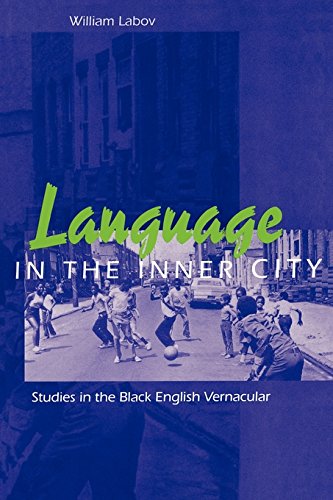
Title
Language In The Inner City: Studies In The Black English Vernacular (Conduct And Communication),Used
Sold by Ergodebooks, an authorized reseller.
Returns accepted within 30 days | support@ergodebooks.com
Shipping Information
- Free Standard Shipping — United States only
- Processing Time: 3–5 business days
- Estimated Delivery: 6–10 business days after dispatch
- Double-boxed, fully insured & discreetly packaged
- Tracking number sent via email once dispatched
Returns & Refund
Returns accepted within 30 days of delivery.
Damaged or Defective Item
Free return shipping + replacement or full refund
Wrong Item Received
Free return shipping + replacement or full refund
Change of Mind
Return shipping at customer's expense · 25% restocking fee applies
Payment Option

With The Recent Controversy In The Oakland, California School District About Ebonicsor As It Is Referred To In Sociolinguistic Circles, African American Vernacular English Or Black English Vernacularmuch Attention Has Been Paid To The Patterns Of Speech Prevalent Among African Americans In The Inner City.In January 1997, At The Height Of The Ebonics Debate, Author And Prominent Sociolinguist William Labov Testified Before A Senate Subcommittee That For Most Inner City African American Children, The Relation Of Sound To Spelling Is Different, And More Complicated Than For Speakers Of Other Dialects. He Suggested That It Was Time To Apply This Knowledge To The Teaching Of Reading.The Testimony Harkened Back To Research Contained In His Groundbreaking Book Language In The Inner City, Originally Published In 1972. In It, Labov Probed The Question 'Does 'Black English' Exist?' And Emerged With An Answer That Was Well Ahead Of His Time, And That Remains Essential To Our Contemporary Understanding Of The Subject.Language In The Inner City Firmly Establishes African American Vernacular English Not Simply As Slang But As A Wellformed Set Of Rules Of Pronunciation And Grammar Capable Of Conveying Complex Logic And Reasoning. Studying Not Only The Normal Processes Of Communication In The Inner City But Such Art Forms As The Ritual Insult And Ritualized Narrative, Labov Confirms The Black Vernacular As A Separate And Independent Dialect Of English. His Analysis Goes On To Clarify The Nature And Processes Of Linguistic Change In The Context Of A Changing Society.Perhaps Even More Today Than Two Decades Ago, Labov'S Conclusions Are Mandatory Reading For Anyone Concerned With Education And Social Change, With African American Culture, And With The Future Of Race Relations In This Country.
⚠️ WARNING (California Proposition 65):
This product may contain chemicals known to the State of California to cause cancer, birth defects, or other reproductive harm.
For more information, please visit www.P65Warnings.ca.gov.
- Q: How many pages does this book have? A: This book has four hundred forty pages. It provides extensive insights into the sociolinguistic aspects of African American Vernacular English.
- Q: What type of binding does this book have? A: This book features a hardcover binding. This durable binding is ideal for frequent use and ensures longevity.
- Q: Who is the author of this book? A: The author of this book is William Labov. He is a prominent sociolinguist known for his research on language and society.
- Q: How can I use this book for educational purposes? A: You can use this book to enhance your understanding of linguistic diversity. It's suitable for educators and students interested in sociolinguistics.
- Q: Is this book suitable for beginners in linguistics? A: Yes, this book is suitable for beginners. It provides foundational knowledge about African American Vernacular English.
- Q: What age group is this book appropriate for? A: This book is appropriate for high school students and adults. It delves into complex linguistic concepts that require critical thinking.
- Q: How should I store this book to keep it in good condition? A: Store this book upright in a cool, dry place. Avoid exposure to direct sunlight to prevent fading and damage.
- Q: Can I clean the book if it gets dirty? A: Yes, you can clean the book's cover gently with a soft cloth. Avoid using liquids that may damage the binding or pages.
- Q: Is there a warranty or return policy for this book? A: Typically, books have a return policy within thirty days of purchase. Check with the retailer for specific warranty details.
- Q: What if the book arrives damaged? A: If the book arrives damaged, contact the seller for a replacement or refund. Most retailers have policies in place for such situations.
- Q: How does this book compare to other works on linguistics? A: This book is unique in its focus on African American Vernacular English. It is often cited for its groundbreaking analysis compared to other linguistic studies.
- Q: Is this book suitable for advanced linguistics studies? A: Yes, this book is suitable for advanced studies. It provides deep insights and analyses that are beneficial for graduate-level research.
- Q: What themes are explored in this book? A: This book explores themes such as linguistic identity, social change, and the rules of African American Vernacular English. It provides rich context for understanding these themes.
- Q: Are there any illustrations or visuals in the book? A: No, this book primarily consists of text. Its focus is on detailed linguistic analysis rather than visual content.
- Q: Can this book be used in a classroom setting? A: Yes, this book can be effectively used in classroom settings. It serves as a valuable resource for discussions on language and culture.
- Q: What is the main argument presented by the author? A: The main argument is that African American Vernacular English is a legitimate dialect with its own rules. This challenges misconceptions about language and identity.