If you have any questions, you are always welcome to contact us. We'll get back to you as soon as possible, withing 24 hours on weekdays.
Customer service
All questions about your order, return and delivery must be sent to our customer service team by e-mail at yourstore@yourdomain.com
Sale & Press
If you are interested in selling our products, need more information about our brand or wish to make a collaboration, please contact us at press@yourdomain.com
Help
If you have any questions, you are always welcome to contact us. We'll get back to you as soon as possible, withing 24 hours on weekdays.
Customer service
All questions about your order, return and delivery must be sent to our customer service team by e-mail at yourstore@yourdomain.com
Sale & Press
If you are interested in selling our products, need more information about our brand or wish to make a collaboration, please contact us at press@yourdomain.com
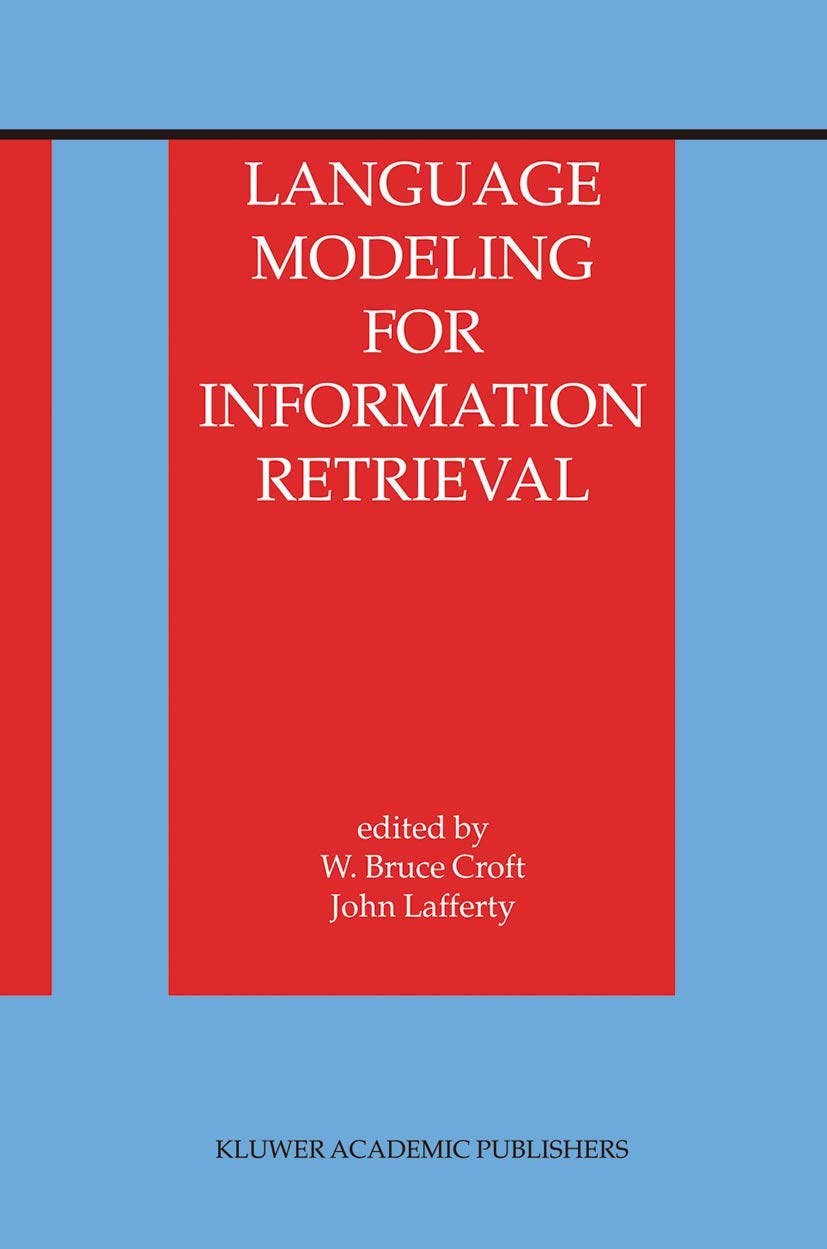
A statisticallanguage model, or more simply a language model, is a prob abilistic mechanism for generating text. Such adefinition is general enough to include an endless variety of schemes. However, a distinction should be made between generative models, which can in principle be used to synthesize artificial text, and discriminative techniques to classify text into predefined cat egories. The first statisticallanguage modeler was Claude Shannon. In exploring the application of his newly founded theory of information to human language, Shannon considered language as a statistical source, and measured how weH simple ngram models predicted or, equivalently, compressed natural text. To do this, he estimated the entropy of English through experiments with human subjects, and also estimated the crossentropy of the ngram models on natural 1 text. The ability of language models to be quantitatively evaluated in tbis way is one of their important virtues. Of course, estimating the true entropy of language is an elusive goal, aiming at many moving targets, since language is so varied and evolves so quickly. Yet fifty years after Shannon's study, language models remain, by all measures, far from the Shannon entropy liInit in terms of their predictive power. However, tbis has not kept them from being useful for a variety of text processing tasks, and moreover can be viewed as encouragement that there is still great room for improvement in statisticallanguage modeling.
⚠️ WARNING (California Proposition 65):
This product may contain chemicals known to the State of California to cause cancer,
birth defects, or other reproductive harm.
For MAP (Minimum Advertised Price) violations and Intellectual Property (IP) or Trademark concerns, please contact:
support@ergodebooks.com
⚠️ California Proposition 65 Warning: Some products sold on this website may expose you to chemicals known to the State of California to cause cancer, birth defects, or other reproductive harm. For more information, visit www.P65Warnings.ca.gov.