If you have any questions, you are always welcome to contact us. We'll get back to you as soon as possible, withing 24 hours on weekdays.
Customer service
All questions about your order, return and delivery must be sent to our customer service team by e-mail at yourstore@yourdomain.com
Sale & Press
If you are interested in selling our products, need more information about our brand or wish to make a collaboration, please contact us at press@yourdomain.com
Help
If you have any questions, you are always welcome to contact us. We'll get back to you as soon as possible, withing 24 hours on weekdays.
Customer service
All questions about your order, return and delivery must be sent to our customer service team by e-mail at yourstore@yourdomain.com
Sale & Press
If you are interested in selling our products, need more information about our brand or wish to make a collaboration, please contact us at press@yourdomain.com
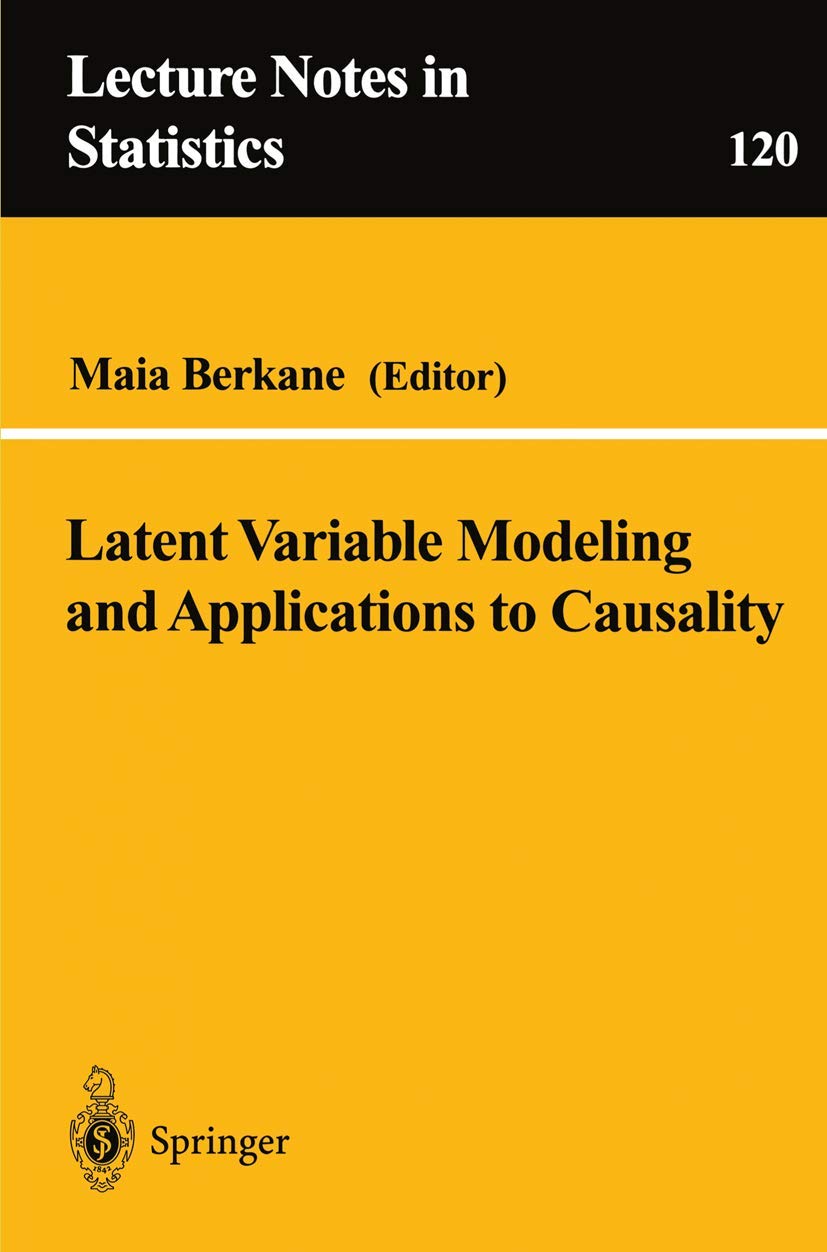
This volume gathers refereed papers presented at the 1994 UCLA conference on 'La tent Variable Modeling and Application to Causality. ' The meeting was organized by the UCLA Interdivisional Program in Statistics with the purpose of bringing together a group of people who have done recent advanced work in this field. The papers in this volume are representative of a wide variety of disciplines in which the use of latent variable models is rapidly growing. The volume is divided into two broad sections. The first section covers Path Models and Causal Reasoning and the papers are innovations from contributors in disciplines not traditionally associated with behavioural sciences, (e. g. computer science with Judea Pearl and public health with James Robins). Also in this section are contri butions by Rod McDonald and Michael Sobel who have a more traditional approach to causal inference, generating from problems in behavioural sciences. The second section encompasses new approaches to questions of model selection with emphasis on factor analysis and time varying systems. Amemiya uses nonlinear factor analysis which has a higher order of complexity associated with the identifiability condi tions. Muthen studies longitudinal hierarchichal models with latent variables and treats the time vector as a variable rather than a level of hierarchy. Deleeuw extends exploratory factor analysis models by including time as a variable and allowing for discrete and ordi nal latent variables. Arminger looks at autoregressive structures and Bock treats factor analysis models for categorical data.
⚠️ WARNING (California Proposition 65):
This product may contain chemicals known to the State of California to cause cancer,
birth defects, or other reproductive harm.
For MAP (Minimum Advertised Price) violations and Intellectual Property (IP) or Trademark concerns, please contact:
support@ergodebooks.com
⚠️ California Proposition 65 Warning: Some products sold on this website may expose you to chemicals known to the State of California to cause cancer, birth defects, or other reproductive harm. For more information, visit www.P65Warnings.ca.gov.