If you have any questions, you are always welcome to contact us. We'll get back to you as soon as possible, withing 24 hours on weekdays.
Customer service
All questions about your order, return and delivery must be sent to our customer service team by e-mail at yourstore@yourdomain.com
Sale & Press
If you are interested in selling our products, need more information about our brand or wish to make a collaboration, please contact us at press@yourdomain.com
Help
If you have any questions, you are always welcome to contact us. We'll get back to you as soon as possible, withing 24 hours on weekdays.
Customer service
All questions about your order, return and delivery must be sent to our customer service team by e-mail at yourstore@yourdomain.com
Sale & Press
If you are interested in selling our products, need more information about our brand or wish to make a collaboration, please contact us at press@yourdomain.com
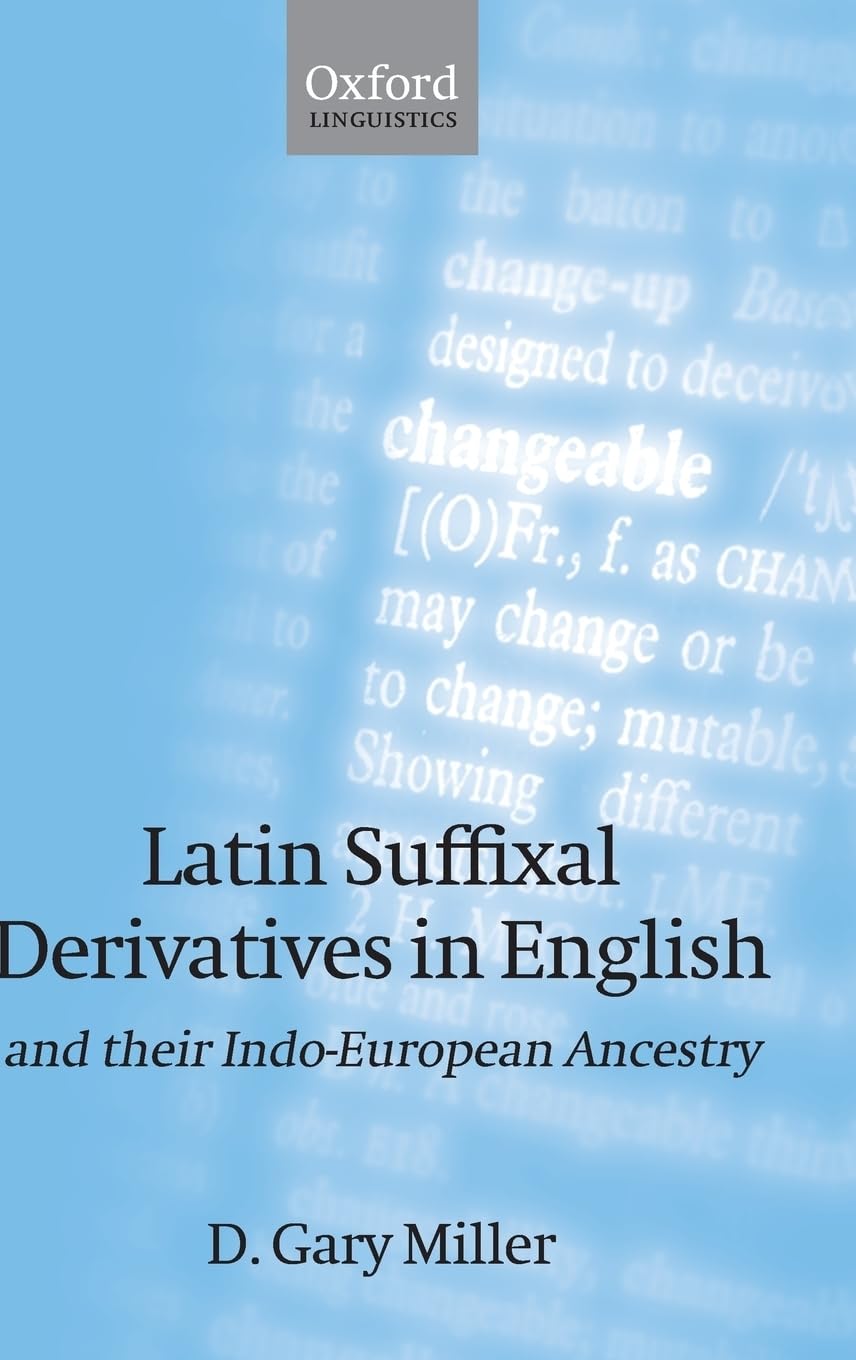
This is the fullest account ever published of Latin suffixes in English. It explores the rich variety of English words formed by the addition of one or more Latin suffixes, such as ial, able, ability, ible, and id. It traces the histories of over 3,000 words, revealing the range of derivational patterns in IndoEuropean, Latin, and English. It describes the different kinds of suffixes, shows how they entered English via different channels at different times, and considers the complexity of competition between native and borrowed forms. The author examines postclassical, medieval, and early modern Latin derivatives, and demonstrates that Latin is still, and likely to remain, a productive source of English words. He traces the suffixes back to their ProtoIndoEuropean origins and provides copious examples for every aspect of his discussion.Professor Miller's innovative book makes an important contribution to the history of both English and Latin morphology and etymology, as well as to the history of suffixal derivation in IndoEuropean. It will interest scholars and students of comparative morphology, historical and comparative linguistics, etymology, and lexicography.
⚠️ WARNING (California Proposition 65):
This product may contain chemicals known to the State of California to cause cancer,
birth defects, or other reproductive harm.
For MAP (Minimum Advertised Price) violations and Intellectual Property (IP) or Trademark concerns, please contact:
support@ergodebooks.com
⚠️ California Proposition 65 Warning: Some products sold on this website may expose you to chemicals known to the State of California to cause cancer, birth defects, or other reproductive harm. For more information, visit www.P65Warnings.ca.gov.