If you have any questions, you are always welcome to contact us. We'll get back to you as soon as possible, withing 24 hours on weekdays.
Customer service
All questions about your order, return and delivery must be sent to our customer service team by e-mail at yourstore@yourdomain.com
Sale & Press
If you are interested in selling our products, need more information about our brand or wish to make a collaboration, please contact us at press@yourdomain.com
Help
If you have any questions, you are always welcome to contact us. We'll get back to you as soon as possible, withing 24 hours on weekdays.
Customer service
All questions about your order, return and delivery must be sent to our customer service team by e-mail at yourstore@yourdomain.com
Sale & Press
If you are interested in selling our products, need more information about our brand or wish to make a collaboration, please contact us at press@yourdomain.com
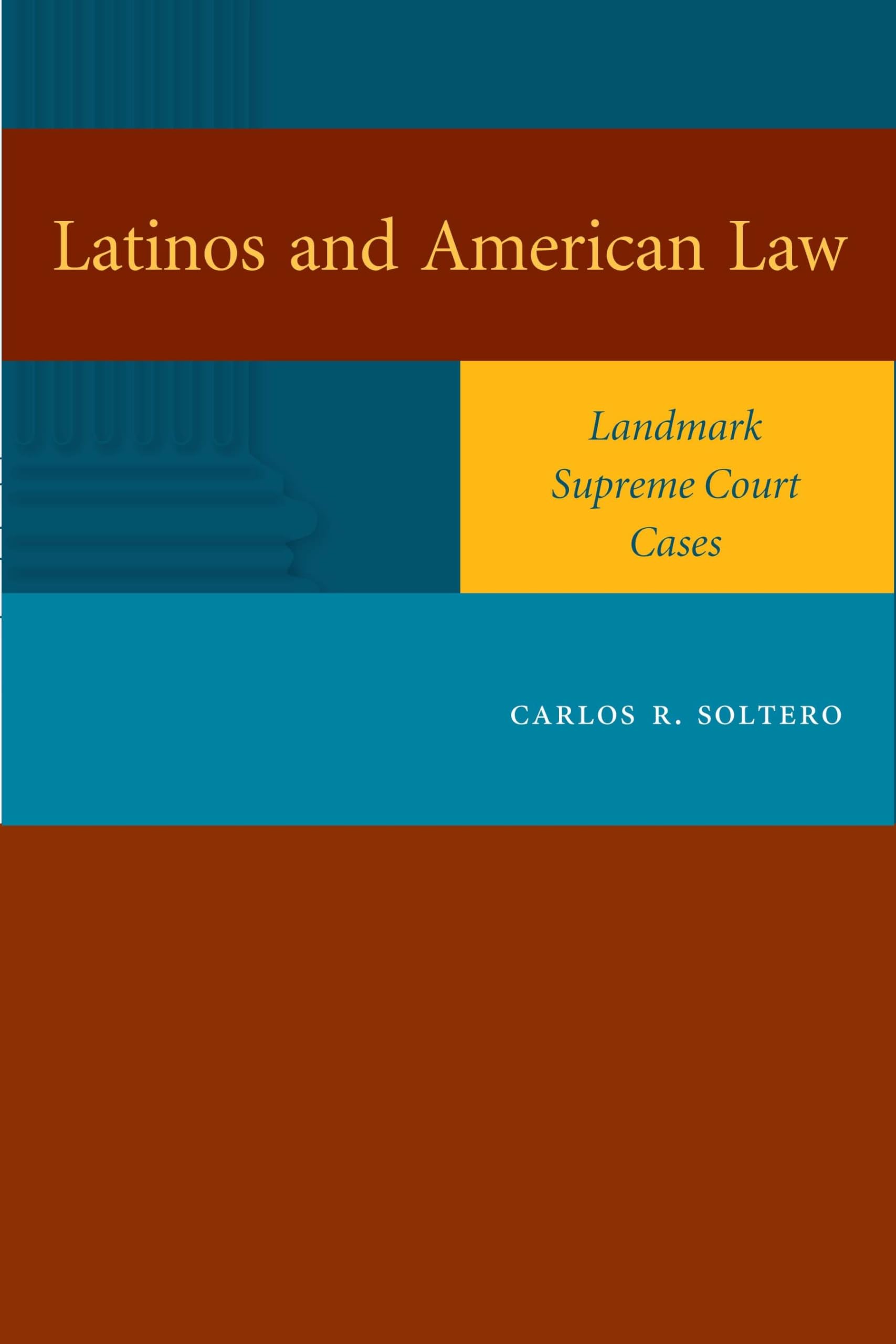
To achieve justice and equal protection under the law, Latinos have turned to the U.S. court system to assert and defend their rights. Some of these cases have reached the United States Supreme Court, whose rulings over more than a century have both expanded and restricted the legal rights of Latinos, creating a complex terrain of power relations between the U.S. government and the country's nowlargest ethnic minority. To map this legal landscape, Latinos and American Law examines fourteen landmark Supreme Court cases that have significantly affected Latino rights, from Botiller v. Dominguez in 1889 to Alexander v. Sandoval in 2001.Carlos Soltero organizes his study chronologically, looking at one or more decisions handed down by the Fuller Court (18881910), the Taft Court (19211930), the Warren Court (19531969), the Burger Court (19691986), and the Rehnquist Court (19862005). For each case, he opens with historical and legal background on the issues involved and then thoroughly discusses the opinion(s) rendered by the justices. He also offers an analysis of each decision's significance, as well as subsequent developments that have affected its impact. Through these case studies, Soltero demonstrates that in dealing with Latinos over issues such as education, the administration of criminal justice, voting rights, employment, and immigration, the Supreme Court has more often mirrored, rather than led, the attitudes and politics of the larger U.S. society.
⚠️ WARNING (California Proposition 65):
This product may contain chemicals known to the State of California to cause cancer,
birth defects, or other reproductive harm.
For MAP (Minimum Advertised Price) violations and Intellectual Property (IP) or Trademark concerns, please contact:
support@ergodebooks.com
⚠️ California Proposition 65 Warning: Some products sold on this website may expose you to chemicals known to the State of California to cause cancer, birth defects, or other reproductive harm. For more information, visit www.P65Warnings.ca.gov.