If you have any questions, you are always welcome to contact us. We'll get back to you as soon as possible, withing 24 hours on weekdays.
Customer service
All questions about your order, return and delivery must be sent to our customer service team by e-mail at yourstore@yourdomain.com
Sale & Press
If you are interested in selling our products, need more information about our brand or wish to make a collaboration, please contact us at press@yourdomain.com
Help
If you have any questions, you are always welcome to contact us. We'll get back to you as soon as possible, withing 24 hours on weekdays.
Customer service
All questions about your order, return and delivery must be sent to our customer service team by e-mail at yourstore@yourdomain.com
Sale & Press
If you are interested in selling our products, need more information about our brand or wish to make a collaboration, please contact us at press@yourdomain.com
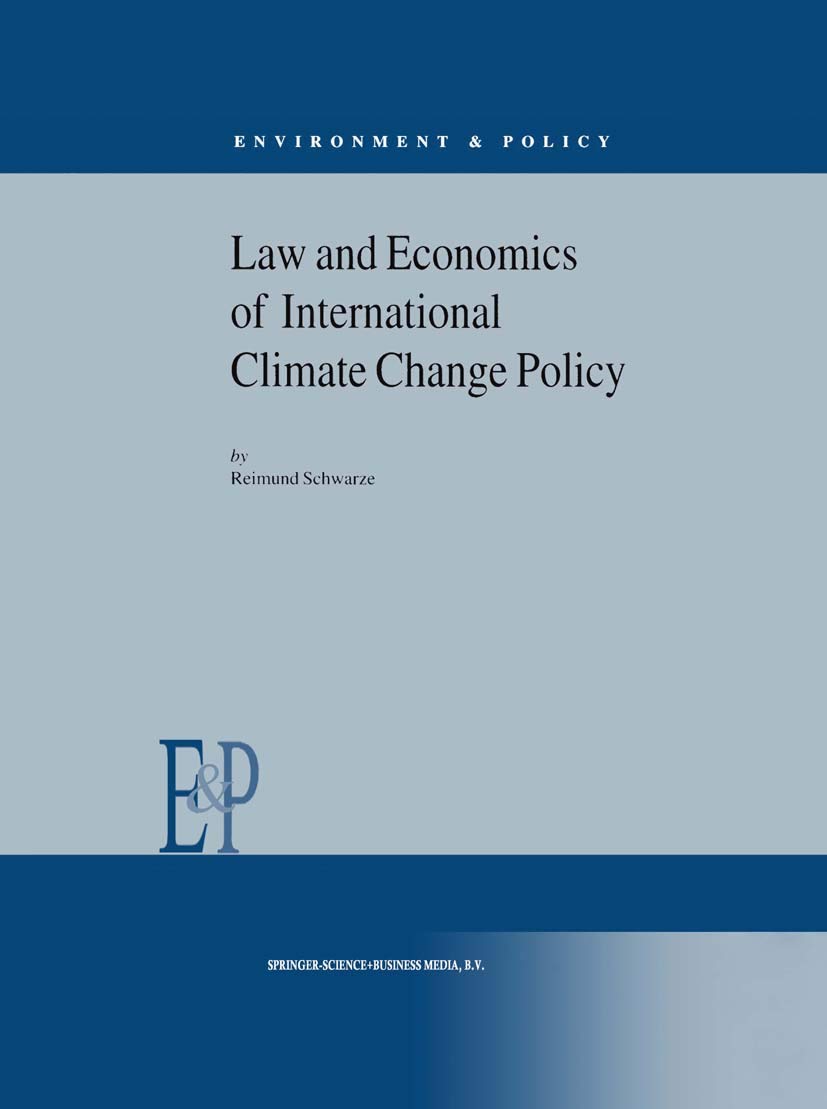
International climate change policy can be broadly divided into two periods: A first period, where a broad consensus was reached to tackle the risk of global warming in a coordinated global effort, and a second period, where this consensus was finally framed into a concrete policy. The first period started at the "Earth Summit" of Rio de Janeiro in 1992, where the United Nations Framework Convention on Climate Change (UNFCCC) was opened for signature. The UNFCCC was subsequently signed and ratified by 174 countries, making it one of the most accepted international rd treaties ever. The second period was initiated at the 3 Conference of the Parties (COP3) to the UNFCCC in Kyoto in 1997, which produced the Kyoto Protocol (KP). Till now, eightyfour countries have signed the Kyoto Protocol, but only twelve ratified it. A major reason for this slow ratification is that most operational details of the Kyoto Protocol were not decided in Kyoto but deferred to following conferences. This deferral of the details, while probably appropriate to initially reach an agreement, is a major stepping stone for a speedy ratification of the protocol. National policy makers and their constituencies, who would ultimately bear the cost of Kyoto, are generally not prepared to ratify a treaty that could mean anything, from an unsustainable strict regime of international control of greenhouse gases (GHGs) to an "Lregime" ofloopholes, or from a pure marketbased international carbon trading to a regime of huge international carbon tax funds.
⚠️ WARNING (California Proposition 65):
This product may contain chemicals known to the State of California to cause cancer,
birth defects, or other reproductive harm.
For MAP (Minimum Advertised Price) violations and Intellectual Property (IP) or Trademark concerns, please contact:
support@ergodebooks.com
⚠️ California Proposition 65 Warning: Some products sold on this website may expose you to chemicals known to the State of California to cause cancer, birth defects, or other reproductive harm. For more information, visit www.P65Warnings.ca.gov.