
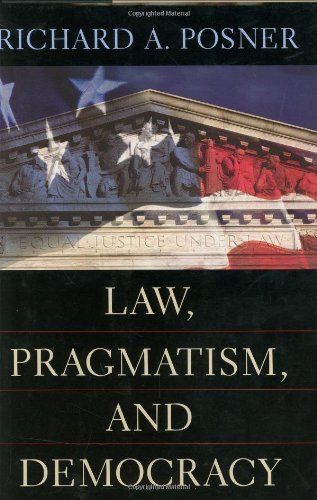
Title
Law, Pragmatism, and Democracy,Used
Sold by Ergodebooks, an authorized reseller.
Returns accepted within 30 days | support@ergodebooks.com
Shipping Information
- Free Standard Shipping — United States only
- Processing Time: 3–5 business days
- Estimated Delivery: 6–10 business days after dispatch
- Double-boxed, fully insured & discreetly packaged
- Tracking number sent via email once dispatched
Returns & Refund
Returns accepted within 30 days of delivery.
Damaged or Defective Item
Free return shipping + replacement or full refund
Wrong Item Received
Free return shipping + replacement or full refund
Change of Mind
Return shipping at customer's expense · 25% restocking fee applies
Payment Option

A liberal state is a representative democracy constrained by the rule of law. Richard Posner argues for a conception of the liberal state based on pragmatic theories of government. He views the actions of elected officials as guided by interests rather than by reason and the decisions of judges by discretion rather than by rules. He emphasizes the institutional and material, rather than moral and deliberative, factors in democratic decision making.Posner argues that democracy is best viewed as a competition for power by means of regular elections. Citizens should not be expected to play a significant role in making complex public policy regarding, say, taxes or missile defense. The great advantage of democracy is not that it is the rule of the wise or the good but that it enables stability and orderly succession in government and limits the tendency of rulers to enrich or empower themselves to the disadvantage of the public. Posner's theory steers between political theorists' concept of deliberative democracy on the left and economists' publicchoice theory on the right. It makes a significant contribution to the theory of democracyand to the theory of law as well, by showing that the principles that inform Schumpeterian democratic theory also inform the theory and practice of adjudication. The book argues for law and democracy as twin halves of a pragmatic theory of American government.
⚠️ WARNING (California Proposition 65):
This product may contain chemicals known to the State of California to cause cancer, birth defects, or other reproductive harm.
For more information, please visit www.P65Warnings.ca.gov.
- Q: What is the main theme of 'Law, Pragmatism, and Democracy'? A: 'Law, Pragmatism, and Democracy' explores the relationship between liberal democracy and the rule of law, highlighting how democratic decision-making is influenced by pragmatic theories rather than purely moral or deliberative approaches.
- Q: Who is the author of this book? A: The book is authored by The Honorable Richard A. Posner, a prominent legal scholar and former judge.
- Q: What are the key features of this book? A: The key features of 'Law, Pragmatism, and Democracy' include its in-depth analysis of democracy as a competition for power, the role of elected officials, and a pragmatic view of law that challenges traditional democratic theories.
- Q: Is this book suitable for academic study? A: Yes, this book is suitable for academic study, particularly for students and scholars interested in law, political science, and democratic theory.
- Q: What is the condition of the book? A: The book is listed as 'New', ensuring that it is in pristine condition for readers.
- Q: How many pages does 'Law, Pragmatism, and Democracy' contain? A: The book contains 416 pages, providing a comprehensive exploration of its themes.
- Q: When was this book published? A: 'Law, Pragmatism, and Democracy' was published on March 31, 2003.
- Q: What type of binding does this book have? A: The book is available in hardcover binding, offering durability and a quality reading experience.
- Q: What should I consider before purchasing this book? A: Consider your interest in legal theory and democratic processes, as well as whether you prefer a pragmatic approach to understanding law and governance.
- Q: Is there an edition of this book available? A: Yes, this is the First Edition of 'Law, Pragmatism, and Democracy', making it a significant addition to any collection focused on legal and political theory.