If you have any questions, you are always welcome to contact us. We'll get back to you as soon as possible, withing 24 hours on weekdays.
Customer service
All questions about your order, return and delivery must be sent to our customer service team by e-mail at yourstore@yourdomain.com
Sale & Press
If you are interested in selling our products, need more information about our brand or wish to make a collaboration, please contact us at press@yourdomain.com
Help
If you have any questions, you are always welcome to contact us. We'll get back to you as soon as possible, withing 24 hours on weekdays.
Customer service
All questions about your order, return and delivery must be sent to our customer service team by e-mail at yourstore@yourdomain.com
Sale & Press
If you are interested in selling our products, need more information about our brand or wish to make a collaboration, please contact us at press@yourdomain.com
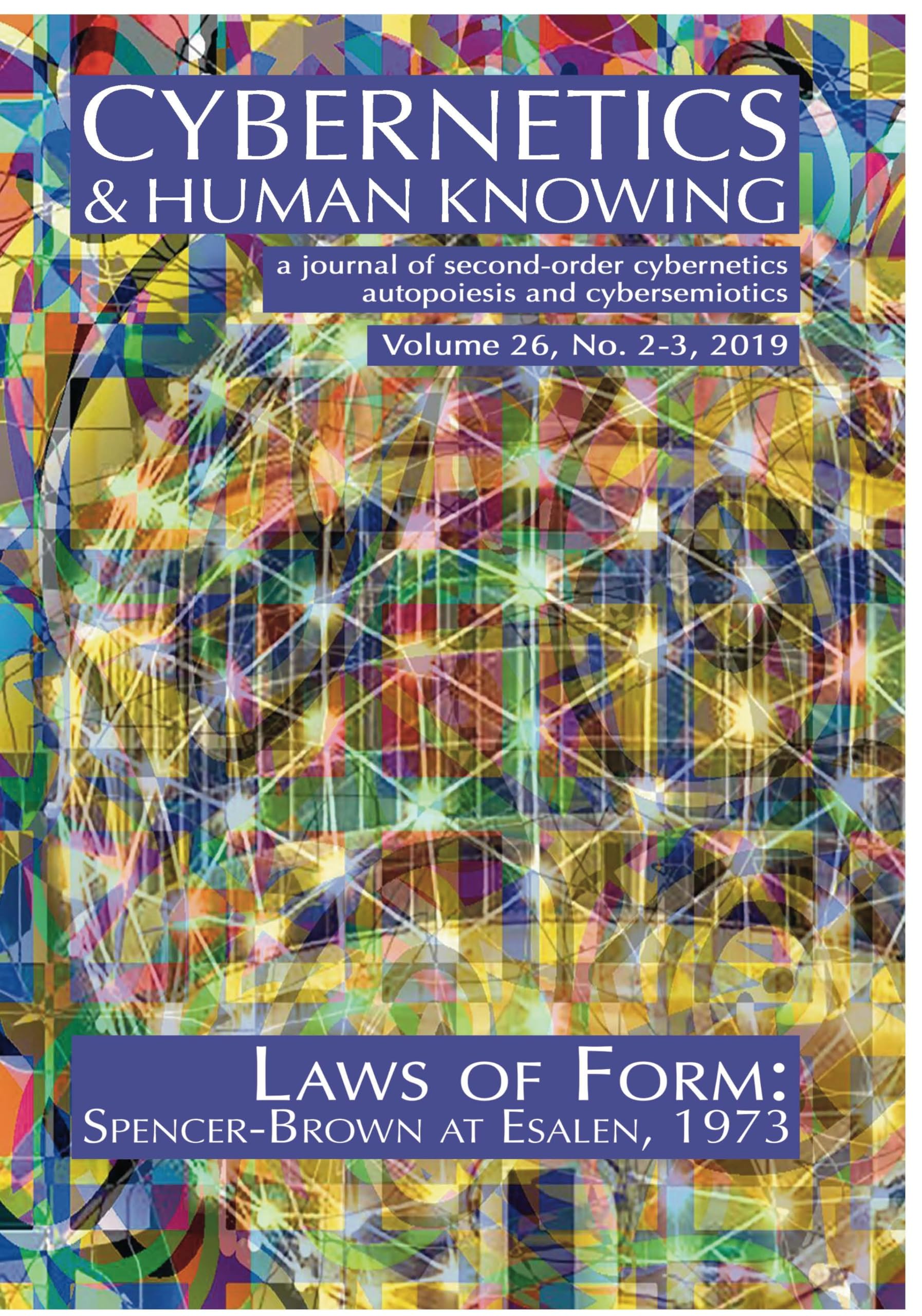
This Special Issue of Cybernetics and Human Knowing contains rare material related to G. SpencerBrown's book Laws of Form and its contents.In 1973 there was a conference at Big Sur at which SpencerBrown discussed his calculus with a group of scientists. This was the AUM Conference at Esalen, and the scientists consisted in an assortment of remarkable individuals exploring the cutting edge of human consciousness and culture, including Alan Watts, Ram Dass, John Lilly, Heinz von Foerster, Kurt von Meier, and others. One of the participants, Walter Barney, has written about this conference and has long been a keeper of the transcripts of SpencerBrowns talks. In this issue we print Barneys transcripts of the conference and an article by Walter Barney and Kurt von Meier reflecting on the AUM conference. The transcripts are a remarkable amalgam of the thinking of SpencerBrown and the questions and comments of the participants in AUM. The transcripts carry the same lucidity that infuses Laws of Form.The other articles in this issue include a paper on Flagg Resolution by James Flagg and Louis Kauffman, a paper on Paper Computers and the Emergence of Fermions by Louis Kauffman, and a Virtual Logic Column by Louis Kauffman that is a new take on the Barber paradox and the Russell Paradox, based on satire, mirrors, and the key observation of Douglas Harding that no person can (in the absence of mirrors) perceive his or her own head. There is an American Society for Cybernetics Column by Zane Gillespie about the structure of implausibility in music, art, and cybernetics.
⚠️ WARNING (California Proposition 65):
This product may contain chemicals known to the State of California to cause cancer,
birth defects, or other reproductive harm.
For MAP (Minimum Advertised Price) violations and Intellectual Property (IP) or Trademark concerns, please contact:
support@ergodebooks.com
⚠️ California Proposition 65 Warning: Some products sold on this website may expose you to chemicals known to the State of California to cause cancer, birth defects, or other reproductive harm. For more information, visit www.P65Warnings.ca.gov.