
Title
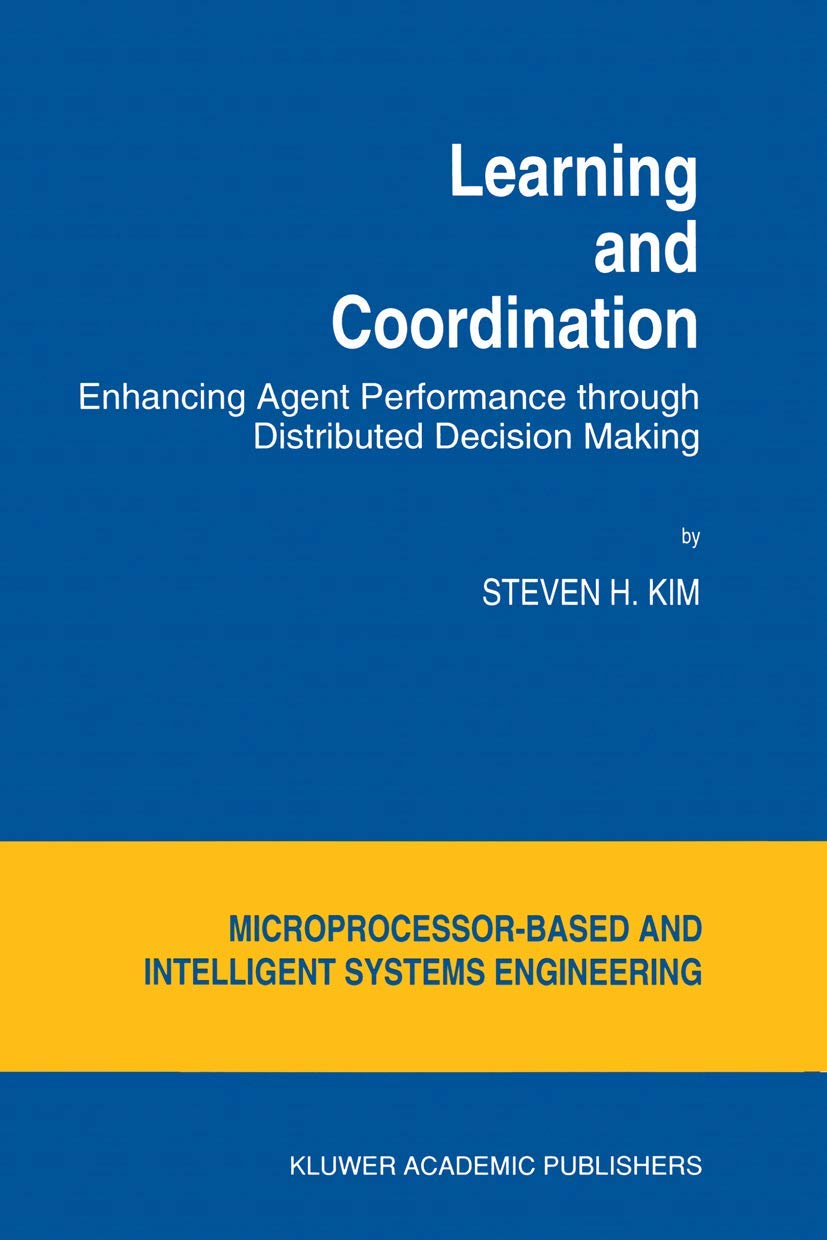
Learning and Coordination: Enhancing Agent Performance through Distributed Decision Making (Intelligent Systems, Control and Aut,Used
Sold by Ergodebooks, an authorized reseller.
Returns accepted within 30 days | support@ergodebooks.com
Shipping Information
- Free Standard Shipping — United States only
- Processing Time: 3–5 business days
- Estimated Delivery: 6–10 business days after dispatch
- Double-boxed, fully insured & discreetly packaged
- Tracking number sent via email once dispatched
Returns & Refund
Returns accepted within 30 days of delivery.
Damaged or Defective Item
Free return shipping + replacement or full refund
Wrong Item Received
Free return shipping + replacement or full refund
Change of Mind
Return shipping at customer's expense · 25% restocking fee applies
Payment Option

Intelligent systems of the natural kind are adaptive and robust: they learn over time and degrade gracefully under stress. If artificial systems are to display a similar level of sophistication, an organizing framework and operating principles are required to manage the resulting complexity of design and behavior.This book presents a general framework for adaptive systems. The utility of the comprehensive framework is demonstrated by tailoring it to particular models of computational learning, ranging from neural networks to declarative logic.The key to robustness lies in distributed decision making. An exemplar of this strategy is the neural network in both its biological and synthetic forms. In a neural network, the knowledge is encoded in the collection of cells and their linkages, rather than in any single component. Distributed decision making is even more apparent in the case of independent agents. For a population of autonomous agents, their proper coordination may well be more instrumental for attaining their objectives than are their individual capabilities.This book probes the problems and opportunities arising from autonomous agents acting individually and collectively. Following the general framework for learning systems and its application to neural networks, the coordination of independent agents through game theory is explored. Finally, the utility of game theory for artificial agents is revealed through a case study in robotic coordination.Given the universality of the subjects learning behavior and coordinative strategies in uncertain environments this book will be of interest to students and researchers in various disciplines, ranging from all areas of engineering to the computing disciplines; from the life sciences to the physical sciences; and from the management arts to social studies.
⚠️ WARNING (California Proposition 65):
This product may contain chemicals known to the State of California to cause cancer, birth defects, or other reproductive harm.
For more information, please visit www.P65Warnings.ca.gov.