If you have any questions, you are always welcome to contact us. We'll get back to you as soon as possible, withing 24 hours on weekdays.
Customer service
All questions about your order, return and delivery must be sent to our customer service team by e-mail at yourstore@yourdomain.com
Sale & Press
If you are interested in selling our products, need more information about our brand or wish to make a collaboration, please contact us at press@yourdomain.com
Help
If you have any questions, you are always welcome to contact us. We'll get back to you as soon as possible, withing 24 hours on weekdays.
Customer service
All questions about your order, return and delivery must be sent to our customer service team by e-mail at yourstore@yourdomain.com
Sale & Press
If you are interested in selling our products, need more information about our brand or wish to make a collaboration, please contact us at press@yourdomain.com
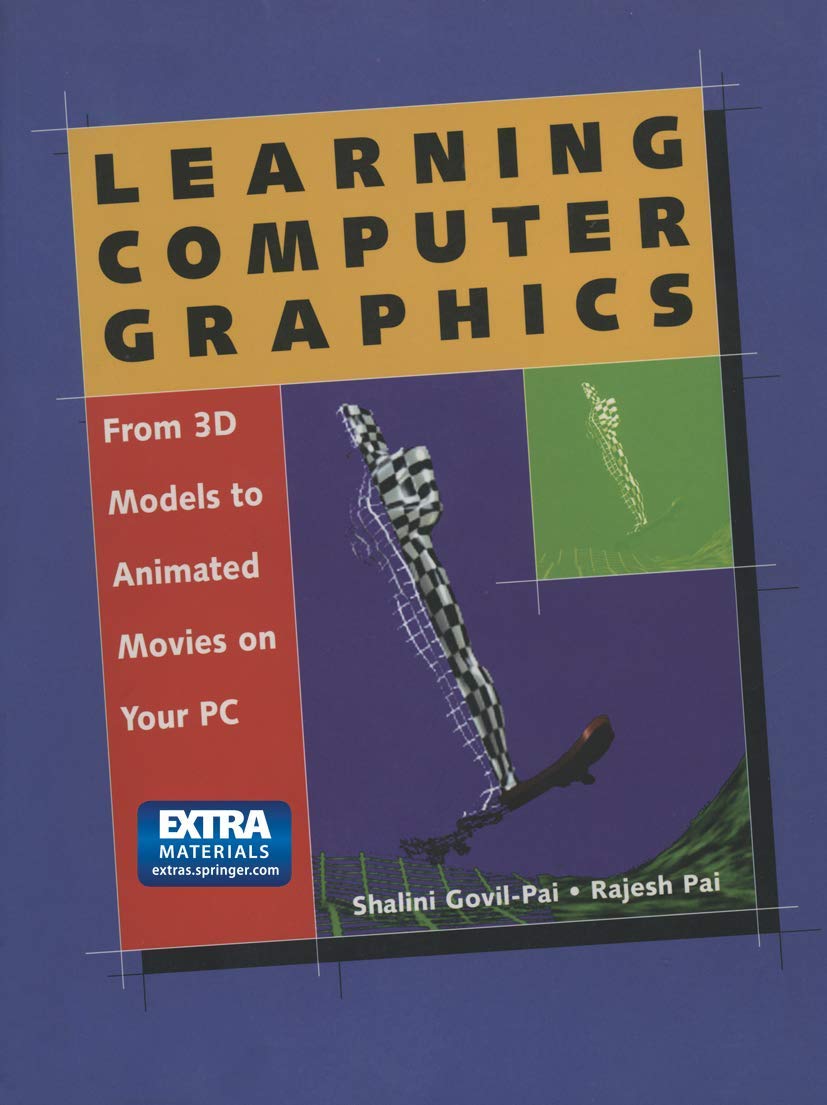
Modeling creating objects in threedimensional space. Animation assigning a timevarying geometry and behavior to the modeled object. Rendering creating a photorealistic image of the modeled object. Image Manipulation enhancing rendered images to produce desired special effects. This book is organized to give the reader a clear and concise over view of the above basic principles in computer graphics. New concepts introduced in a chapter are illustrated by handson projects using the software provided. The chapters are organized as described below: Chapter 1 providesanoverviewofcomputergraphics (CG) andhow it has evolved. It includes an introduction to computer graphics ter minology and definitions. Chapter 2 describes what modeling means in CG. The concept of wire frame models is elucidated. Basic models (sphere, cube, cylinder, cone, polygon) are covered and an insight into polygonal representa tions of other complex objects is also provided. The projects included in this chapter involve use of modeling concepts leamed in the chapter. Chapter 3 discusses animation in detail. Principles of frame ani mation and real time animation are explained. The reader is given the opportunity to animate the modeled objects from Chapter 2. Chapter 4 covers rendering of the wire frame objects created in Chapter 2. The fundamentals oflighting, shading, and texture mapping are discussed. The objects created in Chapter 2 are rendered by the user and the complete animation is seen in a rendered form.
⚠️ WARNING (California Proposition 65):
This product may contain chemicals known to the State of California to cause cancer,
birth defects, or other reproductive harm.
For MAP (Minimum Advertised Price) violations and Intellectual Property (IP) or Trademark concerns, please contact:
support@ergodebooks.com
⚠️ California Proposition 65 Warning: Some products sold on this website may expose you to chemicals known to the State of California to cause cancer, birth defects, or other reproductive harm. For more information, visit www.P65Warnings.ca.gov.