
Title
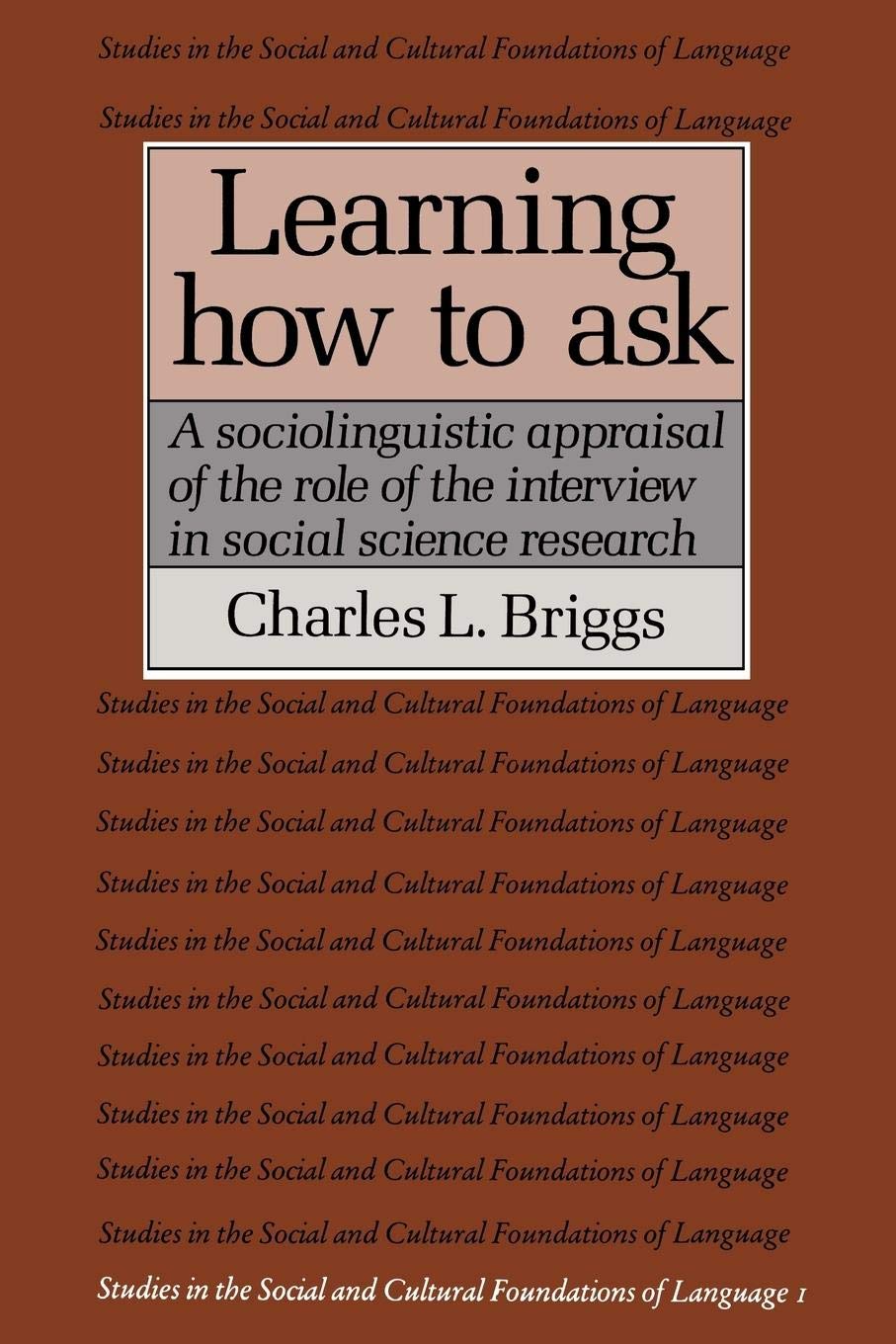
Learning How to Ask: A Sociolinguistic Appraisal of the Role of the Interview in Social Science Research (Studies in the Social ,Used
Sold by Ergodebooks, an authorized reseller.
Returns accepted within 30 days | support@ergodebooks.com
Shipping Information
- Free Standard Shipping — United States only
- Processing Time: 3–5 business days
- Estimated Delivery: 6–10 business days after dispatch
- Double-boxed, fully insured & discreetly packaged
- Tracking number sent via email once dispatched
Returns & Refund
Returns accepted within 30 days of delivery.
Damaged or Defective Item
Free return shipping + replacement or full refund
Wrong Item Received
Free return shipping + replacement or full refund
Change of Mind
Return shipping at customer's expense · 25% restocking fee applies
Payment Option

Interviews are ubiquitous in modern society, and they play a crucial role in social scientific research. But, as Charles Briggs convincingly argues in this book, received interviewing techniques rest on fundamental misapprehensions about the nature both of the interview as a communicative event, and of the nature of the data that it produces. Furthermore, interviewers rarely examine the compatibility of interviews as a means of acquiring information to one another. These oversights often blind interviewers to ensuing errors of interpretation, as well as to the limitations of the interview as a means of acquiring data. To conflict these problems, Professor Briggs presents an analysis of the 'communicative blunders' that he himself committed in conducting research interviews among Spanishspeakers in northern New Mexico. By focusing on these errors and exploring how they may be avoided, he is able to propose new techniques for designing, implementing, and analyzing interviewbased research. These rest on identifying the subjects' resources for conveying information, and the relative compatability of the shared rules and understandings that underlie their strategies with those associated with interviews. Critical of existing paradigms of interviewing, which he sees as deriving from Western 'folk' theories of reality and communication, Briggs shows that the development of more sophisticated interviewing methodologies requires further research into interviewing itself. Briggs's conclusions provide a basis for the reexamination of current uses of interviews in a wide range of contexts from social science research to job applications, welfare and health care delivery, criminal and legal investigations, journalism and broadcasting, and other areas of everyday life. His book will appeal to linguists, sociologists, anthropologists, historians, psychologists, as well as other readers whose research or professional activities depend on the use of interviews.
⚠️ WARNING (California Proposition 65):
This product may contain chemicals known to the State of California to cause cancer, birth defects, or other reproductive harm.
For more information, please visit www.P65Warnings.ca.gov.